 Marine Mitra
What causes black soil at the bottom of a shrimp pond?
త్వరిత సమాధానం · Quick answer
Black soil at the shrimp pond bottom is caused by iron sulphide (FeS) forming when hydrogen sulphide (from anaerobic decomposition of organic matter) reacts with iron in the soil. The black colour indicates active anaerobic conditions — oxygen-depleted sediment where sulphate-reducing bacteria are decomposing organic matter without oxygen, producing H2S as a byproduct.
మీ చెరువు పుస్తకం ఫోన్లో · Keep your pond's book on your phone Pond Book · Google Play
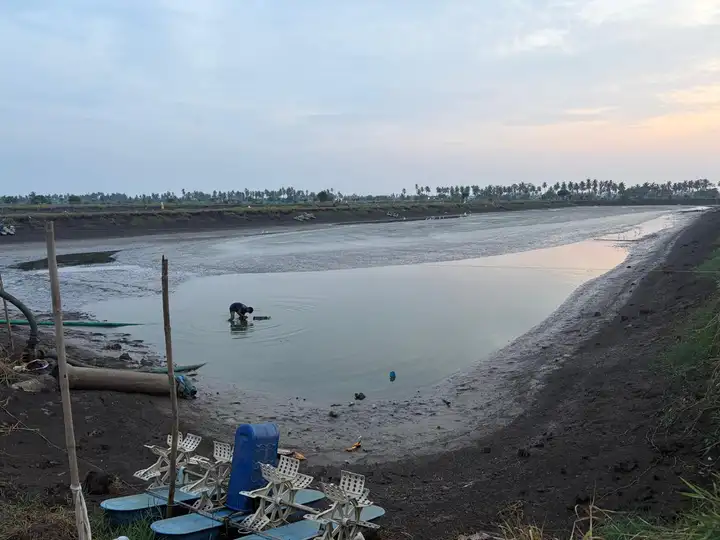
The chemistry of black soil
The black colour of degraded shrimp pond bottom is iron sulphide (FeS) — a black solid that forms when hydrogen sulphide (H2S) reacts with iron (Fe2+) naturally present in most soil types:
Fe2+ + H2S → FeS (black) + 2H+
Iron sulphide precipitation is the visual indicator that H2S is being produced. And H2S is only produced when anaerobic bacteria (sulphate-reducing bacteria, SRB) are decomposing organic matter in the complete absence of dissolved oxygen.
So black soil is a direct indicator of: significant organic accumulation, complete oxygen depletion in the sediment layer, and active H2S production. All three are problems.
Why it becomes black instead of staying brown
Fresh organic matter on the pond bottom is brown — the colour of decomposing feed and faeces. In well-aerated conditions with adequate DO penetrating the sediment surface, aerobic bacteria decompose this material to CO2 and water. The sediment stays light brown.
When organic loading exceeds aerobic decomposition capacity — through overfeeding, feeding in fixed areas without rotation, or insufficient aeration — the sediment oxygen is depleted. The aerobic bacteria die out. Anaerobic bacteria (primarily sulphate-reducing bacteria) take over. They consume sulphate (SO42-) as an electron acceptor instead of oxygen, producing H2S as a waste product.
H2S reacts with soil iron to form black FeS. The bottom turns black.
What black bottom means for shrimp
Shrimp living above black sediment are exposed to: H2S off-gassing from the bottom (toxic at 0.002 ppm at gill level), elevated ammonia from anaerobic decomposition, reduced pH from H2S and CO2 accumulation near the bottom, and complete absence of oxygen in the bottom 10-20 cm — forcing shrimp to avoid this zone and crowd in the upper water layers.
This explains why shrimp in ponds with significant black bottom spend abnormal time near aerators or pond surface. They are avoiding the toxic zone below.
How to reverse it during the crop
Complete reversal during an active crop is not possible — you cannot excavate sludge while shrimp are present. Management can slow further development:
- Reduce feeding in affected areas, rotate to other pond zones
- Apply zeolite at 300 kg/ha to stabilise sediment-water interface chemistry
- Apply oxidising agents (calcium peroxide at 5-10 kg/ha) to temporarily restore aerobic conditions in the surface sediment layer
- Increase aerator output and reposition to push water across the black areas
Complete resolution requires: harvest, full sludge excavation, 20-day dry-out, quicklime application.