 Marine Mitra
How to manage the shrimp pond bottom — sludge, gas and oxygen
త్వరిత సమాధానం · Quick answer
Manage shrimp pond bottom through: rotating feeding areas every 10 days (prevents sludge accumulation in fixed zones), maintaining DO above 4 ppm always (prevents anaerobic sediment), applying zeolite at 200 kg/ha on pond bottom monthly from day 30, using probiotics (Rhodopseudomonas, Bacillus) weekly for bottom sediment digestion, central drain for bottom-water exchange, and complete sludge removal plus 20-day dry-out between crops.
మీ చెరువు పుస్తకం ఫోన్లో · Keep your pond's book on your phone Pond Book · Google Play
Why the pond bottom determines crop outcomes
A shrimp pond bottom accumulates everything that settles — uneaten feed, shrimp faeces, dead phytoplankton, moulted shells, dead animals. This organic matter is the substrate for all the chemical and biological processes that define pond bottom quality.
Good pond bottom: 2-3 cm of light-coloured organic sediment, minimal smell, aerobic conditions maintained by dissolved oxygen penetrating the surface layer. Shrimp move freely on the bottom, feed from it, and rest there.
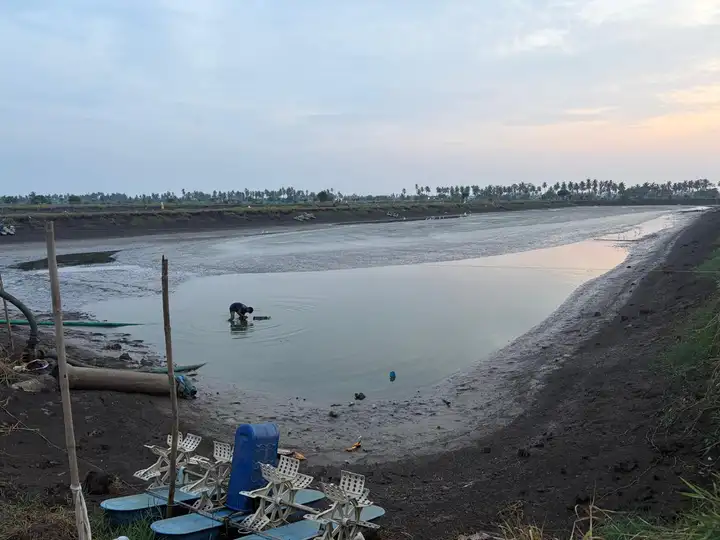
Bad pond bottom: 10-20 cm of black, foul-smelling anoxic sludge generating H2S, ammonia, and methane. Shrimp avoid the bottom and crowd near aerators or the surface.
The sludge accumulation cycle
Feed enters the pond. Shrimp eat most, some sinks uneaten. Shrimp excrete waste onto the bottom. Dead algae settle. Each gram of organic matter on the pond bottom requires oxygen to decompose aerobically. When the oxygen supply at the sediment-water interface is insufficient, anaerobic decomposition begins — producing H2S and methane instead of CO2 and water.
The threshold: when organic load on the bottom exceeds the aerobic decomposition capacity supported by the available dissolved oxygen, the sediment layer turns anaerobic. From that point, every molecule of organic matter added makes the situation worse.
Active management within the crop
Feed area rotation. The simplest and most effective in-crop bottom management tool. By moving feeding locations every 10 days, you prevent any single area from accumulating the critical organic load that triggers anaerobic conditions. The area rests and aerobically decomposes the deposited material while feeding moves elsewhere.
Zeolite application. At 200 kg/ha monthly from day 30, zeolite applied to pond bottom adsorbs ammonia from the sediment-water interface and moderates pH. Does not remove the organic matter but reduces its immediate toxicity.
Bottom probiotic application. Rhodopseudomonas palustris and Bacillus species applied weekly digest bottom organic matter aerobically, converting it to CO2 and biomass rather than H2S and methane. Applied at manufacturer dose, effects show as lighter bottom colour and reduced smell after 14-21 days.
Central drain exchange. Bottom water exchange through a central drain removes the worst-quality water from the lowest pond point — the most concentrated organic layer — rather than just surface water.
Between crops — the reset
Complete sludge excavation, 20-day dry-out, quicklime treatment. This is the only true reset. In-crop management slows accumulation but never reverses it. The between-crop preparation window is where you actually remove what accumulated.
 What causes black soil at the bottom of a shrimp pond?