 Marine Mitra
Water quality management in shrimp ponds — the complete guide
త్వరిత సమాధానం · Quick answer
Key water quality parameters for vannamei: DO above 4 ppm (daily minimum at 4-5 am), pH 7.5-8.5 with daily swing below 0.5 units, alkalinity 80-120 ppm, salinity 15-25 ppt optimal, total ammonia nitrogen below 1.0 ppm, Secchi disc 30-45 cm, temperature 26-32°C. Alkalinity is the buffer that controls pH stability. Test DO daily, pH daily, alkalinity and ammonia weekly.
మీ చెరువు పుస్తకం ఫోన్లో · Keep your pond's book on your phone Pond Book · Google Play
Why water quality is a system, not individual parameters
A shrimp pond is a living biological system. Every water quality parameter influences every other. High temperature reduces oxygen solubility — so your DO drops without the aerators changing. Low alkalinity allows pH to swing widely with the photosynthesis cycle. A BGA bloom crash crashes pH, which crashes DO, which stresses shrimp, which reduces immunity, which opens the door for vibrio.
Managing water quality means understanding the connections, not just monitoring individual numbers. This guide covers each parameter, the correct range, the signs it has gone wrong, and the response.
Dissolved Oxygen (DO)
Target: Above 4 ppm at all times. Minimum daily reading (4-5 am) above 4 ppm. Intensive ponds from week 8 onwards: above 5 ppm.
The daily cycle: During daylight, photosynthesis produces oxygen — DO rises. At night, respiration consumes oxygen — DO falls. The pre-dawn minimum (4-5 am) is the most important daily measurement.
What goes wrong: Below 3.5 ppm, shrimp show stress. Below 3 ppm, growth stops. Below 2.5 ppm, mortality starts. Farms that only measure DO at 8 am — after the sun has been producing oxygen for 2-3 hours — miss the daily low entirely.
How to increase: More aerators, optimise aerator placement for full pond circulation, control bloom density (heavy bloom consumes as much at night as it produces in the day), reduce evening feed timing to shift post-meal oxygen demand away from the pre-dawn window.
→ Read: How to increase dissolved oxygen in shrimp ponds at night
pH
Target: 7.5-8.5 range, 7.8-8.3 optimal. Daily swing below 0.5 units. Morning pH (before sunrise) is the daily low; afternoon pH (2-4 pm) is the daily high.
What goes wrong: pH below 7.0 causes metabolic stress and slows growth. pH above 9.0 causes ammonia toxicity (high pH shifts equilibrium toward toxic unionised NH3). Daily swing above 1.0 unit causes repeated osmotic stress at moulting.
The alkalinity connection: Low alkalinity (below 60 ppm) removes the buffering capacity that keeps pH stable through the daily photosynthesis cycle. Fixing pH instability usually means fixing alkalinity first.
How to raise pH: Agricultural lime (CaCO3) at 50-100 kg/ha for gradual increase. Quicklime (CaO) for emergency correction.
How to lower pH: Water exchange 15-20% to dilute dense bloom. Reduce fertilisation.
→ Read: What is the ideal pH for shrimp pond water? → Read: How do I fix pH crash after heavy rain in my shrimp pond?
Alkalinity
Target: 80-120 ppm total alkalinity (as CaCO3).
Why it matters: Alkalinity is the buffer system. Carbonate and bicarbonate ions absorb CO2 (the acid produced by respiration) and OH⁻ (the base produced by photosynthesis) without allowing pH to change sharply. At alkalinity below 60 ppm, pH swings of 1.5-2.0 units per day are common. At alkalinity above 100 ppm, swings stay below 0.3 units.
Why soft shell connects to alkalinity: Shell calcification requires carbonate ions. Low alkalinity means low carbonate availability — moulting shrimp cannot harden their new shell properly.
How to maintain: Apply agricultural lime or dolomite (calcium-magnesium carbonate) at 50-100 kg/ha when weekly alkalinity test shows below 80 ppm. Dolomite simultaneously addresses calcium and magnesium deficiency.
Salinity
Target: 15-25 ppt for optimal vannamei growth. Tolerance: 5-35 ppt.
Why it matters: Outside the 15-25 ppt range, shrimp spend more energy on osmoregulation — the process of maintaining internal salt balance. Energy used for osmoregulation is not available for growth. FCR worsens, growth slows.
Monsoon management: Rapid salinity drops from heavy rain (from 20 ppt to 10 ppt in 48 hours) stress shrimp more than the final salinity level. Reduce feed 20-30% during salinity transition events. Do not rush to correct salinity with water exchange — allow natural equilibration.
→ Read: What is the ideal salinity for vannamei shrimp farming?
Ammonia
Target: Unionised NH3 below 0.1 ppm. Total ammonia nitrogen (TAN) below 1.0 ppm.
The danger form: Ammonia exists as ionised ammonium (NH4+, relatively harmless) and unionised ammonia (NH3, toxic). Higher temperature and higher pH shift the ratio toward toxic NH3. A pond with 1.0 ppm TAN at pH 8.2 and 32°C has more toxic NH3 than the same pond at pH 7.8 and 26°C.
Sources: Shrimp excretion (primary source, increases with biomass), uneaten feed decomposition (secondary), algal bloom crash (large burst release).
Response to spike: Reduce feed 30-50%, apply zeolite at 200 kg/ha, water exchange 20% from clean reservoir, add molasses 5-10 kg/ha with full aeration to support bacterial ammonia assimilation.
→ Read: How to manage ammonia spikes in shrimp ponds
Phytoplankton bloom and Secchi disc
Target: Secchi disc reading 30-45 cm. Brown-green or olive-green colour (diatom dominance).
The bloom produces: Dissolved oxygen through photosynthesis, natural food for young shrimp (especially diatoms providing EPA and DHA), and water stability through the carbon-nitrogen cycle.
What goes wrong:
- BGA (blue-green algae): Dark green or grey-green water with surface scum. Cyanobacteria produce toxins, crash oxygen at night, and are difficult to eliminate once dominant. Response: reduce feed 30%, water exchange 20%, apply lime to lower pH below 8.0.
- Bloom crash: Sudden clearing of the water. Loss of phytoplankton means loss of oxygen production and natural food. Emergency: apply TSP 8 kg/ha and urea 15 kg/ha in split doses, maintain strong aeration.
- Dense bloom: Secchi below 20 cm. Overproduction — bloom will crash. Exchange 15-20% water to thin.
→ Read: What is plankton in pond water and why does its color matter? → Read: What is BGA and why does it harm shrimp ponds? → Read: Why is green water better than clear water for vannamei survival?
Temperature
Target: 26-32°C. Above 33°C is a management alert. Below 22°C slows growth.
Summer management: Increase pond depth to 1.5 metres (thermal buffer). Run aerators 20+ hours daily. Shift feeding to cool morning and evening slots, avoiding 11 am-4 pm peak heat. Reduce stocking density 15-20% for crops running through April-May.
Hydrogen sulphide (H2S): Produced by anaerobic decomposition in pond bottom. Toxic at 0.1 ppm — damages shrimp gills. Identified by rotten-egg smell from pond bottom. Prevented by maintaining adequate DO, rotating feeding areas, and removing sludge between crops.
The daily testing schedule
Five tests, 15 minutes, every day:
- DO at 4-5 am (daily minimum)
- DO at 2-3 pm (daily maximum, calculate swing)
- pH morning and afternoon (calculate daily swing)
- Temperature morning
- Secchi disc mid-morning
Weekly: alkalinity, ammonia, salinity, nitrite.
→ Read: Complete water quality testing schedule for shrimp farmers → Read: How to manage my pond when river or canal water quality is bad?
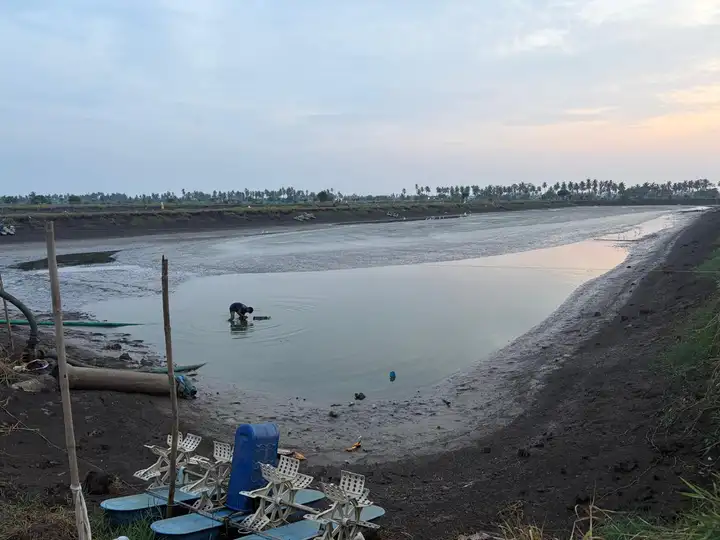 What causes black soil at the bottom of a shrimp pond?