 Marine Mitra
Your whole farm.
One phone.
ప్రతి చెరువు, ప్రతి రోజు — మీ ఫోన్లో
Log feed, water and netting at the pond bank in seconds. Mitra reads your test strips and old logbooks, tracks growth and FCR, and keeps owners, managers and workers on the same page.
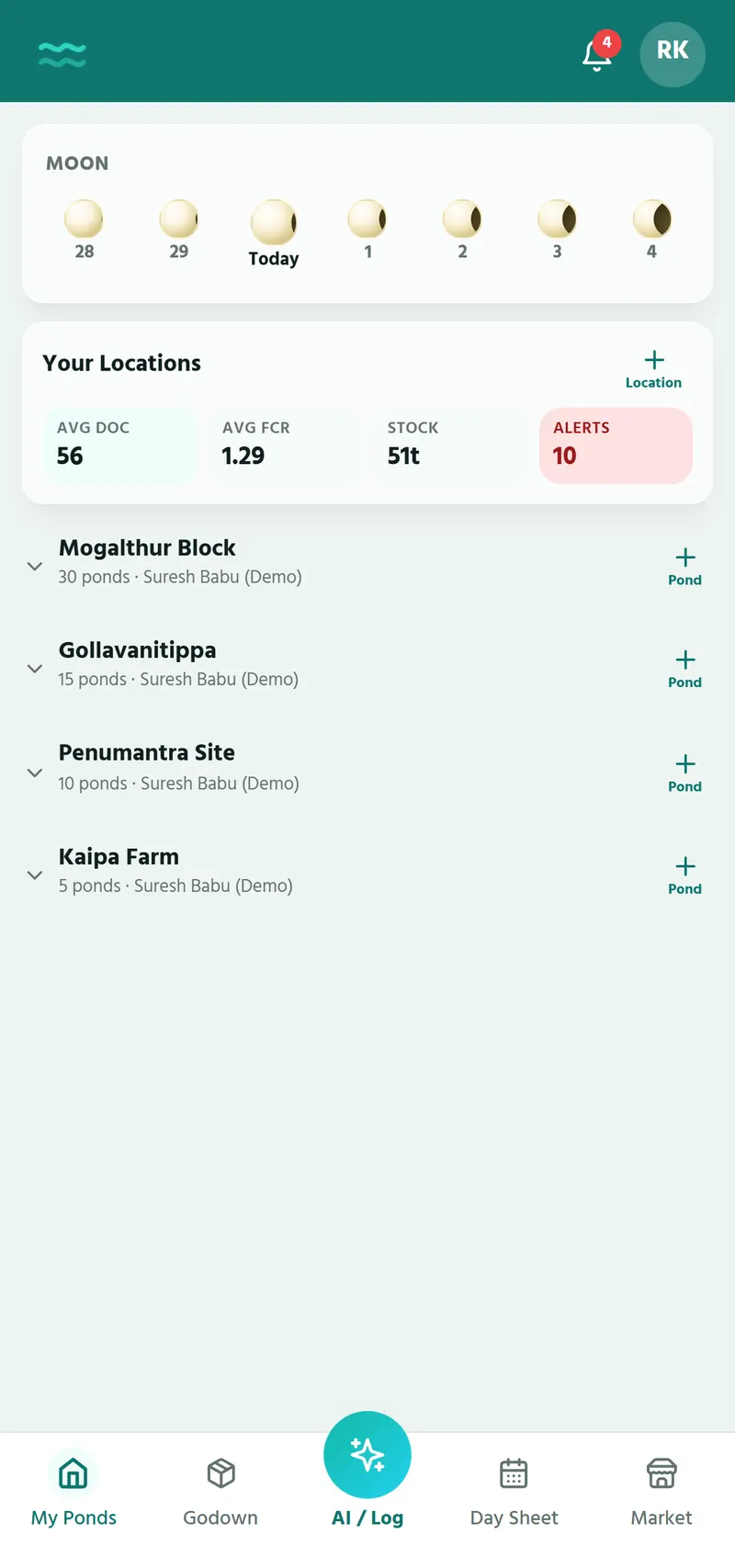
See It Work
Real screens. Real farm data.
Recorded straight from the app on our demo farm — four locations, sixty ponds. No mockups, no drawings.
Sign in, in seconds
Your phone number and a 4-digit PIN. Your whole farm is waiting on the other side.
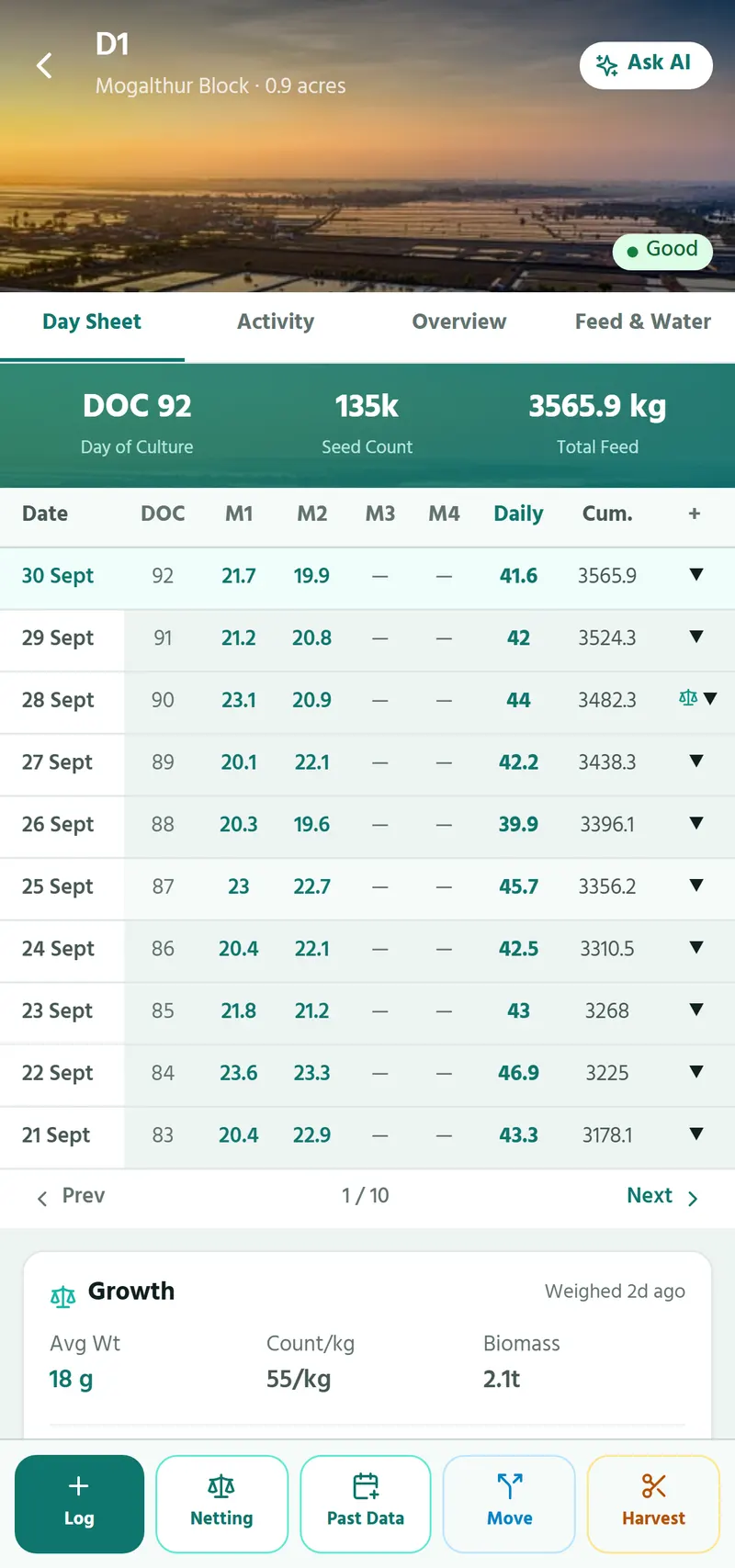
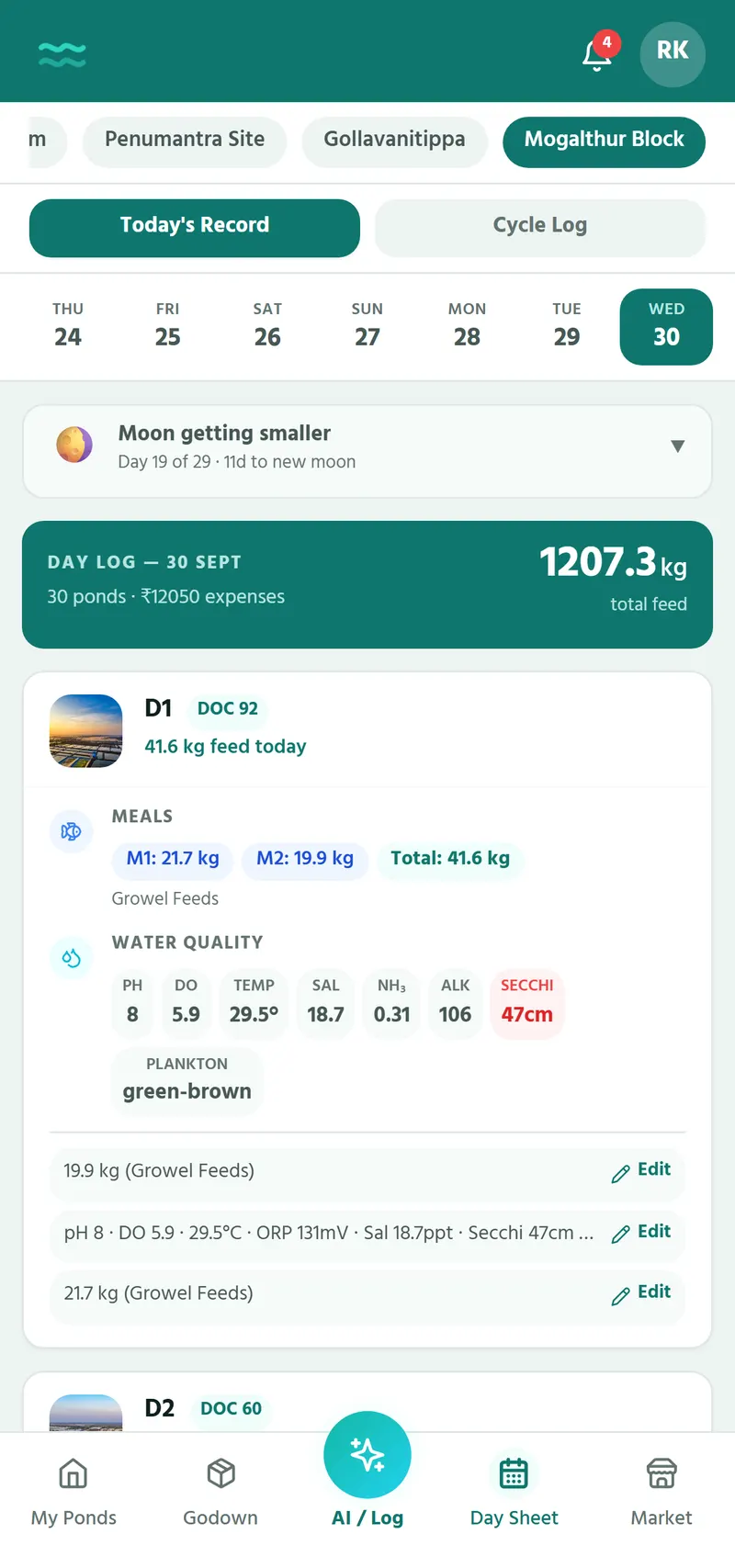
Every meal, every day
Open a pond and see each day's meals and running feed total — and, further down, how your shrimp are growing.
Netting, made simple
Type the average weight or the count per kg — the other fills itself in. Growth, biomass and FCR update on their own.
Clips play only while on screen, and not at all if your phone is saving data.
What Mitra Does
Everything the pond bank needs
Built for the person standing at the pond at 6 am — one hand free, one bar of signal, and no time to type an essay.
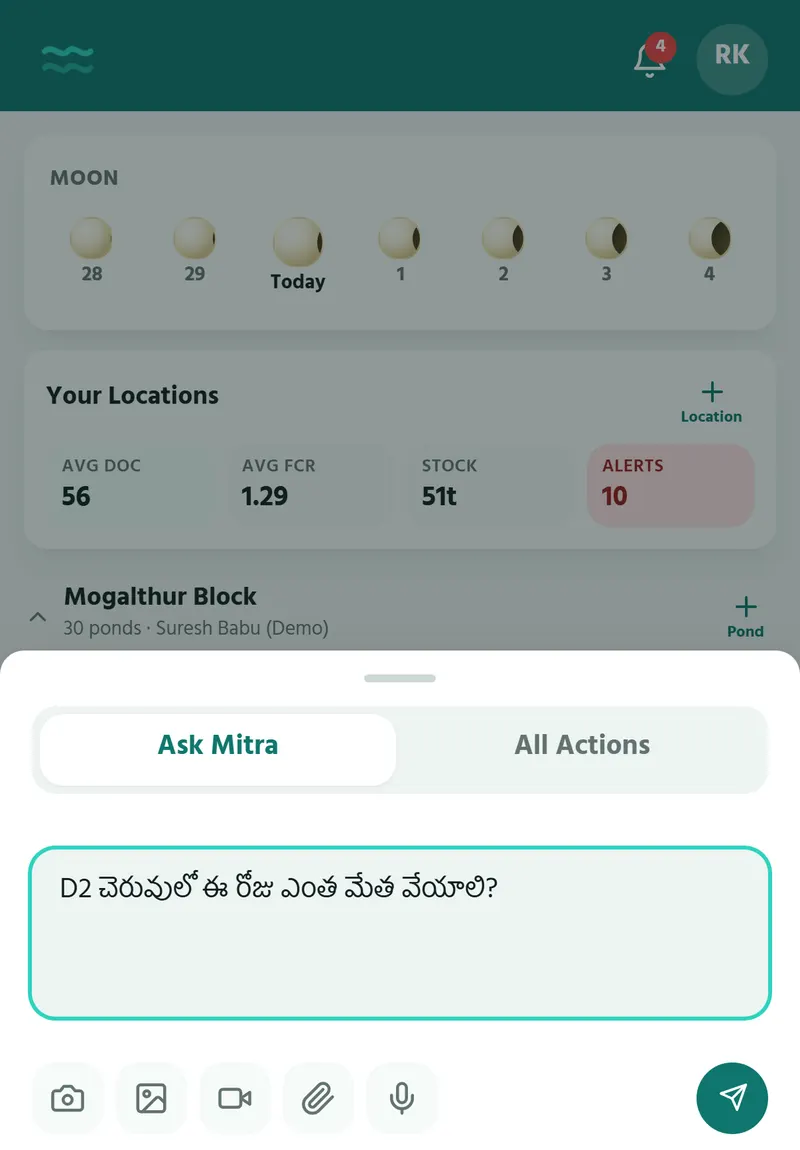
Just ask. In your language.
Type it, say it, or snap a photo. Mitra answers questions about your ponds and turns "fed D2 forty kilos" into a saved log.
- Speak in Telugu, Hindi or English
- Reads test strips, meters and old logbook pages
- You check every entry before it's saved
Know how your crop is really doing
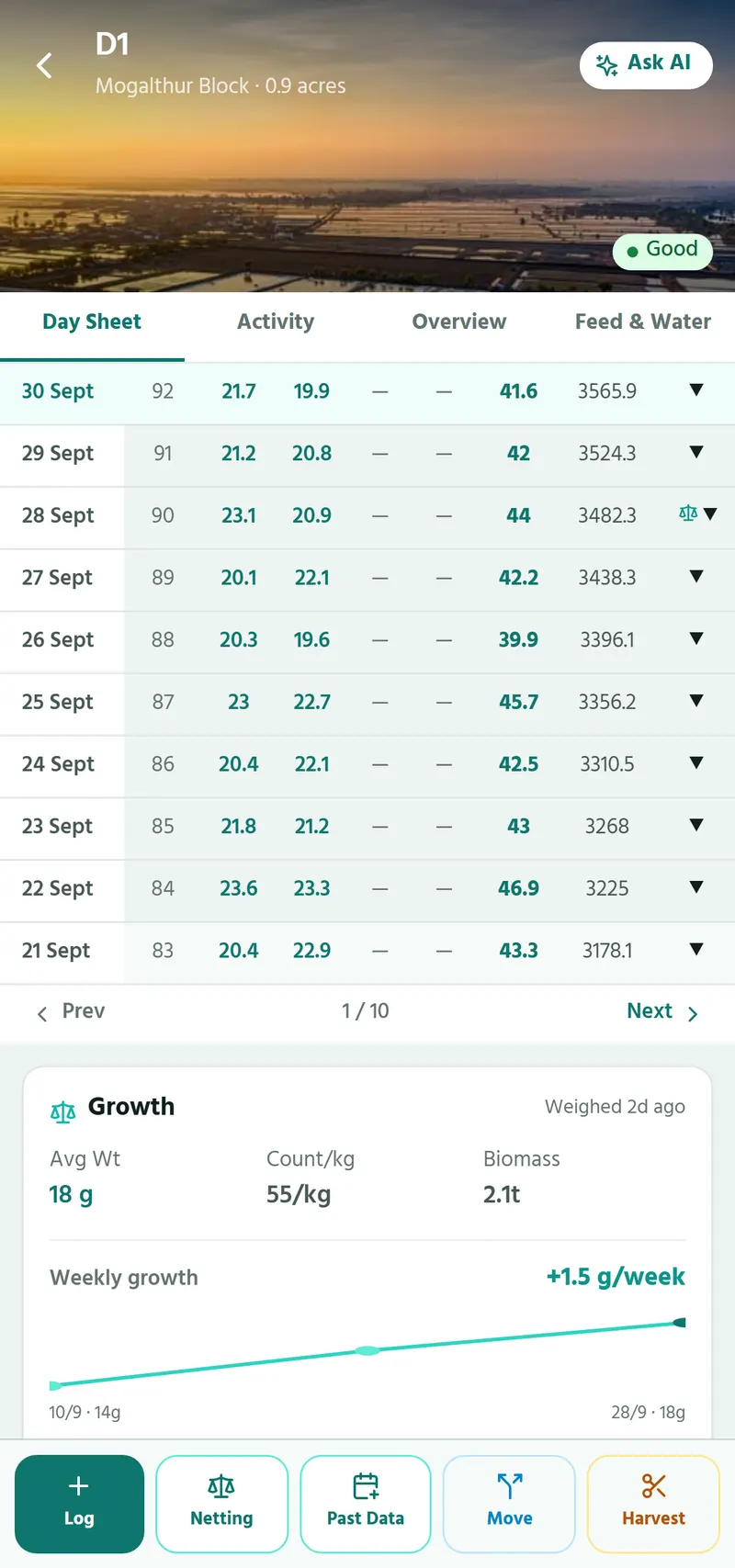
Net once a week. Mitra works out average weight, count per kg, biomass and FCR — and draws the growth trend for every pond.
- DOC and FCR calculated for you
- A reminder when a pond is due for netting
Every day, recorded
Feed by meal, water readings, mortality and medicine — every pond, every day, in one table the owner can read from anywhere.
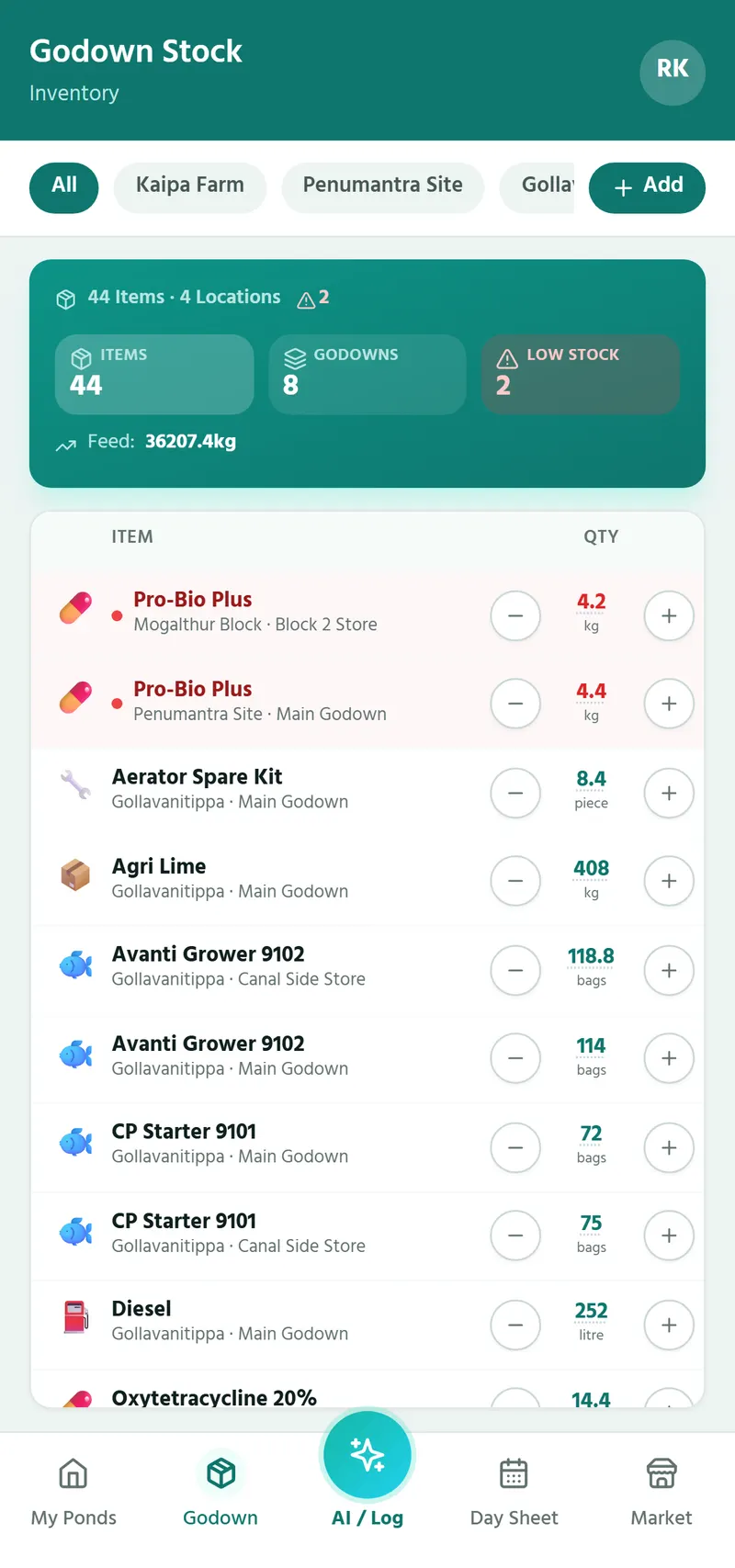
Stock, counted
Feed and medicine across every godown, with low-stock warnings before you run out. Snap a shop bill to add stock.
Water quality
pH, DO, temperature, salinity, ammonia and plankton colour — typed or read from a strip photo.
Old logbooks, digitised
Photograph paper logbook pages and back-fill the days you missed.
Harvest & profit
Record every harvest and see yield, revenue and profit for each crop.
Moon & molting
New and full moon days on your home screen, when shrimp molt and feeding changes.
Farm weather
The forecast for your farm's location, with feeding and aeration tips.
Reminders
What's due today — a pond that needs netting, a log that's missing.
Market & rates
Buy and sell seed, feed, medicine, aerators, labour, pond leases and harvest — and check shrimp rates by count.
Private by default
Only the people you add can see your farm. Nothing is shared with other farms.
Your Team
Three roles. One farm.
Everyone sees exactly what they need — and logs only what they've been given.
Where We're Going
From one pond to the whole value chain
Every kilo of shrimp passes through many hands before it reaches a plate. Today, most of that journey lives in paper books and phone calls. We're starting at the pond — and building outward.
The pond, fully recorded
Everything on this page works in the app right now.
- Daily logs in Telugu & English
- Mitra, the AI copilot
- Netting, growth & FCR
- Godown, harvest & profit
- Owners, managers & workers
- Market & shrimp rates
Experts, one tap away
Book a technician's pond visit from inside the app, chat with them, and choose exactly which pond records they get to see. Water-test labs come next.
We're approving the first technicians now.
Aqua technician? Apply in the app →Pond to plate, connected
- Seed traced back to its hatchery
- Shop ledgers that settle themselves
- Every harvest traceable to the pond it came from
This column is our direction, not something you can use yet. We'll only put it on this page as "live" once it really is.
Marine Mitra is built in Andhra Pradesh, for the farmers, managers and workers who keep India's ponds running — Telugu first, made for cheap phones and weak signal, and shaped by what people at the pond bank actually tell us.
How It Works
Start in 3 steps
No training, no paperwork. Most farms are logging on day one.
Sign in
Phone number & a 4-digit PIN, or Google.
Add your ponds
Set up your farm once — locations, ponds and what's stocked.
Log daily
Tap it in, say it, or scan a photo. Invite your team when you're ready.
FAQ
Questions
What is Marine Mitra?
A mobile-first app for managing shrimp and fish pond aquaculture farms — daily feed, water quality, mortality, medicine, netting and expense logging per pond, with growth, stock and profit in one place.
Can a farm owner, managers and workers share one farm?
Yes. Owners invite managers to a location and workers to specific ponds; a manager can invite workers to that farm's ponds. Everyone logs only what they've been given, and owners see a combined view across every location.
Does Marine Mitra use AI to read test strips or old logbooks?
Yes. Photograph a water quality test strip, drop-test card, or digital meter display and Marine Mitra pre-fills the readings. It can also read old paper logbook pages to back-fill missing days.
How do I sign in?
With your phone number and a 4-digit PIN, or with Google Sign-In — tap "Start Free" above to get started.
Is my farm data private?
Farm data is visible only to the farm owner and the managers and workers they add — never shared with other farms or made public. See our Privacy Policy.
Disease Management
What are the common bacterial diseases in fish farming in India and how are they managed?
Common bacterial diseases in fish farming in India: **Vibriosis** (marine/brackishwater fish — reddening, empty stomach, brown gills), **Aeromonas infections** (freshwater — ulcers, haemorrhages, dropsy), **Epizootic Ulcerative Syndrome (EUS)** caused by Aphanomyces invadans (red ulcers on body — notifiable disease), and **Columnaris** (gill rot, skin erosion). Treatment: water quality correction first + antibiotic feed only after veterinary diagnosis. Prevention: correct density, good water quality, quality fingerlings. Source: Liptox 1995, CAA Guidelines, CIBA Package 2021.
What is black gill disease in shrimp — causes, symptoms, and treatment?
Black gill disease in shrimp is caused by **siltation and low dissolved oxygen (DO)**, leading to **blackening of the gills and increased H₂S** in the water. It is an environment-related disease — not a viral or bacterial infection. Treatment: improve water quality, increase aeration, and reduce silt. Source: Shrimp Farming Techniques (Liptox 1995), Table 2 — Environment Related Shrimp Diseases.
What are the antibiotic withdrawal periods for shrimp and which antibiotics are banned?
Antibiotic withdrawal periods in shrimp (CIBA Package 2021 verified): Oxolinic acid — 96 hours (4 days) withdrawal before harvest; Florfenicol — 32 hours withdrawal before harvest. Banned antibiotics (completely prohibited — zero tolerance in export markets): Chloramphenicol, Nitrofurans (furazolidone, nitrofurazone, nitrofurantion, prefuran), Malachite green. CIBA Annual Report 2021 (MPEDA data): USA refused 6% of rejected Indian consignments for veterinary drugs and 1% for nitrofuran. CAA Guidelines Section 9.8 verified: no banned antibiotics in feed ingredients.
What is White Faeces Syndrome (WFS) in shrimp and what causes it?
White Faeces Syndrome (WFS) in vannamei shrimp: white or pale-coloured faecal strands floating at pond surface or accumulating in feed trays. CIBA Annual Report 2021 surveyed 50 ponds and verified three critical variables associated with WFS: stocking density (SD), Total Ammonia Nitrogen (TAN), and Nitrite-N (NO₂-N). Healthy ponds: low TAN and NO₂. Moderate WFS: low-medium TAN and NO₂. Severe WFS: medium-high TAN (above 1 ppm) and NO₂ (above 0.5 ppm) + high SD. EHP incidence was significantly associated with WFS development. FCR increases when WFS is present.
What is Epizootic Ulcerative Syndrome (EUS) in freshwater fish?
Epizootic Ulcerative Syndrome (EUS) is a fungal/oomycete disease of freshwater and estuarine fish caused by Aphanomyces invadans. OIE-listed notifiable disease. Verified from Shrimp Farming Techniques (Liptox 1995): EUS is referenced as an example of viral pathogen spread in Asia. Signs: deep red ulcers (lesions) on body and head, particularly dorsal surface; rapid mortality in naive populations. Affects: catla, rohu, mrigal (Indian Major Carps), snakehead (murrel), mullet, other freshwater fish. NOT a shrimp disease. Management: lime treatment of ponds, quarantine of new fish, reporting to state fisheries authority (OIE-notifiable).
What are fungal diseases in shrimp and how are they managed?
Fungal diseases in shrimp (verified Shrimp Farming Techniques, Liptox 1995): cause extensive mortality ranging from 20-100% when they occur. Key pathogens: Lagenidium (marine oomycete), Sirolpidium, Fusarium (causes gill blackening). Lagenidium and Sirolpidium primarily affect eggs and early larval stages in hatcheries. Fusarium is associated with gill disease and causes gill darkening — from same source: "Gills darken readily upon exposure to toxic metals or chemicals and also as a result of infection by fungi like Fusarium sp." Prevention: strict biosecurity in hatcheries, avoiding organic overload, proper water treatment.
What is microsporidian disease in shrimp and how is it different from EHP?
Microsporidian diseases in shrimp: 1) Cotton/milky disease — caused by Microsporidian protozoan parasite in muscle tissue, makes muscle milky/white, affects all culturable shrimps, spores transmitted horizontally. Verified from Shrimp Farming Techniques (Liptox 1995): "No eggs are found in milky shrimps — microsporidian infection renders shrimp incapable of reproduction." 2) EHP (Enterocytozoon hepatopenaei) — microsporidian targeting hepatopancreas tubule epithelium, not muscle. CIBA 2021: 40% prevalence in 140 AP/TN farms. PCR test distinguishes both from viral white muscle (IMNV) and environmental muscle necrosis.
What is ciliate infestation in shrimp and how to prevent it?
Ciliate infestation in shrimp is caused by protozoan ciliates — Zoothamnium, Epistylis, and Vorticella — and suctoreans Ephelota gemmipara and Acineta (verified Shrimp Farming Techniques, Liptox 1995). Signs: respiratory and locomotory difficulties when present in large numbers on gills and shell; in pond-grown shrimps, ciliates form fuzzy mat on shell from deterioration of culture water. Prevention: avoid heavy silt, high nutrient load, turbidity, and low oxygen tension. Treatment: baths of chloroquine diphosphate or formalin (Liptox 1995 — consult current regulations before use). Indicator species — their presence means water quality is deteriorating.
What is gregarine disease in shrimp and what causes it?
Gregarine disease in shrimp: gregarines are common protozoan parasites of the digestive tract. Verified from Shrimp Farming Techniques (Liptox 1995): "Gregarines are common parasites of the digestive tract of shrimps. Their presence in large numbers in the gut interferes with particle filtration to the hepatopancreatic ducts or through the gut resulting in large scale mortalities." Prevention: better water quality conditions. No effective treatment available as of source date. Gregarines are intracellular/intercellular parasites in the gut epithelium — not detectable by PCR for WSSV/EHP; require microscopy of gut smear for diagnosis.
What is blue disease in shrimp — causes and prevention?
Blue disease in shrimp (verified Shrimp Farming Techniques, Liptox 1995, Table 2): caused by poor soil-water quality. Symptom: bluish exoskeleton (shrimps appear distinctly bluish rather than their normal translucent/grey colour). Management: dietary and environmental manipulation. Additional context from same source: low carotenoid astaxanthin in diet, poor soil and water quality, and low calcium-potassium balance are causative factors. Not a viral or bacterial disease — a nutritional-environmental condition. Reducing stocking density, feeding with high-quality feed, and frequent water exchange prevent this disease.
What is white gut disease in shrimp — symptoms, cause, and what to do?
White gut disease in shrimp is characterised by a **white or translucent midgut line** visible through the shrimp's transparent body. It is associated with **microsporidian infections** of the digestive system, including the hepatopancreas and midgut. Infected shrimp have **white turbid hepatopancreas**, reduced feeding, and slowed growth. No effective chemical treatment is available — prevention through **PCR-tested seed** and **strict biosecurity** is the primary control strategy.
What is vibriosis in shrimp — symptoms, causes, and how to manage it in Indian ponds?
Vibriosis is caused by **Vibrio** bacteria — primarily **V. anguillarum** and **V. alginolyticus** in Indian shrimp ponds. It typically begins when shrimp reach **25–35g**, or **2–3 months after stocking PL-20**. Dead shrimp appear at pond edges in the morning. In severe cases, only **5–30% of stocked production** is harvested. Management: reduce biomass, increase water exchange, and between crops apply **quicklime (CaO) at 0.5 kg/m² of pond bottom**.
What is Viral Nervous Necrosis (VNN) in Asian seabass?
Viral Nervous Necrosis (VNN), also called Viral Encephalopathy and Retinopathy (VER), is caused by Betanodavirus and affects the brain and retina of fish. Primary host: Asian seabass (Lates calcarifer). CIBA Annual Report 2021 documented VNN from brackishwater ornamental fish and seabass in Tamil Nadu. CIBA developed a recombinant protein vaccine candidate for VNN using truncated outer coat protein (CP) of VNN. Signs: abnormal spiral swimming, loss of equilibrium, anorexia, dark colouration, mortality in larvae and fingerlings. Species-specific to fish — NOT applicable to shrimp.
What are the environmental diseases in shrimp culture systems?
Environmental diseases in shrimp culture systems (verified from Shrimp Farming Techniques Table 2, Liptox 1995): Cramped tail/body cramp — temperature shock, lesions on body and tail; Muscle necrosis — overcrowding, low DO, salinity or temperature shock, white opaque abdomen; Tail rot — distal portion of tail infected; Black gill disease — siltation, less DO, gill blackening and increased H₂S; Gill necrosis — heavy metal pollution, gill tissue damage; Blue disease — poor soil-water quality, bluish prawns; Red disease — handling stress and detritus-rich organic matter, reddish colouration of shell, gills and pleopods; Gas bubble disease — supersaturation of atmospheric gases and oxygen, gas bubbles in gills; Chronic soft shell syndrome — poor pond soil-water conditions, nutritional problems, soft shell.
What is Vibrio harveyi luminescent disease in shrimp hatcheries?
Luminescent (luminescence) disease in shrimp hatcheries is caused by Vibrio parahaemolyticus, V. alginolyticus, V. harveyi, and V. splendidus — verified from project source (Shrimp Farming Techniques 1995). Larvae refuse to feed, vibrios colonise feeding appendages and oral cavity (SEM confirmed). CIBA Annual Report 2021 verified: V. campbellii is the dominant Vibrio species in Indian shrimp hatcheries — produces siderophores at 60-184% higher rates than V. harveyi, giving it competitive advantage. CIBA developed real-time PCR diagnostic for V. campbellii with 100% sensitivity and specificity.
What are the common bacterial diseases in freshwater fish farming?
Major bacterial diseases in freshwater cultured fish: 1) Vibriosis — Vibrio anguillarum, V. alginolyticus affecting marine and brackishwater fish; 2) Aeromonas infections (A. hydrophila, A. salmonicida) — cause ulcers, dropsy, hemorrhages in carps and catfish; 3) Columnaris disease (Flavobacterium columnare) — cotton-like lesions on gills and skin; 4) Bacterial Kidney Disease (BKD) — Renibacterium salmoninarum, mainly salmonids; 5) Furunculosis — Aeromonas salmonicida in cold-water fish. CIBA Annual Report 2021 documented Gram-negative and Gram-positive bacterial infections in brackishwater ornamental fish Monodactylus argenteus, Etroplus suratensis in Kerala.
What is IHHNV (Infectious Hypodermal Haematopoietic Necrosis Virus) in shrimp?
IHHNV is a small (~22nm) single-stranded DNA parvo-like virus with worldwide distribution (Bonami and Lightner 1991). Verified from project source: affects P. monodon broodstocks in Southeast Asia; P. stylirostris and P. vannamei also susceptible. Disease in vannamei = Runt Deformity Syndrome (RDS) — characterised by greatly reduced growth rates and cuticular deformities: bent rostrum, wrinkled antennal flagella, cuticular roughness, deformities in thoracic and abdominal exoskeleton. NOT detected in CIBA 2021 Indian surveillance as exotic pathogen.
What is brown spot shell disease in shrimp?
Brown spot shell disease (also called burned spot disease, rust disease, shell disease, black spot disease) is a bacterial disease of shrimp shell caused by Vibrio, Pseudomonas, and Beneckea bacteria (verified Shrimp Farming Techniques 1995). Recorded from freshwater prawns and Penaeus sp. cultured in India. Signs: brown, black, or eroded spots on the shell surface, particularly on carapace and abdominal segments. Management: better water quality, remove infected and dead shrimp, reduce stock density, adequate nutrition. Terramycin in feed at 0.45 mg/kg feed for 2 weeks.
What is cotton shrimp (white muscle disease) in penaeid shrimp?
Cotton shrimp disease (white muscle disease / muscle necrosis) is a non-infectious condition where abdominal muscle becomes white and opaque. From Shrimp Farming Techniques (Liptox 1995, verified project source), Table 2: "Muscle necrosis — Causes: overcrowding, low dissolved oxygen, salinity or temperature shock. Symptoms: White opaque areas in abdomen." DO below 3.2 ppm is documented as dangerous (same source). Not IMNV (which requires PCR). Correction of stressors reverses early-stage cases.
How does stress trigger disease outbreaks in shrimp ponds?
Shrimp have no adaptive immune system — they rely entirely on innate (non-specific) immunity. Stress suppresses this innate immunity within hours, creating a window when normally harmless bacteria or latent viruses become lethal. The primary stress triggers in Indian shrimp farms are: low dissolved oxygen (DO below 3.2 ppm), ammonia spikes (TAN above 1 ppm), sudden salinity or temperature change (above 5 ppt or 4°C in 24 hours), handling and transport, moulting, and overcrowding. EHP infection combined with high TAN and high stocking density produces severe White Faecal Syndrome (CIBA 2021 verified).
What is loose shell syndrome in shrimp? Causes and prevention
Loose shell syndrome (LSS) in vannamei: carapace separates from underlying tissue — visible as gap between shell and body when held to light. Distinct from normal post-moult soft shell (resolves in 4-6 hours). Causes: nutritional deficiency (calcium, phosphorus, vitamin D3), low alkalinity below 80 ppm, chronic EHP infection. From Shrimp Farming Techniques verified: "Chronic soft-shell syndrome in P. monodon attributed to high soil pH, low water phosphate and low organic matter." Management: correct feed, alkalinity above 80 ppm, PCR-test for EHP.
What is the role of shrimp immunity in disease resistance?
Shrimp have ONLY innate immunity — no adaptive (antibody-based) immune system. Defence components: haemocytes (phagocytosis and encapsulation), prophenoloxidase (proPO) cascade producing melanisation to kill pathogens, antimicrobial peptides (penaeidins, crustin), clotting mechanism, lectins for pathogen recognition. Cannot be vaccinated. Every pathogen exposure is fought with same non-specific tools. CIBA research (Panigrahi et al. 2021): probiotic and protein supplementation significantly affects haemocyte activity in P. vannamei biofloc systems.
What are bacterial diseases in fish? Complete diagnosis guide
The main bacterial diseases in freshwater fish in India are: 1) Motile Aeromonad Septicaemia (MAS) caused by Aeromonas hydrophila — haemorrhagic spots, ulcers, dropsy, pop-eye; 2) Columnaris disease caused by Flavobacterium columnare — white patches on skin, cotton-wool appearance, gill destruction; 3) Vibriosis caused by Vibrio species — in marine/brackishwater fish and shrimp; 4) Pseudomonas infection — fin rot, tail rot, haemorrhage; 5) Streptococcosis — exophthalmia, spiralling, most severe in tilapia at temperatures above 28°C.
What is Yellow Head Virus (YHV) in shrimp?
Yellow Head Virus (YHV) is a positive-sense ssRNA virus (Genus Okavirus, Family Roniviridae) causing Yellow Head Disease in P. monodon. Signs: sudden feeding cessation, yellow cephalothorax (from gill/HP yellowing visible through carapace), mass mortality within 5-7 days (up to 100%). CIBA 2021 survey of 140 AP and TN farms confirmed YHV NOT detected. India remains YHV-free. Included in standard SPF broodstock PCR panel for imported broodstock.
What is Taura Syndrome Virus (TSV) in shrimp?
Taura Syndrome Virus (TSV): positive-sense ssRNA virus (Aparavirus, Dicistroviridae) affecting L. vannamei. Three phases: acute (red uropods/tail fan, soft cuticle, 40-95% mortality), transition (irregular black spots on cuticle, partial recovery), chronic (carrier state). CIBA 2021: TSV NOT detected in 140 Indian farm survey. SPF vannamei PCR panel includes TSV as mandatory test. Transmission: waterborne, via raw shrimp feed — not confirmed vertical.
What is IMNV (Infectious Myonecrosis Virus) in vannamei shrimp?
IMNV (Infectious Myonecrosis Virus) is a viral disease specifically affecting Penaeus vannamei. CIBA 2021 surveillance of 140 vannamei shrimp farms in Tamil Nadu and Andhra Pradesh found IMNV prevalence at 3.6% — lower than EHP (40%) and WSSV (10%). Samples from farmers in Gujarat, Haryana, and Kerala tested positive for IMNV alongside EHP and WSSV. RT-PCR diagnostic is the standard detection method.
What causes early mortality syndrome (EMS) in shrimp ponds?
EMS (Early Mortality Syndrome), officially Acute Hepatopancreatic Necrosis Disease (AHPND), is caused by Vibrio parahaemolyticus strains carrying plasmid pVA1 with PirA/PirB toxins destroying shrimp hepatopancreas. Signs: mass mortality within DOC 5-30, pale shrunken hepatopancreas, empty gut. CIBA 2021 survey of 140 AP and TN farms: AHPND NOT detected. Only EHP (40%), WSSV (10%), IMNV (3.6%) are prevalent in India.
What is running mortality syndrome (RMS) in shrimp?
Running Mortality Syndrome (RMS) is persistent daily low-level mortality — typically 0.05-0.5% of stock per day — continuing for weeks during culture. Cumulative losses reach 20-40% total crop. Not a single pathogen disease — a syndrome of chronic management failures: sub-optimal water quality (ammonia above 0.1 ppm, DO below 4 ppm), chronic EHP infection (40% India prevalence per CIBA 2021), Vibrio opportunistic colonisation, overcrowding stress. Manage by finding and correcting the chronic root cause.
What is vibriosis in tiger shrimp? Causes, symptoms and treatment
Vibriosis in tiger shrimp (Penaeus monodon) is caused by Vibrio alginolyticus and related species. Symptoms: body reddening, extended gill covers, slight melanized erosions of uropods/pleopods/periopods, empty stomachs and midguts, sometimes white watery liquid oozing out. Brown-coloured gills common. Treatment: reduce biomass via partial harvest, increase water exchange. For next cycle: dry pond bottom until soil cracks, physically remove excess detritus, apply quicklime (CaO) at 0.5 kg per m² of pond bottom.
What is white faecal syndrome (WFS) in shrimp and its connection to EHP?
White Faecal Syndrome (WFS) in P. vannamei is a clinical condition characterised by white faecal strings floating on the pond surface. CIBA research has significantly associated WFS with EHP (Enterocytozoon hepatopenaei) and stunted growth. WFS severity is influenced by stocking density, total ammonia nitrogen (TAN), and nitrite — not by EHP alone. EHP is a precursor to WFS, but deteriorated pond environment worsens severity. Healthy ponds had low TAN, low NO2, and low to medium stocking density.
What is Tilapia Lake Virus (TiLV) and India prevalence data
Tilapia Lake Virus (TiLV) is a viral disease affecting farmed tilapia globally. CIBA 2021 molecular characterisation detected TiLV in 45.9% of samples from North and South 24 Parganas and Hooghly districts of West Bengal. Indian TiLV isolates had 95% homology with global isolates and 99.74% similarity among the Indian isolates. Phylogenetic analysis showed close relation with isolates previously reported from same geographical region in India — indicating the virus is established, not freshly introduced.
What is Mud Crab Reovirus (MCRV) and how to prevent it?
Mud Crab Reovirus (MCRV) is an emerging viral disease affecting Scylla mud crabs in India. CIBA 2021 documented MCRV mortalities in farmed Scylla serrata in Tamil Nadu. Affected animals: 3-5 g weight, 30-40 days of culture, experienced 70% mass mortality within fortnight. Clinical signs: weakness, off-feed, grey colouration, no response to external stimuli, atrophied hepatopancreas, empty gut. Prevention: RT-PCR negative seed/water-crab stocking is essential.
What is tilapia minor disease and how to treat it?
Tilapia minor refers to streptococcal infection — primarily Streptococcus iniae and Streptococcus agalactiae bacterial diseases that cause significant mortality in tilapia farms. Symptoms: erratic swimming, single eye protrusion (exophthalmos), corneal opacity, dark colouration, surface gasping, peripheral nervous signs. Triggered by water temperature above 28°C combined with high stocking density. Treatment: oxytetracycline or amoxicillin in feed (veterinary supervised), reduce stocking, improve water quality, autogenous vaccine in commercial farms.
What are heterotrophic bacteria? Role in biofloc aquaculture
Heterotrophic bacteria are microorganisms that consume organic carbon as their energy source — unlike autotrophic bacteria that use inorganic compounds. In biofloc systems, heterotrophic bacteria (mainly Bacillus, Pseudomonas, Lactobacillus species) consume ammonia and organic waste, converting them to bacterial protein that shrimp eat. Requires C:N ratio above 15. Faster than nitrification but consumes more oxygen. Foundation of biofloc, bioaugmentation, and probiotic aquaculture.
What is Aeromonas hydrophila? Fish disease symptoms and treatment
Aeromonas hydrophila is a gram-negative bacterium that causes haemorrhagic septicaemia in freshwater fish — including catla, rohu, tilapia, pangasius. Symptoms: red haemorrhages on skin, ulcers, dropsy (swollen abdomen), pop-eye, lethargy, surface gasping. Triggered by stress (overcrowding, low DO, temperature shift, poor water quality). Treatment: improve water quality, salt bath (1-3 ppt), oxytetracycline 50-75 mg/kg fish for 7-10 days (only under veterinary supervision), reduce stocking density.
What is the importance of probiotics in aquaculture?
Probiotics in aquaculture maintain microbial balance in pond water and shrimp/fish gut, reducing pathogenic bacteria (especially Vibrio) through competitive exclusion, bacteriocin production, and improved gut immunity. Research shows consistent benefits: 8-15% better survival, reduced Vibrio counts, improved FCR in preventive use. Probiotics do not treat active disease outbreaks — they are prevention tools applied weekly at 1-2 ppm in water or included in feed.
What are the benefits of using probiotics in aquaculture ponds?
Benefits of probiotics in aquaculture ponds: competitive exclusion of Vibrio (40-60% lower Vibrio counts in treated ponds), improved shrimp gut microbiome (better nutrient absorption, 0.1 FCR improvement), enhanced immunity (increased haemocyte activity), water quality improvement (faster organic decomposition, lower ammonia), and reduced BGA outbreak frequency. Best results at 1-2 ppm weekly from week 4 onwards throughout the crop.
What is tilapia parvovirus and how does it affect Indian fish farms?
TiLV (Tilapia Lake Virus), also informally called tilapia parvovirus, is a segmented negative-sense RNA virus first identified in Israel in 2014. It causes Tilapia Lake Virus Disease (TLVD) with mortality rates 20-90% in affected farms. Signs: loss of balance, skin lesions, exophthalmos (bulging eyes), haemorrhagic areas on skin and gills. No approved vaccine or treatment. Prevention: PCR-tested seed, biosecurity, avoid stress.
Can probiotic cure Vibrio infection in aquaculture ponds?
Probiotics cannot cure an active Vibrio infection. They are prevention tools, not antibiotics. Bacillus probiotics applied preventively at 1-2 ppm weekly reduce Vibrio counts by competitive exclusion. During active outbreak, primary response must be: feed cut 50%, water exchange 20-25%, full aeration, BKC at 1-2 ppm. Apply probiotics only after BKC clears — BKC kills probiotics too.
What is WSSV in shrimp and how does it spread between ponds?
WSSV (White Spot Syndrome Virus) is a dsDNA virus that infects almost all penaeid shrimp. Spread routes: infected canal water or wild carriers entering through unscreened intake, contaminated equipment (cast nets, boots) moved between ponds, birds and crabs eating infected shrimp and visiting other ponds, and infected PL from hatcheries without PCR testing. CIBA surveillance found 10% farm prevalence in AP in 2021.
What is EHP in shrimp and how does it affect the crop?
EHP (Enterocytozoon hepatopenaei) is a microsporidian parasite that infects the hepatopancreas tubule cells of shrimp. CIBA found 40% farm prevalence in AP and Tamil Nadu in 2021. It causes growth retardation, severe size variation, and FCR drift above 1.6, but rarely direct mortality. The 2026 AP study found 64% of 145 farms infected, with 20-30% profit margin loss per affected crop.
What is white gut disease in shrimp and how to treat it?
White gut in shrimp is a visible pale or white intestinal line instead of the normal dark-brown gut. Causes include EHP infection reducing hepatopancreatic enzyme production, gregarine parasites in the gut lumen, bacterial enteritis (vibrio-associated), or overfeeding causing gut stress. Each has different management. Check feeding tray response, sampling, and send gut tissue for PCR and histopathology.
What is black gill disease in shrimp and what causes it?
Black gill in shrimp (black discolouration of gill tissue) is caused by: chronic bacterial infection (primarily Vibrio species), accumulated hydrogen sulphide (H2S) from anaerobic pond bottom, heavy metal toxicity, or occasionally fungal colonisation. Confirmed by gill biopsy. Treatment: improve DO, reduce pond bottom organic load, water exchange from clean reservoir. Chronic black gill = damaged gill lamellae that reduce oxygen uptake.
Complete guide to shrimp disease management — identification, treatment and prevention
The five most economically damaging shrimp diseases in India are EHP (40% farm prevalence, silent growth loss), WSSV (10% prevalence, 100% mortality in 3-7 days), vibriosis (most common bacterial, treatable), IMNV (3.6% prevalence, white muscle), and AHPND/EMS (early mortality, day 20-40). Know each by visual sign, confirm by PCR, and respond by disease type — not generically.
What is monodon baculovirus (MBV) in shrimp?
MBV (Monodon Baculovirus) is a dsDNA baculovirus (75 x 300 nm) that primarily infects Penaeus monodon and related species. It infects the hepatopancreas and midgut epithelial cells. Key sign is spherical occlusion bodies in hepatopancreas squash preparations (0.1-20 micron diameter). Most severe in hatcheries affecting larvae and PL. Transmission is oral via faecal contamination. No treatment — prevention through broodstock screening and biosecurity.
How to use PCR diagnostic results to make farm decisions
PCR results are reported as positive, negative, or Ct value (cycle threshold). Low Ct value (below 25) = high pathogen load, active infection, urgent action needed. High Ct value (30-35) = low pathogen load, monitor closely. Negative = pathogen not detected in that sample (not a guarantee the pond is clean). Use results combined with clinical signs and mortality data — not in isolation.
What is chronic hepatopancreatic necrosis disease (CHPND) in shrimp?
CHPND (Chronic Hepatopancreatic Necrosis Disease) is caused by Vibrio harveyi and related Vibrio species colonising damaged or immunocompromised hepatopancreatic tissue. Unlike acute AHPND (caused by specific toxin-producing V. parahaemolyticus strains), CHPND develops slowly from week 6 onwards, with gradual hepatopancreas discolouration, reduced feeding, and cumulative mortality over weeks.
How to send shrimp samples for disease testing in India
For shrimp disease testing in India: collect 10-15 live but weak shrimp from pond edges (not already dead), place in a sealed bag with ice (not frozen), send to a CIBA-certified lab within 24-48 hours. Request PCR panel covering WSSV, EHP, AHPND, and IMNV. CIBA Chennai, SIFT Kakinada, and MPEDA-authorised labs accept samples. Cost ₹800-2,500 per panel.
What is hepatopancreatic microsporidiosis (HPM) in shrimp?
HPM (Hepatopancreatic Microsporidiosis) is a general term for microsporidian infections of the shrimp hepatopancreas. EHP (Enterocytozoon hepatopenaei) is the specific microsporidian causing the most common and economically significant form. HPM causes stunted growth, size variation, and FCR increase. No approved treatment — prevention through pond preparation and SPF PL sourcing.
How to reduce shrimp mortality in the first 30 days
Reduce first-30-day shrimp mortality by: stocking PCR-tested SPF PL, acclimatising PL salinity and temperature for 30-60 minutes before release, stocking only after pond bloom is established (Secchi 30-40 cm), running aerators from 8 pm to 8 am continuously, feeding 4-5 times daily with 1 mm crumble feed, and monitoring daily for 2 weeks post-stocking.
What causes soft shell in vannamei shrimp?
Soft shell in vannamei is caused by: low alkalinity (below 80 ppm — not enough calcium carbonate for shell calcification), low calcium or magnesium in water, excessive moulting frequency from stress, vibrio infection preventing proper re-mineralisation, and EHP or other diseases compromising hepatopancreas function. Fix by maintaining alkalinity 80-120 ppm with dolomite/agricultural lime and checking water mineral balance.
When to treat a shrimp pond for disease — the right timing
Treat immediately when: mortality exceeds 50 dead per acre per day for 2 consecutive days, more than 20% of cast-net sample shows clinical disease signs, feed consumption drops more than 50% over 48 hours, or PCR confirms an active pathogen. Do NOT treat based on one bad sampling day, vague "shrimp looking weak," or as a preventive habit without specific diagnosis.
What is cotton shrimp disease?
Cotton shrimp refers to shrimp with white, opaque, cooked-looking abdominal muscle — visually like cotton or bleached flesh. Main cause in farmed vannamei is Infectious Myonecrosis Virus (IMNV), causing white muscle necrosis. Secondary causes include temperature stress above 33°C (physiological white muscle), nutritional deficiency, or handling trauma. Each cause needs different management.
What is the difference between acute and chronic disease in shrimp?
Acute disease in shrimp: sudden onset, rapid mortality (3-7 days for WSSV, 20-40 days for AHPND), dramatic clinical signs, forces immediate response. Chronic disease: slow progression over weeks, no dramatic mortality, gradual growth reduction, FCR drift, size variation (EHP, loose shell syndrome, chronic vibrio). Chronic disease causes greater total economic loss in Indian shrimp farming than acute disease.
How to treat fungal infections in shrimp ponds
Fungal infections in shrimp are mainly caused by Lagenidium, Sirolpidium, and Haliphthoros species in larvae and Fusarium species in adults. Larval fungal infections show as white cottony growth on appendages and are rapidly fatal in hatcheries. In grow-out ponds, Fusarium causes black necrotic patches on shell and appendages. Treatment: improve water quality, remove dead shrimp fast, apply potassium permanganate at 2-3 ppm in severe cases.
What is necrosis in shrimp and how to prevent it?
Necrosis in shrimp refers to localised tissue death. Types include: white muscle necrosis (IMN/IMNV — viral, opaque white areas in tail muscle), black gill necrosis (bacterial, Vibrio-associated, poor water quality), shell necrosis (Fusarium fungal, black-brown lesions), hepatopancreatic necrosis (AHPND/EMS, acute early mortality), and haemocytic enteritis necrosis (environmental stress). Each has distinct location, cause, and management.
Signs of bacterial infection in shrimp — what to look for
Bacterial infection signs in shrimp include: reduced feeding (50%+ tray residue after 90 min), reddening of the swimmerets, pleopods and tail, black or brown discolouration of gills, empty or pale gut, antennae breakage, body surface fouling with debris, and blue-green luminescence at night (Vibrio harveyi). Multiple signs together confirm active bacterial infection.
How climate change is increasing disease risk in shrimp farms
Climate change raises water temperature above 32°C more frequently, which accelerates Vibrio bacteria growth, weakens shrimp immunity, and destabilises pond water quality. Monsoon irregularity creates sudden salinity and pH swings that stress shrimp and lower their resistance. AP coastal farms are already seeing disease windows extend from 2 months to 4-5 months per year.
Why does vibrio infection get worse in higher salinity water?
Higher salinity above 25 ppt favours luminous Vibrio harveyi, which is the most aggressive form. In high-salinity ponds, severity is greater and mortality faster. Lower salinity ponds usually face less severe vibriosis. Maintaining 15 to 25 ppt salinity reduces outbreak severity significantly.
Why do my shrimp glow blue-green in the dark at night?
Shrimp glow because of Vibrio harveyi, a luminescent bacterium that infects them in salinity above 25 ppt. The condition often kills 50 to 80 percent of post-larvae and juveniles within days. You will also see lethargy, reduced feeding, and shrimp gathering at pond edges before mortality starts.
Why is loose shell syndrome linked to vibrio in older shrimp?
Loose shell syndrome appears in shrimp larger than 12 grams when chronic vibrio infection from a deteriorated pond bottom damages the moulting cycle. The shells become paper-thin with a gap between muscle and carapace. The primary cause is toxic bottom conditions, not nutrition.
Which microbes products are useful in shrimp pond management?
Useful microbe products in shrimp ponds include Bacillus probiotics (B. licheniformis, B. subtilis for water and gut), nitrifying bacteria (Nitrosomonas, Nitrobacter for ammonia removal), Rhodopseudomonas palustris (purple non-sulfur bacteria for sediment), and lactic acid bacteria (Lactobacillus for shrimp gut health). Apply weekly during second half of crop. Effects show in 7-14 days.
Why are white faecal strings floating on my pond surface at 65 days?
White faecal strings on the pond surface mean white faeces syndrome (WFS), which usually appears after 60 days of culture and cuts shrimp survival by 20 to 30 percent. The strings come from damaged hepatopancreas tubules, often linked to vibrio, EHP, blue-green algae, or loose shell syndrome.
Can I save my crop after seeing white spots on shrimp carapace?
No reliable cure exists for white spot disease once symptoms appear. Cumulative mortality reaches 100 percent within 3 to 7 days. The only practical action is to weigh shrimp size, do an emergency partial harvest of any market-size shrimp, and stop further water exchange that could spread WSSV to neighbouring ponds.
How does poor pond bottom cause chronic vibrio infection at day 60?
Chronic vibrio at day 60 is driven by accumulated organic sludge on the pond bottom that lowers dissolved oxygen below 3.2 ppm, releases hydrogen sulfide, and breeds vibrio bacteria. The combination triggers black gill disease, loose shell syndrome, and continuous low-level mortality through harvest.
Can blue-green algae in my pond cause white faeces syndrome?
Blue-green algae (cyanobacteria) blooms produce gut-damaging toxins that contribute to white faeces syndrome in vannamei after 60 days of culture. Combined with vibrio infection or EHP, BGA dominance can drop survival by 20 to 30 percent. Stable green water with diatoms, not BGA, is the safe pond colour.
What water exchange rate helps recover a pond with white faeces signs?
A 20 to 25 percent water exchange every 3 to 4 days from a screened, aged reservoir helps reduce bacterial load, dilute toxins, and break the bloom cycle in WFS-affected ponds. Combined with reduced feeding, lower stocking density carryover, and better management, survival recovery is documented.
Can BKC application stop a vibrio outbreak in my shrimp pond?
Yes — BKC is a strong disinfectant proven useful for treating bacterial and external fouling diseases in shrimp. It must be applied at the first sign of luminous shrimp or fouling, combined with reduced feeding, partial water exchange, and improved aeration. BKC alone cannot fix a poor pond bottom.
Why do my shrimp suddenly stop feeding 2 days before mass mortality starts?
A sharp drop in feed consumption usually means a disease outbreak is already underway — WSSV, AHPND, vibrio, or EHP all reduce appetite before mortality. WSSV-affected shrimp may feed voraciously for 2 to 3 days then stop abruptly. Mass mortality follows within 24 to 72 hours.
What is vibriosis in shrimp and how do I identify it early?
Vibriosis is the bacterial disease caused by Vibrio species. Early signs include reduced feeding, lethargy, surface gathering, blue-green luminescence at night (V. harveyi), reddish body discoloration, fouling on shell and gills, and empty gut in cast-net samples. Mortality follows within 24 to 72 hours of these early signs unless action is taken.
What is vibrio in shrimp and how does it affect different culture stages?
Vibrio refers to bacterial pathogens of the genus Vibrio (V. harveyi, V. parahaemolyticus, V. alginolyticus, V. anguillarum). Acute vibrio infection appears around one month of culture causing high mortality. Chronic infection after day 60 causes loose shell syndrome and gradual mortality. Luminous vibriosis (V. harveyi) shows blue-green glow at night in high-salinity coastal ponds.
What is the microb (microbiome) of a healthy shrimp pond?
The shrimp pond microbiome is the bacterial community in pond water, sediment, and shrimp gut, dominated by Proteobacteria (40-70%), Planctomycetes (12-31%), Bacteroidetes (10-26%), Actinobacteria, and Bacillota phyla. A balanced microbiome maintained through optimal water quality, probiotics like Bacillus species, and proper sediment management prevents vibrio dominance and supports shrimp growth.
Emergency steps when shrimp start dying in your pond
When dead shrimp appear on the pond surface or banks, count them in a 5-minute walk. Above 50 dead in a 1-acre pond is a real outbreak. Cut feed by 50%, run all aerators continuously, exchange 20-30% water from your reservoir, and pull samples for PCR within 24 hours. Do not dump fresh feed or any chemical until you know what you are dealing with.
Can you save a shrimp crop after a disease outbreak?
You can salvage some value from most disease outbreaks if shrimp are above 8-10 grams and you act within 48 hours. WSSV at small size (under 5 g) is usually a total loss — emergency harvest gives only feed cost recovery. Vibrio outbreaks at any size respond well to feed cut + aeration + water exchange. EHP-affected ponds rarely recover growth but the standing crop can be harvested. Decisions depend on body weight, market price, and remaining feed cost.
What are the main prawn diseases I should know as a farmer?
The main prawn and shrimp diseases in India are WSSV (white spot, 100% mortality in 3-7 days, 10% farm prevalence), EHP (slow growth, no mortality, 40% prevalence), IMN (white muscle areas, 3.6% prevalence), AHPND (early mortality with empty stomach), vibriosis (luminous shrimp, day 30 onwards), and white faeces syndrome (day 60+).
What medicines are approved for shrimp disease treatment in India?
CAA and MPEDA prohibit 20+ antibiotics in shrimp farming including chloramphenicol, nitrofurans, and fluoroquinolones (ciprofloxacin, enrofloxacin). Approved interventions are mostly preventive — probiotics (Bacillus species), water conditioners (zeolite, lime), disinfectants (BKC, chlorine, formalin only between crops), and immunostimulants. There is no approved antiviral for WSSV or EHP. Antibiotic use without prescription and proper withdrawal time risks export rejection.
What disinfection step kills EHP spores during pond preparation?
EHP spores need lime CaO at 6,000 kg/ha applied to a moist pond bottom for 7 days, followed by drying in direct sunlight for at least 15 days. Skip this step and your next vannamei crop will show the same size variation at 60 days of culture, with shrimp stuck below 8 grams.
How does EHP make my shrimp more vulnerable to white gut and vibrio?
EHP infection damages hepatopancreas tubules and weakens shrimp immunity, increasing susceptibility to AHPND, secondary vibrio, and white faeces syndrome. Combined infection drops survival by 30 to 50 percent. EHP is therefore the silent foundation under most mid-crop disease crashes.
How long should I keep my pond dry after a WSSV outbreak before stocking again?
Keep the pond dry for at least 30 days after a WSSV outbreak — and use that time to remove all black sludge, plough the bottom, dose with chlorine at 30 ppm, then lime at 1,000–2,000 kg/ha based on soil pH. Skipping any one step leaves enough virus in the bottom to crash your next crop within 7 days.
How do I know if EHP is causing slow growth in my shrimp pond?
EHP is the most likely cause when shrimp eat normally, water quality is fine, but growth is severely retarded with wide size variation by day 60 to 90. The pathogen damages hepatopancreas tubules silently. Confirmation requires PCR testing of hepatopancreas tissue at a CIBA-certified lab.
What is IMN disease (infectious myonecrosis) in vannamei?
IMN (Infectious Myonecrosis) is a viral disease caused by Infectious Myonecrosis Virus (IMNV), affecting vannamei shrimp. Key signs are white opaque areas in tail and abdominal muscles, lethargy, and gradual mortality. CIBA found 3.6% farm-level prevalence in 2021 with co-infection with EHP common on the east coast of India.
What is the full form of EHP (Enterocytozoon hepatopenaei)?
EHP stands for Enterocytozoon hepatopenaei — a microsporidian parasite that infects the hepatopancreas tubules of shrimp, causing slow growth and severe size variation. CIBA disease surveillance found EHP in 40 percent of farms surveyed in 2021, making it the most prevalent shrimp disease in approved districts of Andhra Pradesh and Tamil Nadu.
What is white spot disease and how does it kill shrimp in 3 to 7 days?
White spot disease is caused by a double-stranded DNA virus measuring 120 to 150 nm that attacks the stomach, gills, heart, and eyes of shrimp. It causes 100% cumulative mortality within 3 to 7 days of infection. There is no cure — your only protection is strict biosecurity, SPF seed, and disinfected intake water.
What is the fastest way to confirm early-stage WSSV using pond-side PCR kits before mass mortality begins?
The fastest pond-side diagnosis is Loop-Mediated Isothermal Amplification (LAMP) coupled with a lateral flow dipstick, delivering visual results in one hour at 60–65°C using a simple water bath. Alternatively, rapid immunodot test kits provide field results under 30 minutes, allowing immediate isolation before mass mortality hits.
How long does the White Spot Syndrome Virus survive in the benthic sludge of ponds after a failed harvest?
WSSV remains viable in standard pond environments for 3 to 4 days and can survive up to 30 days in benthic sludge under specific conditions. To safely eradicate it, you must apply 100 ppm burnt lime, remove the topsoil, and sun-dry the pond bottom until cracks reach 25 to 50 mm deep.
Can overhead bird netting completely block WSSV transmission in high-density commercial aquaculture setups?
No, overhead bird netting cannot completely block WSSV. While it stops birds from dropping infected carcasses, it cannot stop ground vectors like crabs or internal outbreaks triggered by cold spells. You must combine netting with 0.5-meter crab fencing and strict intake water disinfection to achieve true biosecurity.
Why is my shrimp's hepatopancreas turning yellowish-white, and how does it correlate to Yellow Head Virus (YHV)?
A pale, swollen, yellowish-white hepatopancreas visible through the carapace is the classic sign of Yellow Head Virus (YHV). This lethal RNA virus causes up to 100% mass mortality within five days, spreading rapidly through cannibalism and contaminated water. There is no cure; survival depends entirely on strict biosecurity, SPF seed, and rigorous intake water disinfection.
How to accurately distinguish between IMNV-induced white tail muscle necrosis and physical cramping from handling stress?
There is no separate condition called "physical cramping" — handling stress actually triggers the visible symptoms of Infectious Myonecrosis Virus (IMNV). You will see focal to extensive whitish necrotic areas in the distal abdominal segments, and a reddened tail fan that looks cooked. You must rely on RT-PCR testing and immediately cull positive populations.
Does Infectious Myonecrosis Virus (IMNV) cause sudden mortality spikes or a slow, continuous daily die-off?
IMNV causes both. It triggers an acute onset of instantaneous high mortality spikes, which then progresses into a chronic phase of persistent, low-level daily mortalities. You will immediately notice whitish necrotic areas in the tail muscle and deeply reddened tail fans.
What water quality parameters accelerate the spread of IMNV during the Indian monsoon season?
Sudden drops in salinity and extreme fluctuations in water temperature are the exact parameters that trigger acute IMNV outbreaks. Heavy monsoon rains create a lethal osmotic shock, disproportionately killing juveniles and sub-adults farmed in low-salinity brackish water.
What Causes Early Mortality Syndrome In Vannamei Shrimp Ponds?
Early mortality syndrome (EMS) is caused by a toxic strain of Vibrio parahaemolyticus bacteria that attacks the shrimp's digestive organ. This matters because it causes up to 100% mortality within the first 20 to 30 days of stocking your pond.
What Is Running Mortality Syndrome In Vannamei Shrimp?
Running mortality syndrome causes continuous low-level daily deaths starting around 30 to 40 days of culture. This matters because surviving shrimp result in a highly inflated feed conversion ratio, causing massive financial losses across farms in Andhra Pradesh and Tamil Nadu since 2011.
What Is Yellow Head Virus In Vannamei Shrimp?
Yellow head virus is a rod-shaped, single-stranded RNA virus measuring 40 to 60 nm by 150 to 200 nm that attacks Vannamei shrimp. It matters because it causes 100% mortality within just 3 to 5 days, wiping out your entire pond.
What Is Taura Syndrome Virus In Vannamei Shrimp?
Taura syndrome virus is a 32 nm single-stranded RNA virus that attacks juvenile Vannamei weighing 0.1 to 1.5 grams. This matters because infected shrimp turn red and suffer 5% to 95% mortality within 14 to 40 days of stocking.
How Does Heavy Rain And Cold Weather Cause Disease In Shrimp Ponds?
Climate change brings heavy rains and extreme weather that drop pond temperatures below the safe 28 to 33°C range. This matters because a sudden temperature drop below 27°C suppresses Vannamei immunity, allowing deadly viruses like WSSV to multiply and destroy the crop.
What is the role of immunity in shrimp disease resistance?
Shrimp lack adaptive immunity and rely entirely on 3 types of blood cells and small proteins under 150 amino acids to fight disease. This matters because if stress suppresses this basic defense, opportunistic bacteria will quickly multiply and destroy your entire crop.
How Does Stress Trigger Disease In Vannamei Ponds?
Stress from poor water quality, like dissolved oxygen dropping below 4 ppm or ammonia rising above 0.1 ppm, weakens the shrimp's immune system. This matters because stressed shrimp lose their natural resistance, allowing opportunistic bacteria and deadly viruses to easily attack and wipe out the crop.
What Is the Difference Between WSSV and EMS in Vannamei Shrimp?
WSSV leaves 1-2 mm white spots on older shrimp, while EMS shrinks the hepatopancreas in young shrimp starting just 10 days post-stocking. Identifying them matters so you can apply emergency bleaching for WSSV or reduce stocking density for EMS to stop 100% crop loss.
The Exact Pond Parameters You Need to Stop WSSV and AHPND in Shrimp Farms
Maintaining exact pond water and soil parameters is the absolute baseline for preventing deadly outbreaks of WSSV and AHPND in Litopenaeus vannamei and Penaeus monodon. Farmers must keep Dissolved Oxygen (DO) between 5–7 ppm, monitor Total Ammonia Nitrogen (TAN) strictly below 0.01 ppm, and regulate water transparency to 25–45 cm. Rapid responses to drops in DO or pH fluctuations, using paddle wheel aerators and treated water exchange, will sustain biomass and prevent complete crop loss in high-density regions like Andhra Pradesh.
How to safely harvest an IMNV-infected pond without cross-contaminating neighboring farm blocks through shared equipment?
To harvest an IMNV-infected pond safely, you must completely isolate the block and dedicate an independent set of nets and equipment solely for that pond. Net-harvest the surviving shrimp, ensure zero water discharge, and force all personnel and transport vehicles through tire and footbaths maintained at exactly 200 ppm calcium hypochlorite.
EMS/AHPND Survival Guide: Why Your PLs Die in the First 10 Days
Scrape the black sludge from your pond bottom and apply heavy disinfectants during prep. Nurse your post larvae in a separate, isolated tank until they are larger before moving them to grow-out ponds. Never release infected pond water without disinfecting it first.
White Gut Disease Management for Andhra Pradesh Shrimp Farmers
Stop feeding immediately when white strings appear in check trays. Apply 6,000 kg/ha of quicklime into dry pond sediment during prep to kill the pathogens. Treat all intake water with 30 ppm calcium hypochlorite and let it sit for 3 to 4 days.
Why are my Vannamei shrimp crowding the pond edges with reddish discoloration during sudden Andhra Pradesh cold spells?
Red, sluggish shrimp crowding the edges during cold spells indicate acute viral or bacterial outbreaks like WSSV or severe Vibriosis. Sudden temperature drops below 27°C cause intense stress, triggering latent carriers into mass mortalities. You must isolate the pond instantly and lock down farm-wide biosecurity.
Can you cure WSSV in shrimp or only prevent it through biosecurity?
There is no known cure for the White Spot Syndrome Virus (WSSV) once infection occurs. Survival relies entirely on strict biosecurity to block the pathogen, using PCR-screened SPF seed and disinfecting intake water. If an outbreak hits, you must immediately isolate the pond and harvest the remaining stock to contain the spread.
How does temperature fluctuation trigger WSSV outbreaks in coastal shrimp ponds?
Rapid temperature fluctuations weaken the natural immune defenses of shrimp, causing latent White Spot Syndrome Virus (WSSV) infections to flare into lethal outbreaks. While infected shrimp can often survive in stable water temperatures above 30°C, a sudden drop below 27°C exponentially increases mortality rates. Maintaining stable pond parameters is your first line of defense against this devastating pathogen.
What does White Spot Disease (WSD) look like on shrimp?
White Spot Disease (WSD) spreads alarmingly fast in shrimp ponds, with cumulative mortality typically reaching 100% within three to seven days of infection. The virus rapidly attacks the shrimp's vital organs and spreads easily through the water and via the cannibalism of infected shrimp. Because there is no known treatment to control a WSD outbreak, strict biosecurity—such as using Specific Pathogen Free (SPF) broodstock and chlorinating water—is the only way to prevent rapid and total crop loss.
Water Quality
What is a diatom bloom and why is it important in shrimp ponds?
A diatom bloom is the proliferation of diatom microalgae (Bacillariophyceae) in shrimp pond water, creating a characteristic brown-green or golden-brown water colour. Diatoms are silica-shelled microalgae — most common genera in shrimp hatcheries: Chaetoceros and Skeletonema (CIBA Package 2021 verified — used at 80,000 cells/ml in vannamei hatchery). In grow-out ponds, diatom bloom stabilises DO production (more consistent than green algae bloom), provides natural food for early PL stages, creates stable turbidity (Secchi 25-45 cm per CAA), and buffers pH changes more moderately than dense cyanobacteria blooms.
What is the optimal salinity for vannamei shrimp farming?
Optimal salinity for P. vannamei culture ponds (CAA Guidelines Table 2 verified): 15-25 ppt. CAA range for culture ponds: 15-35 ppt (Liptox Table 1 verified). Vannamei is euryhaline — tolerates 5-40 ppt but grows optimally at 15-25 ppt. P. indicus: 25-35 ppt preferred (CIBA Package 2021). P. monodon: 15-35 ppt. Hatchery optimal (CAA hatchery table verified): 28-33 ppt. CIBA Gujarat ISW study: salinity of inland saline waters recommended 5-25 ppt for aquaculture use. Monsoon crop in Gujarat study: salinity drops significantly — survival varied 52-100% vs 68-83% in summer.
What water quality parameters should be tested daily in shrimp ponds?
Daily mandatory: dissolved oxygen (pre-dawn 4-6 AM — critical window), temperature, Secchi disc transparency (morning 8-9 AM). Weekly mandatory: pH, salinity, ammonia-N, nitrite-N, alkalinity. Monthly or when triggered: nitrate-N, H₂S, heavy metals (if contamination suspected), hepatopancreas dissection of 10 shrimp, biweekly cast net ABW sampling. CAA Guidelines verified: "Water quality parameters should be monitored regularly and periodical water exchange is necessary to maintain optimal water quality conditions. Dissolved oxygen concentrations should be measured during early morning hours."
What is the difference between total hardness and alkalinity in water?
Total hardness (ppm CaCO₃) measures the concentration of divalent cations — primarily calcium (Ca²⁺) and magnesium (Mg²⁺). Alkalinity (ppm CaCO₃) measures the capacity to neutralise acids — primarily from bicarbonate (HCO₃⁻) and carbonate (CO₃²⁻). Both expressed in ppm CaCO₃ but they measure completely different ions. CIBA Package 2021 verified RAS optimal hardness: 60-140 ppm. CIBA ISW Mathura study (88 samples): total hardness range 250-12,700 ppm CaCO₃ — only 28% in optimal range. ISW alkalinity range 40-1,000 ppm CaCO₃ — 69% in optimal range.
What are heavy metal limits in shrimp ponds and sources of contamination?
Heavy metal limits in shrimp culture ponds (CAA Guidelines Table 2, verified): Mercury (Hg) below 0.0001 ppm, Cadmium (Cd) below 0.01 ppm, Chromium (Cr) below 0.1 ppm, Copper (Cu) below 0.025 ppm, Lead (Pb) below 0.1 ppm, Zinc (Zn) below 0.1 ppm. Liptox Table 1 verified culture pond heavy metal limits: Hg below 0.0025 ppm, Cu below 0.1 ppm, Cd below 0.15 ppm, Zn below 0.25 ppm. Heavy metal poisoning signs: morphological deformities, gill tissue damage, ultimately mortalities (Liptox verified).
What is the ideal pH of pond water for fish and shrimp farming?
Ideal pH for shrimp culture ponds: **7.5–8.5** (CIBA Package 2021, CAA Guidelines). For freshwater fish (catla, rohu, IMC): **7.5–8.5** with optimal between **7.5–8.0**. For tiger shrimp ponds: **7–8.5** (CIBA Package 2021). Correct low pH with agricultural lime: **250 kg/ha** (for pH 6.5–7.5) to **1,000 kg/ha** (for pH 4.0–4.5). Low pH below 6.5 causes direct stress and growth suppression in both fish and shrimp.
What is total suspended solids (TSS) in aquaculture water?
Total Suspended Solids (TSS) is the mass of all suspended particles in water that can be trapped by a filter — measured in mg/L. Sources in shrimp ponds: uneaten feed, faecal matter, dead plankton, sediment, algal cells. CAA wastewater composition (verified): "suspended solids, comprising unconsumed feed, faecal matter and plankton" are primary pond solid waste. Higher TSS = more organic load = higher BOD = higher oxygen demand. For farm effluent discharge: must comply with national effluent standards (SS below 100 mg/L for discharge to receiving water bodies). TSS is not directly given a culture-pond limit in CAA Table 2 — managed indirectly through Secchi disc transparency.
What is a Secchi disc and how to use it in shrimp farming?
A Secchi disc is a circular disc (20 cm diameter) alternately divided into black and white quarters on a calibrated rope — lowered into water until it disappears from view. The depth at which it disappears = Secchi disc reading (cm). CAA Guidelines Table 2 verified: optimal transparency for shrimp culture ponds 25-45 cm. Hatchery optimal (Liptox Table 1 verified): 50 FTU = approximately 25-60 cm Secchi. Below 15 cm = over-dense bloom risk. Above 60 cm = insufficient bloom — fertilise. CIBA ISW Gujarat seasonal study: Secchi changes with plankton dynamics, not directly with rainfall.
What role does plankton play in shrimp ponds and how do you manage it?
Plankton in shrimp ponds serves as **natural food** for post-larvae and small shrimp, especially in extensive and semi-intensive systems. A healthy **green or olive-green plankton bloom** provides natural protein and reduces feed costs. The **Secchi disk visibility of 25–60 cm** indicates a productive but manageable bloom. Excessive bloom (turbidity less than 25 cm visibility) causes **oxygen crash at night** — a major disease trigger.
What causes water colour to change in shrimp ponds?
Water colour in shrimp ponds is determined by the dominant phytoplankton species, suspended organic particles, and dissolved compounds. Normal colours: brown-green (diatom bloom — optimal), green (Chlorella/green algae — acceptable), golden-brown (diatom-dominated — optimal). Warning colours: blue-green/pea-green (cyanobacteria — Microcystis, Anabaena — toxin risk; verified from Shrimp Farming Techniques Liptox 1995: "Dinoflagellates, blue green algae and a few diatoms cause mortalities among shrimps due to their exudates"), black/dark water (H₂S + anaerobic decomposition), red-brown (dinoflagellate bloom — potential toxins), milky white (mineral precipitation or bloom crash).
What is hydrogen sulphide (H₂S) in shrimp ponds and how to manage it?
Hydrogen sulphide (H₂S) is a toxic gas produced by anaerobic bacterial decomposition of organic sulphur compounds in shrimp pond sediment. Culture pond critical limit: 0.25 ppm (Shrimp Farming Techniques, Liptox 1995, verified Table 1). H₂S and low DO always occur together — verified from project source: "depletion of DO and presence of H₂S go hand in hand. This situation often results in the dreaded black-gill disease in shrimps followed by mass mortality." CAA wastewater composition list includes H₂S as a dissolved metabolite in shrimp pond effluent.
What are nitrite and nitrate levels in shrimp ponds and why do they matter?
Nitrite-N (NO₂-N) optimal level in shrimp culture ponds: below 0.01 ppm (CAA Guidelines Table 2 verified). Hatchery nitrite limit: below 0.02 ppm (Liptox Table 1 verified). Nitrate-N (NO₃-N) optimal: below 0.03 ppm (CAA Guidelines verified). In RAS (CIBA Package 2021 verified): NO₂-N below 0.01 ppm, NO₃-N 5-150 ppm acceptable range (much higher tolerance). CIBA WFS study: severe WFS associated with nitrite-N above 0.5 ppm in shrimp ponds (higher than the optimal limit — indicating farming reality).
What is the ideal transparency and turbidity for shrimp ponds?
Ideal transparency for shrimp culture ponds (CAA Guidelines verified): 25-45 cm Secchi disc. Hatchery water: 50 FTU (25-60 cm Secchi). Transparency above 45 cm = insufficient phytoplankton bloom, insufficient natural food, shrimp visible to predators. Transparency below 25 cm = risk of nighttime DO crash from excessive organic/algal load, ammonia accumulation. Turbidity from siltation or mud is different from phytoplankton turbidity — siltation causes black gill disease and requires different management.
What is the role of phytoplankton in shrimp and fish ponds?
Phytoplankton are microscopic photosynthetic organisms (microalgae, cyanobacteria) forming the base of the pond food web. In shrimp ponds: produce DO through photosynthesis (DO peak 2-4 PM), provide natural food for post-larvae, create turbidity that reduces shrimp stress. Optimal Secchi disc transparency 25-45 cm (CAA verified) = healthy diatom bloom. Too dense (Secchi below 20 cm) = DO crash risk at night. Too clear (Secchi above 60 cm) = insufficient natural food and shrimp visible to predators. Dominant beneficial genera: Chaetoceros, Skeletonema (diatoms) — verified in CIBA Package 2021 hatchery use at 80,000 cells/ml.
What is alkalinity in shrimp ponds and why does it matter?
Total alkalinity in shrimp ponds is the buffering capacity of water against pH changes, measured as ppm CaCO₃. CIBA Annual Report 2021 ISW study verified: optimum alkalinity 120-200 ppm CaCO₃; farmers successfully raise crops up to 400-500 ppm; above 600 ppm not recommended. CIBA high-alkalinity stress trial (P. vannamei): at 600 ppm TA, total haemocyte count (THC) reduced by 18-47% depending on salinity — salt deposits visible on gill lamellae. Sodium bisulphate (NaHSO₄) most effective for reducing high TA (25-28% reduction from 310 ppm).
What is ammoniacal nitrogen and why is it toxic to shrimp?
Ammoniacal nitrogen (Total Ammonia Nitrogen, TAN) exists in two forms in shrimp pond water: toxic unionised NH₃ (can diffuse through gill membrane) and non-toxic ionised NH₄⁺. At higher pH and temperature, more TAN becomes toxic NH₃. CAA-verified optimal: NH₃-N below 0.01 ppm in culture ponds, below 0.1 ppm maximum. Verified LC50 (Jayasankar and Muthu 1983): P. indicus NH₃-N = 0.29 mg/L (nauplius), 0.95 (zoea), 3.17 (mysis). P. monodon (Chin and Chen 1987): 0.54 (nauplius), 0.76 (zoea), 2.17 (mysis).
What is the ideal pH range for shrimp culture ponds?
Ideal pH for shrimp culture ponds (CAA Guidelines verified): 7.5-8.5. Hatchery systems: 7.5-8.7 optimal, 7.0-9.0 tolerable (from project source Table 1, verified). Daily pH swing ideally below 1 unit — large swings indicate poor buffering or dense algal bloom. pH above 9 during afternoon causes NH₃ toxicity surge. pH below 7 causes acid stress and shell dissolution. Acid sulphate soil: apply zeolite 250 kg/ha (CIBA Package 2021). CIBA ISW Gujarat study: pH trends depend on plankton dynamics rather than rainfall.
What is dissolved oxygen and why is it critical in aquaculture?
Dissolved oxygen (DO): O₂ gas dissolved in water, measured in mg/L or ppm. CAA optimal for shrimp culture ponds: 5-7 ppm (above 50% air saturation). Critical minimum: 3.7 ppm. Below 3.2 ppm = dangerous for shrimp nursery and farming (Shrimp Farming Techniques, Liptox 1995, verified). Hatchery optimal: above 5 ppm. Daily minimum at 3-5 AM (all organisms respiring, no photosynthesis). Aeration: 1 hp per 500 kg biomass (CIBA Package 2021).
What is the difference between BOD and COD in water?
BOD (Biological Oxygen Demand): oxygen consumed by microorganisms during biological breakdown of organic matter over 5 days at 20°C — measures biodegradable organic matter only. COD (Chemical Oxygen Demand): total oxygen to chemically oxidise ALL oxidisable matter (K₂Cr₂O₇ method) — always ≥ BOD. Hatchery water BOD standard (project source verified): below 1.0 ppm (5 days). CAA farm effluent discharge standard (verified): BOD below 30 mg/L. High river BOD = low dissolved oxygen = fish kill risk.
How to manage the shrimp pond bottom — sludge, gas and oxygen
Manage shrimp pond bottom through: rotating feeding areas every 10 days (prevents sludge accumulation in fixed zones), maintaining DO above 4 ppm always (prevents anaerobic sediment), applying zeolite at 200 kg/ha on pond bottom monthly from day 30, using probiotics (Rhodopseudomonas, Bacillus) weekly for bottom sediment digestion, central drain for bottom-water exchange, and complete sludge removal plus 20-day dry-out between crops.
What are the water quality requirements for Penaeus indicus pond farming?
CIBA Package of Aquaculture Practices 2021 verified P. indicus pond water quality: temperature 26-32°C, pH 7.5-8.5, transparency 25-45 cm, salinity 25-35 ppt (NOT 5-25 ppt like vannamei), DO above 4 ppm, alkalinity ~200 ppm, TAN below 0.1 ppm, NO2-N below 0.1 ppm, NO3-N below 10 ppm, H2S below 0.1 ppm, iron below 1 ppm, hardness 50-150 ppm. Stocking density 10/m². Critically, P. indicus tolerates a narrower salinity range than P. vannamei.
What are the optimal water quality parameters for shrimp farms?
CAA-recommended optimal water quality for shrimp farms: temperature 28-33°C, transparency 25-45 cm, pH 7.5-8.5, dissolved oxygen 5-7 ppm (above 50% air saturation), salinity 15-25 ppt, total alkalinity 200 ppm, dissolved inorganic phosphate 0.1-0.2 ppm, ammonia-N less than 0.01 ppm, nitrite-N less than 0.01 ppm, nitrate-N less than 0.03 ppm. Heavy metals: copper less than 0.025 ppm, mercury less than 0.0001 ppm.
What is the difference between BOD and COD in water quality?
BOD (Biological Oxygen Demand) measures oxygen consumed by microorganisms breaking down organic matter in water — measured over 5 days at 20°C. COD (Chemical Oxygen Demand) measures total oxygen needed to chemically oxidise all organic compounds — completed in 2 hours using chemical oxidants. BOD: measures biodegradable matter. COD: measures total organic load. COD is always higher than BOD. Aquaculture pond BOD: 5-15 mg/L; effluent BOD: should be below 30 mg/L for discharge.
What is specific conductance in water? Aquaculture meaning
Specific conductance is the measurement of water's ability to conduct electrical current — measured in microsiemens per centimetre (μS/cm) at standardised 25°C temperature. It indicates total dissolved ions (salinity, hardness, mineral content). Pure water: 0.5-3 μS/cm. Freshwater pond: 100-1500 μS/cm. Brackishwater shrimp pond: 5,000-50,000 μS/cm. Seawater: ~50,000 μS/cm. Helps detect salinity changes, mineral contamination, and pond water mixing.
What is nitrification process in aquaculture and water treatment?
Nitrification is a two-step biological process where ammonia (NH3) is oxidised to nitrite (NO2-) by Nitrosomonas bacteria, then nitrite is oxidised to nitrate (NO3-) by Nitrobacter bacteria. This process removes toxic nitrogen waste from water. Each step requires oxygen and produces acid (H+). Optimal pH: 7.5-8.0. Optimal temperature: 25-30°C. In aquaculture, nitrification is the foundation of RAS biofilters and stable pond ecosystems.
How to treat pond scum (BGA) in aquaculture using probiotics?
Probiotics alone cannot cure an active BGA outbreak. BGA treatment: immediate water exchange 20-25% to dilute bloom, apply agricultural lime at 100-200 kg/ha to drive pH below 8.0 (BGA disfavours lower pH), stop all fertilisation, increase aeration. Probiotics (Bacillus) applied after the bloom is controlled — they compete with BGA for nutrients in the prevention phase and reduce recurrence with weekly dosing from week 4.
Which plants absorb ammonia from pond water?
Aquatic plants that absorb ammonia: water hyacinth (Eichhornia crassipes) — fastest ammonia uptake, 20-40 mg N per kg plant per day; duckweed (Lemna species) — effective and harvestable as fish feed; water lettuce (Pistia stratiotes) — effective; water spinach (Ipomoea aquatica) — moderate. These are used in constructed wetland/biofilter channels adjacent to ponds, not inside stocked ponds (would compete with phytoplankton and be consumed by fish).
What pH level should a fish pond be maintained at?
Fish pond pH range: Indian Major Carps (catla, rohu, mrigal) — 7.0-8.5, optimal 7.5-8.0. Tilapia — 6.5-9.0, optimal 7.0-8.5 (very tolerant). Pangasius — 6.0-8.5, optimal 6.5-8.0. Vannamei shrimp — 7.5-8.5, optimal 7.8-8.3, daily swing below 0.5 units. Catfish and murrel — 6.5-8.5. Below 6.0 or above 9.5 is lethal for most species.
Which chemicals reduce hydrogen sulphide gas in pond water?
Chemicals that reduce H2S in pond water: 1) Agricultural lime or quicklime — raises pH above 8.0, shifts H2S equilibrium toward less toxic HS⁻ form. 2) Potassium permanganate (KMnO4) at 2-4 ppm — oxidises H2S to sulfate. 3) Hydrogen peroxide (H2O2) at 5-10 ppm — emergency oxidation. 4) Aeration — most practical, oxidises H2S to sulfate by exposing to oxygen. Long-term fix is pond bottom management, not chemical treatment.
Does excess dissolved oxygen harm shrimp health?
Mildly elevated DO (8-12 ppm) is harmless and normal in productive blooms during afternoon. Severely elevated DO above 15-18 ppm causes gas bubble disease (supersaturation) — nitrogen and oxygen come out of solution and form bubbles in shrimp blood and tissue, similar to decompression sickness in humans. This is rare in pond culture but can occur near aerator discharge points, in extremely dense blooms, or during very sunny afternoons in shallow ponds.
How to prevent low dissolved oxygen levels in shrimp culture?
Prevent low DO in shrimp culture: match aeration capacity to biomass (8-10 hp/ha semi-intensive, 16-24 hp/ha intensive), run all aerators continuously from week 6 onwards, maintain moderate bloom (Secchi 30-45 cm — avoid overly dense bloom that depletes DO at night), reduce evening feed to avoid post-meal oxygen demand peak during overnight hours, and measure pre-dawn DO at 4-5 am to catch the daily minimum.
What colour should pond water be for fish and shrimp?
Best pond water colour for vannamei shrimp: brownish-green or olive-green (diatom-dominant bloom, Secchi 30-45 cm). For freshwater fish (IMC, tilapia): bright green or yellowish-green (mixed phytoplankton, Secchi 30-50 cm). Bad colours: dark blue-green or grey-green with scum (blue-green algae/BGA — toxic), muddy grey-brown with no green (clay suspension or dead bloom), reddish-brown (dinoflagellate bloom — problem). Clear water = no productive bloom.
How to reduce ammonia in a fish pond — step by step?
Reduce ammonia in fish pond: Step 1 — cut feed by 50% immediately. Step 2 — apply zeolite at 200 kg/ha. Step 3 — water exchange 20-25% from clean source. Step 4 — add molasses at 5-10 kg/ha with strong aeration (supports bacterial ammonia uptake). Step 5 — apply nitrifying bacteria probiotic after 24 hours. Target TAN below 1 ppm, unionised NH3 below 0.1 ppm.
How to measure and test pH level in a pond correctly?
Test pH in ponds with a digital pH meter (most accurate) or pH test strips (acceptable, less precise). Measure at two times daily: morning before 7 am (daily minimum) and afternoon 2-3 pm (daily maximum). Dip sensor or strip 30 cm below surface — not at surface (algal photosynthesis skews reading). Calibrate digital meter weekly with pH 7.0 buffer solution. Record both readings; calculate daily swing (afternoon - morning should be below 0.5 units for healthy pond.
How does a paddle wheel aerator work in a fish pond?
A paddle wheel aerator works by rotating paddles on a horizontal shaft that break the water surface, splashing water into the air and creating turbulence that transfers atmospheric oxygen into the water. Each rotation pulls oxygen from air into water droplets and introduces oxygenated water back into the pond. Standard 2 hp paddle wheel aerators in India achieve 1.5-2.5 kg of oxygen transfer per hour (OTR) in standard conditions.
How to grow algae for vannamei shrimp in a pond
Grow algae (phytoplankton bloom) in a vannamei pond by: filling with aged reservoir water, applying TSP (triple super phosphate) at 6-10 kg/ha and urea at 12-18 kg/ha in split doses, allowing 7-10 days for bloom to establish, targeting a diatom-dominant brownish-green bloom at Secchi disc 30-45 cm. Maintain by monitoring bloom density daily and re-fertilising if Secchi exceeds 50 cm. Avoid BGA dominance.
Water quality management in shrimp ponds — the complete guide
Key water quality parameters for vannamei: DO above 4 ppm (daily minimum at 4-5 am), pH 7.5-8.5 with daily swing below 0.5 units, alkalinity 80-120 ppm, salinity 15-25 ppt optimal, total ammonia nitrogen below 1.0 ppm, Secchi disc 30-45 cm, temperature 26-32°C. Alkalinity is the buffer that controls pH stability. Test DO daily, pH daily, alkalinity and ammonia weekly.
What is the role of sunshine and weather in shrimp pond management?
Sunshine drives phytoplankton photosynthesis (oxygen production) and temperature. Cloudy days reduce DO production, requiring more aerator hours. Hot sunny days raise temperature above 32°C, reducing feed intake and increasing Vibrio pressure. Wind affects water mixing and evaporation. Rain affects salinity and pH. Seasonal weather patterns determine optimal stocking months and crop timing.
What causes black soil at the bottom of a shrimp pond?
Black soil at the shrimp pond bottom is caused by iron sulphide (FeS) forming when hydrogen sulphide (from anaerobic decomposition of organic matter) reacts with iron in the soil. The black colour indicates active anaerobic conditions — oxygen-depleted sediment where sulphate-reducing bacteria are decomposing organic matter without oxygen, producing H2S as a byproduct.
How to manage hydrogen sulphide in shrimp ponds
Hydrogen sulphide (H2S) forms in anaerobic shrimp pond bottom sediment at concentrations above 0.002 ppm that are already toxic to shrimp gills. Signs: shrimp crowding near aerators or surface, black sludge with rotten egg smell, black gill disease. Manage by: maintaining DO above 4 ppm (prevents anaerobic zones), rotating feeding areas, removing sludge between crops, applying agricultural lime or gypsum to pond bottom.
How to manage ammonia spikes in shrimp ponds
Manage ammonia spikes in shrimp ponds by: cutting feed 30-50% immediately when TAN exceeds 0.5 ppm, exchanging 20-25% water from clean reservoir, applying zeolite at 200 kg/ha to adsorb ammonia, increasing aeration to support nitrifying bacteria, and checking pH (high pH makes same ammonia more toxic). Target TAN below 0.5 ppm at pH 7.5-8.0. Organic molasses addition at 5-10 kg/ha promotes bacterial uptake.
What is the role of diatoms in shrimp pond productivity?
Diatoms are single-celled algae with silica shells (frustules) that give pond water a brownish-green or golden-brown colour. In shrimp ponds they provide: EPA and DHA fatty acids for young shrimp, 30-40% protein content by dry weight, stable oxygen production, and water transparency in the 30-45 cm Secchi range. Maintain diatoms with silicate addition (30 kg/ha) and balanced N:P:Si fertilisation.
What is turbidity in shrimp pond water and how to manage it?
Turbidity in shrimp ponds is the cloudiness of water measured by Secchi disc (target 30-45 cm for vannamei). Causes: phytoplankton bloom (healthy, green-brown colour), suspended clay particles (grey-brown, no colour, problem in sandy bottom ponds), dead algae after bloom crash (dirty brown-green, crisis). Each cause needs different management — never treat all turbidity the same.
What causes sudden water colour change in shrimp ponds?
Sudden water colour changes in shrimp ponds: green to brown-black means BGA crash or plankton die-off (emergency), green to milky-grey means clay suspension or bloom collapse (urgent), brown-green to bright green means green algae replacing diatoms (monitor), water going clear means bloom crash (action needed), water going very dark green or scum forming means BGA dominance (action needed within 24 hours).
What is the correct way to use EDTA in shrimp ponds?
EDTA is used in shrimp ponds primarily to chelate (bind) heavy metals — copper, zinc, iron, cadmium — that enter ponds through intake water or soil leaching. Standard dose: 2-5 ppm EDTA (2-5 kg per 1000 cubic metres of pond water). Apply 24-48 hours before and after chlorine treatment during pond preparation. Do not use continuously during active culture — it also chelates beneficial calcium and magnesium.
How to do a water exchange in a shrimp pond correctly
Correct water exchange in shrimp ponds: exchange 10-20% of pond volume per event (never more than 25% at once). Draw from clean aged reservoir water that matches pond salinity within 3-5 ppt. Discharge bottom water using central drain or bottom siphon — not surface water. Never exchange during peak disease season using untreated canal water. Best time: mid-morning after phytoplankton peak, not at dawn or at night.
What is the ideal pH for shrimp pond water?
Ideal pH for vannamei shrimp ponds is 7.5 to 8.5 with a daily swing of no more than 0.5 units. Morning pH (lowest of the day) should not fall below 7.3. Afternoon pH (highest of the day) should not exceed 8.8. pH above 9.0 or below 7.0 is dangerous. pH drives ammonia toxicity — at pH 8.5, more of total ammonia converts to toxic un-ionised NH3 form.
What is the ideal salinity for vannamei shrimp farming?
Ideal salinity for vannamei shrimp: 15-25 ppt is the optimal growth and survival range. Vannamei can survive 5-35 ppt but growth and FCR are best at 15-25 ppt. Below 5 ppt causes osmotic stress. Above 35 ppt causes dehydration stress. Salinity below 10 ppt increases WSSV susceptibility. Sudden changes above 5 ppt per day cause acute stress regardless of the final level.
Complete water quality testing schedule for shrimp farmers
Recommended testing schedule: DO twice daily (pre-dawn 4-5 am and afternoon 2-3 pm). pH once daily morning. Salinity twice weekly. Alkalinity once weekly. Ammonia once weekly from day 30. Nitrite once weekly from day 45. Temperature once daily morning. Secchi disc daily. Formal full panel (DO, pH, salinity, alkalinity, ammonia, nitrite, H2S) twice weekly from day 45 onwards.
How to increase dissolved oxygen in shrimp ponds at night
Increase nighttime DO by: running all paddle wheel aerators from 8 pm to 7 am (never reduce aeration at night), adding aerator capacity if DO regularly drops below 4 ppm before dawn, reducing phytoplankton density if bloom is too heavy (thin with 15-20% water exchange in the afternoon), reducing afternoon feeding to lighten microbial respiration load overnight, and monitoring DO with a probe at 4 am weekly.
Why does benthic algae at the pond bottom hurt shrimp production?
Benthic algae and filamentous algae growing on the pond bottom indicate water depth below 0.8 metres or persistent clear water, both of which lead to lower production. Dead benthic algae rots at the pond floor, dropping dissolved oxygen below 3 ppm overnight and creating disease risk.
Why does alkalinity below 60 ppm cause pH instability in shrimp pond?
Alkalinity below 60 ppm leaves the pond water without buffering capacity, causing pH swings of 1.0 unit or more between morning and afternoon. The shrimp face daily osmotic stress, moulting fails, and disease pressure rises. Recommended alkalinity range is 80 to 120 ppm. Apply dolomite at 100 kg per hectare to recover.
Why do shrimp gather at pond edges during cloudy weather?
Cloudy weather stops phytoplankton photosynthesis, which causes dissolved oxygen to drop below 4 ppm during daytime. Shrimp respond by moving to shallow edges where surface oxygen is slightly higher. Without immediate aeration and feed reduction, mortality can begin within 12 to 24 hours of persistent cloudy conditions.
What happens when overnight temperature drops suddenly in shrimp pond?
A sudden overnight temperature drop of 3 to 5°C below the pond average triggers stress in vannamei. Feed consumption drops 30 to 50 percent the next morning, immunity weakens, and WSSV outbreaks become more likely. Reduce feed, run aerators, maintain depth above 1.2 metres, and monitor for surface gathering or reddish discolouration.
Can rice bran fermentation help reduce high pH in my pond?
Yes — soak 10 to 15 kg of rice bran or wheat bran in 1,000 litres of pond water, stir every 2 to 3 hours, and ferment for 7 days to develop acid bacteria. Apply the supernatant acidic water to the pond every 7 days until pH drops back to 7.5 to 8.5. A 10 to 20 percent water exchange first speeds the recovery.
Can dolomite help stabilise alkalinity and bloom together?
Yes — dolomite (calcium magnesium carbonate) at 200 kg per hectare stabilises alkalinity by adding calcium and magnesium without spiking pH the way quicklime does. It is ideal for ponds with soil pH above 5, helps maintain alkalinity at 80 to 120 ppm, and supports a stable plankton bloom.
Why does clear water at stocking lead to disease later in the crop?
Clear water at stocking and during the culture cycle is at risk from lower production and shrimp disease outbreaks. Without a phytoplankton bloom, post-larvae lack natural food, oxygen drops at night, benthic algae takes over, and the absence of plankton means the food web that protects against disease is missing.
How do I start a stable plankton bloom before stocking shrimp?
Start a stable plankton bloom by applying nitrogen and phosphorus fertilisers at 40 to 50 kg/ha (urea and super phosphate in 2:1 ratio for low salinity, equal ratio for high salinity), then wait 10 to 15 days for water to turn brownish-green before stocking. Add silicates at 30 kg/ha to favour diatom dominance.
How do I protect my shrimp pond during a summer heat wave?
During a summer heat wave with water above 33°C, maintain pond depth at 1.5 metres if possible, run aerators 24 hours, split feed into 5 to 6 small meals, and reduce daily feed by 15 to 20 percent. Avoid stocking during peak summer months. Maintain alkalinity above 100 ppm with weekly dolomite dosing.
How do I manage water transparency between 30 and 45 cm?
Maintain pond water transparency between 30 and 45 cm by adjusting fertilisation. Below 25 cm — bloom is too dense, stop fertilising and consider partial water exchange. Above 50 cm — bloom is too thin, apply split-dose N and P fertiliser. Check transparency daily in the morning between 8 and 10 am.
How do I manage my pond when river or canal water quality is bad?
When river or canal water quality is bad (high turbidity, low DO, suspected contamination), stop pumping water immediately. Increase aeration to maintain DO, reduce feed by 30 percent to limit waste accumulation, apply zeolite at 200 kg per hectare to absorb ammonia, and wait for source water to improve before resuming exchange.
What is plankton in pond water and why does its color matter for shrimp?
Plankton refers to microscopic organisms drifting in pond water — phytoplankton (plant-like, photosynthetic) and zooplankton (animal-like, feeding on phytoplankton). Brownish-green water indicates safe diatom dominance, dark green is mixed algae, blue-green or with scum is dangerous BGA dominance, and clear water means no bloom and disease risk.
What is BGA (blue-green algae) and why does it harm shrimp ponds?
BGA (blue-green algae) is the common name for cyanobacteria — photosynthetic prokaryotes that dominate when ponds have high nitrogen, low silicate, and stable hot weather. BGA produces toxins that damage shrimp hepatopancreas, contributes to white faeces syndrome, and crashes oxygen overnight. Diatom-dominant blooms are safer for shrimp ponds.
How do I fix pH crash after heavy rain in my shrimp pond?
After heavy rain, pond pH often drops below 7.0 from rainwater dilution. Apply agricultural lime at 50 to 100 kg per hectare immediately, run aerators continuously, and reduce feed by 30 to 50 percent for the next 24 hours. Add dolomite at 50 kg per hectare on day 2 to restore alkalinity buffering.
What does sudden bloom crash mean for my pond health?
A sudden bloom crash means dead phytoplankton has settled to the pond bottom, dissolved oxygen drops below 3 ppm overnight, and ammonia rises sharply. Heavy algal blooms should never be allowed to develop because crash leads to anoxic conditions affecting shrimp survival and growth. Mortality can reach 30 percent in 24 to 48 hours.
Why is green water better than clear water for vannamei survival?
Green water ponds with healthy phytoplankton bloom show better production and lower disease risk in vannamei farming. Clear water at stocking and during culture leads to lower production and higher disease outbreak risk. Green water blocks light penetration to the bottom, preventing benthic algae growth and supplying oxygen.
How do I prepare molasses solution for biofloc and shrimp pond use?
To prepare molasses solution, dilute 1 kg of molasses in 10 litres of pond water and stir for 30 minutes. For biofloc, dose at 0.5-0.7 kg molasses per kg of feed daily to maintain C:N ratio of 15-20. For ammonia spike management in regular ponds, dose 5-10 kg molasses per hectare with aeration to support bacterial uptake of ammonia.
Feed & Nutrition
How to culture Artemia for shrimp and fish hatcheries?
Artemia (brine shrimp) culture for hatchery: hatching protocol — 1-2 g dry cysts per litre in seawater (28-35 ppt), temperature 28-30°C, strong aeration (cysts must stay suspended), continuous light (phototaxis aids nauplius separation). Hatching in 24-36 hours. Nauplii separated from shells by phototaxis. HUFA enrichment — hold nauplii 12-24 hours in Isochrysis/Schizochytrium algae or commercial HUFA emulsion (Selco, INVE) before feeding. Must be fed immediately — cannot store enriched nauplii beyond 24 hours. Source: FAO Manual on Production and Use of Live Food for Aquaculture (verified project file).
What is the difference between probiotics, prebiotics, and synbiotics in aquaculture?
Probiotic: live microorganism that confers health benefit when administered in adequate amounts — e.g., Bacillus subtilis, Lactobacillus — improves water quality and immune function in aquaculture ponds and feed. Prebiotic: non-digestible feed ingredient that selectively stimulates growth of beneficial microorganisms — e.g., mannan oligosaccharides (MOS), beta-glucans, fructooligosaccharides (FOS) — feeds the beneficial bacteria already present. Synbiotic: combination of probiotic + prebiotic working together. CIBA Annual Report 2021 documents Bacillus probiotic effects on haemocyte activity in P. vannamei (Panigrahi et al. 2021, Fish Shellfish Immunol 119:31-41).
What is MBW full form in aquaculture and shrimp farming?
MBW stands for **Mean Body Weight** — the average weight of individual shrimp or fish in a pond at a given point of culture. It is identical in meaning to ABW (Average Body Weight). Both terms are used interchangeably in Indian aquaculture. MBW is calculated by: **total weight of sample ÷ number of individuals in sample**. From Special Publication No. 60 (CMFRI): "Weight samples of at least 100 shrimps to obtain ABW." MBW directly determines daily feed quantity and tracks crop growth performance.
What type of feed is used in shrimp farming and what are the key requirements?
Shrimp feed for commercial vannamei farming: **35% crude protein** floating pellet (minimum). Feeding rate: **4–5% body weight at 4–6g, reducing to 2.5% above 20g**. Feed accounts for **50–70% of total production cost** (Special Publication 60, CMFRI). Key rule: **60% of daily ration given at night** (nocturnal species, CAA verified). Feed tray scoring system determines next meal quantity. Store feed maximum **2 months** (CAA).
How should shrimp feed be stored to prevent quality loss?
Shrimp feed storage guidelines (Special Publication 60 + CAA Guidelines verified): maximum storage period 2-3 months (CAA: "feed stored for more than two months should not be used"; Special Publication 60: "Spoiled or old feed should not be used"). Store in cool, dry areas to prevent mould and contamination. Keep bags off the ground on pallets. Seal opened bags immediately. Avoid direct sunlight (destroys vitamin C, astaxanthin). High humidity causes mould growth and mycotoxin production. Check manufacture date on every delivery — reject bags approaching or exceeding 3 months.
What are the vitamin requirements in shrimp feed?
Vitamin requirements in shrimp feed (Special Publication 60, CMFRI, Table 3 verified): Water-soluble: Thiamine B₁ 150 mg/kg (controls carbohydrate metabolism; deficiency = anorexia, poor growth, mortality), Riboflavin B₂ 100 mg/kg, Pyridoxine B₆ 50 mg/kg, Pantothenic acid 100 mg/kg, Niacin 300 mg/kg, Biotin 1 mg/kg, Inositol 300 mg/kg, Choline 400 mg/kg, Folic acid 20 mg/kg, Vit B₁₂ 0.1 mg/kg, Ascorbic acid 200 mg/kg (deficiency = black death, light-colour hepatopancreas). Fat-soluble: Vit A 1,500 IU/kg, Vit D 7,500 IU/kg, Vit E 400 mg/kg, Vit K 200 mg/kg.
What is soybean meal and how is it used in shrimp feed?
Soybean meal (SBM) is solvent-extracted defatted soybean — the most widely used plant protein ingredient in global aquaculture feed (approximately 44-48% crude protein). CIBA Annual Report 2021 verified (45-day trial, P. vannamei): untreated SBM safe at 250 g/kg (25%) without growth loss. Fermented SBM (Saccharomyces cerevisiae, 60-65% moisture, 3 days) safe at 350 g/kg (35%) without growth loss. Fermentation breaks down antinutritional factors (trypsin inhibitors, phytic acid, saponins) improving digestibility and palatability. Antinutritional factors in raw SBM limit its direct inclusion.
What is silkworm pupae meal and can it be used in shrimp feed?
Silkworm pupae meal (SWP) is the dried, ground byproduct of silk reeling from silkworm (Bombyx mori) cocoons. CIBA Annual Report 2021 verified 8-week feeding trial in juvenile P. vannamei (ABW 1g): SWP included at 0, 2.5, 5, and 10% — no palatability problems at any level, growth results show it can be included up to 10% in vannamei diet. SWP is available from sericulture processing units in Karnataka, Andhra Pradesh, Tamil Nadu, and West Bengal — regions with significant silk production. Nutritional value: SWP contains approximately 50-55% crude protein and 20-30% fat on dry basis.
What is the correct feeding rate for shrimp by body weight?
Shrimp feeding rate guide (Special Publication 60, CMFRI verified): at less than 1g — 20-15% of body weight/day, 3 feedings; 1-2g — 15%, 4 feedings; 4-6g — 7-5%, 4-5 feedings; 8-10g — 4-3%, 4-5 feedings; 12-15g — 2.8-2.5%, 4-5 feedings; above 20g — 2.5%, 5 feedings. CAA Guidelines Table 4 verified: 2-5g = 4.0-3.0% BW/day; 5-10g = 3.0%; 10-15g = 3.0-2.5%; 15-20g = 2.5-2.0%; 20-35g = 2.0%. Since shrimps are nocturnal, more than 60% of feed should be given at night (CAA verified).
What are the mineral requirements in shrimp feed?
Mineral requirements in shrimp diets (Special Publication No. 60, CMFRI, verified Table 2): Calcium 2.8%, Phosphorus 1.8%, Magnesium 0.2%, Sodium 0.6%, Potassium 0.9%, Iron 300 ppm, Copper 25 ppm, Zinc 110 ppm, Manganese 20 ppm, Cobalt 10 ppm, Selenium 1 ppm. Approximately 20 minerals are required by shrimp. Minerals function as exoskeleton constituents and enzyme cofactors for normal metabolism and growth.
What are the protein and lipid requirements in shrimp feed?
Protein and lipid requirements in shrimp feed by body size (Special Publication 60, Table 1, Akiyama et al. 1989 verified): 0-0.5g → 45% protein, 7.5% lipid; 0.5-3g → 40% protein, 6.7% lipid; 3-15g → 38% protein, 6.3% lipid; 15-40g → 36% protein, 6.0% lipid. Larger shrimp need less protein as percentage. Feed represents 50-70% of total production cost (Special Publication 60 verified). Fibre should not exceed 4% (excess increases faecal production and water pollution).
What is feed tray monitoring in shrimp ponds and how to use it?
Feed tray monitoring (Special Publication 60, CMFRI verified): a check tray system used to determine if feed ration is appropriate. Each pond requires minimum 4-8 trays placed 1 metre from pond edge at regular intervals. The points scoring system verified from Special Publication 60: Score 3 = fully consumed (increase ration 10%); Score 1 = less than 10% excess (maintain ration); Score 0 = more than 10% excess (reduce ration 10%). Trays checked 1.5-2 hours after feeding. Tray feeding preferred in loamy bottom ponds. Broadcast preferred in sandy bottom ponds. Do not place trays near drain or aerator.
What are nutritional disorders in shrimp and their signs?
Nutritional disorders in shrimp (verified Shrimp Farming Techniques, Liptox 1995): unfed or malnourished shrimp lose normal full appearance; shell becomes thin and flexible; tail meat greatly resorbed (shrinks); moulting curtailed; shell and gill become darker over time. Chronic soft shell syndrome: persistent soft and thin exoskeleton, weakness, greater susceptibility to cannibalism — caused by inadequate nutrients including sterols, phospholipids, or calcium/phosphorus. Prevention: high-quality feed within 3-month storage limit (Special Publication 60 verified), correct pellet size by body weight (Akiyama 1989 verified).
What are micro-minerals and their role in shrimp and fish feed?
Micro-minerals in aquaculture feed are trace mineral elements required in small amounts (mg/kg feed = ppm): zinc (Zn), copper (Cu), manganese (Mn), iron (Fe), selenium (Se), iodine (I). In shrimp, copper is unique — copper-based haemocyanin is the oxygen-carrying molecule (equivalent of haemoglobin in mammals). Heavy metal limits in shrimp culture ponds (CAA verified): Cu below 0.025 ppm (toxicity limit), Zn below 0.1 ppm. This means dietary copper must be supplied without contaminating pond water above these limits. Iron is essential — CIBA verified that V. campbellii siderophore systems scavenge iron, confirming iron availability drives bacterial competitiveness in shrimp ponds.
What protein levels and pellet sizes does shrimp feed need at different stages of growth?
Shrimp feed protein requirement decreases as the shrimp grows: **0–0.5g = 45% protein**, **0.5–3g = 40%**, **3–15g = 38%**, **15–40g = 36%**. Pellet sizes: **0–3g shrimp = 1mm crumble**, **3–15g = 2×4mm**, **15–40g = 2.5×5mm**. Feed cost is **50–70% of total production cost** — matching protein to size reduces cost without reducing growth.
What is FCR formula and how is it calculated in aquaculture?
FCR (Feed Conversion Ratio) = Total feed consumed (kg) ÷ Total weight of fish/shrimp gained (kg). A FCR of 1.25 means 1.25 kg feed was used to produce 1 kg of shrimp biomass. Lower FCR = better efficiency = lower cost. CIBA Package 2021 verified vannamei FCR target: 1.25. CIBA NGRC Gujarat commercial trial: vannamei FCR 1.45, P. monodon FCR 1.40 (at 30 and 15 PL/m² respectively, 105 DOC). Key drivers: feed quality, pellet size, feeding rate accuracy, DO levels, disease pressure, stocking density.
What is single cell protein (SCP) and its use in aquaculture feed?
Single Cell Protein (SCP): protein from microbial biomass — bacteria (60-80% CP), yeast (45-55%), fungi, microalgae (50-70%) — used in aquaculture feed. CIBA 2021 verified in P. vannamei: fermented SBM using Saccharomyces cerevisiae (yeast SCP) at 350 g/kg without growth loss vs untreated SBM limited to 250 g/kg. C-Phycocyanin from Arthrospira maxima (microalgal SCP) at 800-1,600 mg/kg significantly improved weight gain, survival, ADG, SGR, and FCR in P. vannamei.
What is the role of Bacillus probiotics in shrimp and fish aquaculture?
Bacillus probiotics (B. subtilis, B. licheniformis, B. pumilus, B. megaterium, B. amyloliquefaciens) improve water quality by producing amylases, lipases, and proteases breaking down organic matter, and competitively exclude Vibrio. Spore-forming ability allows survival through feed pelleting (80-90°C). Apply 1-2 ppm weekly during culture; do NOT apply within 48 hours of BKC or disinfectants. CIBA Panigrahi et al. 2021 (Fish Shellfish Immunol 119:31-41): probiotic supplementation significantly affects haemocyte activity in P. vannamei biofloc systems.
How does water temperature affect shrimp feeding and appetite?
Vannamei shrimp feeding is highly temperature-dependent. Optimal feeding activity: 26-30°C. Below 23°C: metabolism slows, appetite drops 30-50%, feed intake falls even if tray shows residual. Above 33°C: heat stress begins, appetite becomes erratic, disease risk increases. In AP coastal farms during winter (December-January), morning water temperatures of 18-22°C cause feeding refusal in early morning feeds — shift 60% of daily ration to afternoon/evening (warmer periods). During summer afternoons when temperature exceeds 33°C, reduce feeding or skip the hottest period feed.
Floating vs sinking shrimp feed — which is better for vannamei?
For vannamei and all penaeid shrimp, sinking (slow-sinking) pellet feed is the correct choice — not floating. Reason: shrimp are not surface feeders. Vannamei are column feeders that find food through chemoreception (sensing dissolved attractants in water) and graze on the bottom and pond surfaces. Floating feed sits on the surface where most shrimp cannot reach it efficiently. Sinking feed should remain water-stable and intact for 90-120 minutes at the pond bottom to allow shrimp time to locate and consume it. Floating feed is appropriate for surface-feeding fish (catla, grass carp, tilapia, pangasius) — not shrimp.
What is Artemia (brine shrimp) and how is it used in shrimp hatcheries?
Artemia is a small crustacean (brine shrimp) producing dormant cysts that hatch into nauplii (450-500 µm) when rehydrated. FAO Live Food Manual (project source): most global cysts supplied from Great Salt Lake, Utah. Artemia nutritional value varies by strain — naturally low in DHA, requiring HUFA enrichment for marine larvae. CIBA Package 2021 (P. indicus hatchery): PL1-PL7 fed live Artemia nauplii; PL8-PL15 artificial larval diet. Enrichment: 30-60 min in HUFA emulsion or Isochrysis algae before feeding.
What is shrimp export from India — statistics, volume and markets 2026
India exported approximately 1.72 million tonnes of seafood worth ₹63,969 crore (USD 8.03 billion) in 2022-23 (MPEDA data). Shrimp constitutes approximately 72% of export value. Top markets: USA (~36-40%), China (15-22%), EU (12-16%), Japan (5-8%), South Korea (3-5%). Vannamei frozen shrimp dominates product category. India is world's largest shrimp exporter by volume ahead of Ecuador, Vietnam, Indonesia. Key challenges: US antidumping duties, EU antibiotic residue alerts, competing supply from Ecuador.
What are rotifers and how are they used in fish hatcheries?
Rotifers are microscopic aquatic invertebrates (0.1-0.5 mm) of phylum Rotifera. In aquaculture, Brachionus plicatilis is the primary species cultured as first live feed for marine fish larvae (sea bass, milkfish, pompano, grouper) and some shellfish. They are small enough for newly hatched larvae to consume, nutritionally rich when enriched with DHA/EPA emulsions, and easy to mass-culture in simple tanks. Added to larval rearing tanks at 10-20 per mL density until larvae transition to Artemia nauplii (typically from 6 dph onwards).
What is the tiger shrimp (Penaeus monodon) feeding schedule by DOC?
CIBA Package 2021 verified tiger shrimp (P. monodon) feeding schedule by DOC: Day 1 (0.02g): 50% body weight, 2 meals/day; Day 15 (0.95g): 10%, 2 meals; Day 30 (2.90g): 8%, 3 meals; Day 45 (7.00g): 6.4%, 3 meals; Day 60 (11.00g): 4.9%, 4 meals; Day 75 (16.50g): 3.7%, 4 meals; Day 90 (24.30g): 3.0%, 5 meals; Day 105 (32.00g): 2.3%, 5 meals; Day 120 (35.00g): 2.3%, 5 meals. Feed has 35-40% protein, 3-5% lipid, 3-4 hour water stability.
What is the effect of protein level on Penaeus indicus biofloc system?
CIBA 2021 verified peer-reviewed research (Panigrahi et al., Fish Shellfish Immunol 119: 31-41) examined cellular and molecular immune response and production performance of Indian White Shrimp (Penaeus indicus, H. Milne-Edwards 1837) reared in biofloc-based system with different protein levels of feed. Anand et al. (Aquaculture 542: 736807) also published on Penaeus indicus nursery rearing optimisation of dietary protein levels and stocking densities under different management regimes.
What are rotifers and why are they used in aquaculture hatcheries?
Rotifers are microscopic aquatic invertebrates (Phylum Rotifera) — primarily Brachionus plicatilis and Brachionus rotundiformis — used as first-feed live food in marine fish and shrimp hatcheries. Used because their small size (100-350 µm) matches newly hatched larval mouth size. CIBA Package 2021 confirms rotifers used for Asian seabass larvae at 15-20/ml from 36 hours post hatch to 12 dph. Enriched with HUFA before feeding to boost DHA content.
What is the shrimp feed tray monitoring points system?
Special Publication 60 verified shrimp feed tray monitoring: each tray scored by feed consumption — fully consumed = 3 points, less than 10% excess = 1 point, more than 10% excess = 0 points. Total points across all trays determine feed adjustment: 15-19 points = +10% feed, 11-14 = +5%, 8-10 = maintain, 4-7 = -5%, 0-3 = -10%. 4-6 trays per 1 ha pond. Tray observation time: 2.5 hours at start, reducing to 1 hour at later DOC. Avoid placing trays near aerators or drains.
How much feed does a vannamei shrimp need per day at different sizes?
CIBA Package 2021 verified vannamei feeding rate: 16% of body weight initially, gradually reduced to 2% at 15g body weight. Feed 4-5 times daily. Sinking pelleted feed: 25-40% protein, 6-8% lipid, 2% unsaturated fatty acids, 0.25-0.4% cholesterol. Akiyama 1989 (verified from project files) detailed table: <1g shrimp eats 20-15% body weight; 4-6g eats 7-5%; 10-12g eats 3-2.8%; 17-20g eats 2.5%; above 20g eats 2.5%.
Can salt supplementation improve Asian seabass nursery survival?
CIBA 2021 evaluated 2% salt supplementation in seabass NurseryPlus feed for Lates calcarifer (Asian sea bass) fry reared in low saline water. Result: salt supplementation improved survival and decreased the shooters percentage. Salt supplementation is beneficial in nursery rearing of seabass under low saline conditions.
What is fish waste hydrolysate (FWH) and its use in vannamei nursery?
CIBA 2021 tested fish waste hydrolysate (FWH) at 0, 10, 20, 40, 80, 160 and 320 ppm in vannamei PL18 nursery rearing under two stocking densities (1,000 and 4,000 per m³). Result: FWH supplementation at 160 and 320 ppm significantly increased weight gain, SGR, ADG and final body weight. Survival significantly higher at 80 ppm and above. FWH also enhanced floc generation in the system — supporting plankton abundance.
What is the vitamin C requirement for milkfish larvae?
CIBA 2021 broken-line regression analysis determined the dietary vitamin C requirement for the growth of milkfish (Chanos chanos) larvae is 855.58 mg ascorbic acid (AA) per kg of diet. Group fed without vitamin C supplementation (L0) showed poor growth performance and lower survival compared to other treatments. This data supports cost-effective ascorbic acid incorporated diet formulation for milkfish larvae.
Can azolla meal be used in milkfish feed?
CIBA 2021 confirmed azolla meal can be included up to 21% in milkfish (Chanos chanos) diet without significant difference in weight gain compared to control. Azolla meal contains 18.17 ± 0.09% crude protein, 4.23 ± 0.02% lipid, 14.34 ± 0.01% fibre, 18.04 ± 0.09% ash. Beyond 21% inclusion (at 28%), feed conversion ratio increased significantly. Trial: 5 isoproteinous/isolipidic diets, milkfish juveniles, 42 days, triplicate tanks of 15 fish each.
What is antibiotic withdrawal period in shrimp farming?
Withdrawal period is the time after antibiotic administration before shrimp can be safely harvested for human consumption. CIBA 2021 research verified: Oxolinic acid (OA) at 5 g/kg feed — residue drops below FSSAI MRL of 0.3 ppm at 96 hours (4 days) post-administration. Florfenicol — reaches MRL within 2 hours of treatment, drops below 2 µg/g tissue by 32 hours (within 2 days). Both must be used under veterinary supervision. Banned antibiotics (chloramphenicol, nitrofurans) cause complete export rejection.
Can silkworm pupae meal be used in vannamei shrimp feed?
CIBA 2021 confirmed silkworm pupae (SWP) meal can be included up to 10% in the diet of P. vannamei. Trial: 8-week feeding experiment in juvenile P. vannamei of ABW 1.00 ± 0.03 g, three replicates per treatment. No problem in palatability of test feeds containing varying SWP meal levels. SWP is a sustainable and viable alternative to fishmeal — utilises a byproduct of India's silk industry.
What is C-Phycocyanin and how is it used in vannamei feed?
C-Phycocyanin (CPC) is an intense blue pigment extracted from cyanobacteria — CIBA used Arthrospira maxima isolated locally. CIBA 2021 feeding trial in juvenile P. vannamei (3.99g ABW) over 45 days showed: dietary supplementation at 800 mg/kg and 1,600 mg/kg of CPC significantly increased weight gain percentage and survival compared to control. ADG, SGR and FCR were significantly enhanced at 800 and 1,600 mg/kg CPC levels. Tested in RAS at 12 animals/100L per tank.
Can mustard oil cake be used in vannamei shrimp feed?
CIBA 2021 confirmed: mustard oil cake (MOC) can be included at 10% level in P. vannamei diet without affecting production performance. Trial in 0.15 ha brackishwater ponds, stocked at 30 pcs/m², 120 days culture. Feed iso-proteinous (CP 35%) and iso-lipidic (EE 6%). Productivity: control (no MOC) 4.33 t/ha, T1 (5% MOC) 5.16 t/ha, T2 (10% MOC) 5.43 t/ha. FCR significantly lower in all MOC supplemented groups.
What pellet size should I feed my shrimp at different body weights?
Recommended pellet sizes by shrimp body weight (Akiyama, Dominy and Lawrence, 1989 — global penaeid standard): 0-3 g shrimp = crumble (1 mm), 3-15 g = 2×4 mm pellet, 15-40 g = 2.5×5 mm pellet. Shrimp do not require more than 3 sizes of feed. Smaller pellet size = more feed particles per unit weight = more shrimp can feed simultaneously. Feed must be water stable to avoid waste.
Can soybean meal replace fish meal in vannamei feed? CIBA research
CIBA research (Annual Report 2021) confirmed: untreated solvent-extracted soybean meal (SBM) can replace fish meal up to 250 g/kg in P. vannamei feed without significant growth difference. Yeast-fermented SBM (Saccharomyces cerevisiae) can be included up to 350 g/kg without growth loss. Fermented soybean meal shows better feed efficiency than untreated SBM at the same inclusion level.
How should shrimp feed be stored correctly on farm?
Shrimp feed storage rules (Special Publication No. 60, CIBA verified): 1) Store in dry, cool, well-ventilated area. 2) Never store directly on concrete floors or in contact with concrete walls. 3) Stack bags on wooden pallets. 4) Keep away from direct sunlight. 5) Feed should not be stored more than 3 months. 6) First-In-First-Out (FIFO) management essential. 7) Discard spoiled or old feed — economic loss of feeding spoiled feed is greater than discarding it.
What is soybean meal in fish and shrimp feed? Protein source explained
Soybean meal is the protein-rich solid residue left after extracting oil from soybeans. Crude protein 38-44%. Used as a partial or full replacement for expensive fish meal in fish and shrimp feeds. Inclusion levels: 25-40% in fish feeds, 15-25% in shrimp feeds. Pros: lower cost, balanced amino acids except methionine and lysine, widely available. Cons: contains antinutrients (trypsin inhibitor, phytic acid), needs proper processing. Fermented soybean meal increases inclusion to 30-35% in shrimp feed.
How is marketing of fish done in India — from farm to consumer?
Fish marketing in India follows different chains depending on species and region. For farmed fish: Farm → aggregator/commission agent → wholesale market (mandis like Basheer Bagh in Hyderabad, Koyambedu in Chennai) → retail fish stalls → consumer. For export shrimp: Farm → processor/exporter → foreign buyer. Direct marketing (farm-to-consumer via local markets, HoReCa) gives 20-40% better farmgate prices.
What is fish export from India — how many tonnes and which countries?
India exported approximately 1.72 million tonnes of seafood worth ₹63,969 crore (USD 8.03 billion) in 2022-23 (MPEDA data). Shrimp accounts for approximately 72% of export value. Top destinations: USA (approximately 36% by value), China (20%+), EU (14%), Southeast Asia (Japan, South Korea, Vietnam). Vannamei frozen shrimp is the largest single product. India is the world's largest shrimp exporter by volume.
What is a seafood export company and how does an AP farmer sell through one?
A seafood export company in India processes farmed or wild-caught seafood and exports to international markets. MPEDA registration is mandatory for export. For AP shrimp farmers, selling directly to a registered processor-exporter (bypassing aggregator) can mean ₹15-30/kg better farmgate price. Requirements: consistent harvest volume, antibiotic-free documentation, clean water quality records, and established trust over 2-3 crop relationships.
What is the tilapia price in India per kg in 2026?
Tilapia farmgate price in India 2026: ₹60-80/kg in Odisha and West Bengal wholesale markets, ₹80-110/kg in Andhra Pradesh inland markets, ₹90-130/kg in urban retail (Hyderabad, Chennai, Bangalore). Live tilapia at urban fish counters: ₹120-160/kg. Export-grade tilapia fillet (frozen, boneless): USD 3.5-4.5/kg (₹295-380/kg). Prices are typically higher during festival seasons.
What is a shrimp processing plant and how does it work?
A shrimp processing plant receives live or iced shrimp, processes it into export-ready product (HLSO, PD, IQF frozen), tests for antibiotic residues by ELISA, and packs for export. Major AP plants are in Kakinada, Bhimavaram, Nellore, and Ongole. MPEDA registration is mandatory. Process: receive → weigh → deheading → grading by count → peeling (if needed) → ELISA testing → IQF freezing → packing.
What is the shrimp industry in India worth and who leads it?
India's shrimp industry is valued at approximately USD 10.1 billion in 2025, projected to reach USD 23.2 billion by 2034 at 9.7% CAGR. India exports 800,000-900,000 tonnes annually. Andhra Pradesh produces 50%+. Major processors: Avanti Feeds, Devi Sea Foods, Apex Frozen Foods, Nekkanti Sea Foods, BMR Group. US and EU are top export markets.
How much feed is required to produce 1 kg of shrimp?
Feed required to produce 1 kg of vannamei shrimp = FCR × 1 kg. Target FCR for semi-intensive AP farms: 1.3-1.5. So 1.3-1.5 kg of feed produces 1 kg of shrimp. At FCR 1.4 and feed price ₹95/kg, feed cost per kg of harvested shrimp = ₹133. FCR above 1.7 is a management problem. Biofloc systems can achieve FCR 1.0-1.2.
How to calculate daily feed input based on shrimp body weight
Daily feed calculation: Estimated alive shrimp × MBW (kg) × Feeding rate (%) = Daily feed (kg). Example: 100,000 shrimp × 0.015 kg (15g MBW) × 5% feeding rate = 75 kg/day. Feeding rate decreases as shrimp grow: 8-10% at 0-1g, 5-6% at 5-10g, 3-4% at 15-25g. Adjust daily based on tray response — 80-100% consumed in 90 min is the target.
What is the vannamei feed chart and how do I read it for daily rations?
A vannamei feed chart (or feeding schedule) shows daily feed quantity as a percentage of estimated biomass, by ABW (average body weight) band and culture day. Standard chart: 0-1g shrimp = 8-10% body weight per day, 1-5g = 6-8%, 5-15g = 4-6%, 15-30g = 3-4%. These are starting points — tray response overrides the chart. If trays show below 70% consumption at 90 minutes, reduce by 10%.
What is vannamei feed and what should it contain?
Vannamei feed should contain: 36-45% crude protein (higher for PL, lower for finisher), 6-7.5% lipid, fish meal as primary protein source for PL and early grow-out, HUFA fatty acids (EPA and DHA from fish oil), vitamin C at 200 mg/kg, balanced amino acids (lysine 2.1-2.5%, methionine 0.9-1.1%), ash below 15%, and pellet stability minimum 90 minutes in water.
What is shrimp feed and what is it made of?
Commercial shrimp feed is a pelleted or extruded product containing: fish meal (protein, 60-72% CP), soybean meal (plant protein, often fermented), wheat flour and rice bran (carbohydrate/binder), fish oil (HUFA fatty acids), squid meal (attractant), vitamin premix (C, E, B complex), mineral premix, and antioxidants (ethoxyquin). Crude protein 36-45% depending on stage. Pellet size: 0.5mm-3mm for different ABW.
What is vannamei feeding frequency and how many times per day?
Vannamei feeding frequency by stage: PL15 to day 30 = 5-6 times per day (every 3-4 hours), day 30-45 = 4-5 times, day 45-90 = 4 times, day 90 to harvest = 3-4 times. Shrimp have small stomachs that empty in 60-90 minutes at small sizes. Each meal should be 80-100% consumed within 90 minutes. Nighttime feeding is important in the first 30-45 days when shrimp are most active nocturnally.
Complete guide to shrimp feed and nutrition for Indian farmers
Vannamei shrimp need 36-45% crude protein, 6-7.5% lipid, balanced amino acids, HUFA fatty acids (EPA and DHA), vitamins C and E, and minerals at precise levels. Feed is 50-60% of total crop cost. FCR target is 1.3-1.5 for semi-intensive. Feed tray discipline (80-100% consumption in 90 minutes) and correct pellet size (1mm crumble 0-3g, 2mm 3-15g, 2.5mm 15g+) can reduce feed cost by 8-15% without losing growth.
How to transport live shrimp from farm to market
Live shrimp transport: maintain cool temperature 15-18°C in transport water (add ice to insulated tank), continuous aeration via battery-powered air pump or oxygen cylinder, maximum transport time 6-8 hours at low density (1 kg shrimp per 10-15 litres water), cover containers from sunlight, and confirm live market demand before investing in the setup.
What is the dress-out percentage of shrimp?
Dress-out percentage is the ratio of processed shrimp weight to live whole-weight. For vannamei head-on, dress-out to headless-shell-on is typically 65-70% (removing head). Dress-out to peeled-tail is approximately 45-50%. Monodon has slightly higher dress-out (68-72% headless) due to denser muscle. Dress-out drops when shrimp are stressed, over-ripe, or poorly iced.
What is the difference between head-on and headless shrimp at market?
Head-on (HO) shrimp include the head, shell, and tail — 100% of harvest weight, faster deterioration after death, lower price per kg but full weight count. Headless shell-on (HLSO) removes the head at the neck, retaining shell and tail — 65-70% of live weight for vannamei, longer shelf life, higher price per kg, most common export format. Peeled variants go further.
How to do a complete pond harvest for shrimp
Complete pond harvest process: stop feed 24 hours before, lower water 50% the evening before, start cast netting at 4-5 am the next morning, shift to drain harvest after 2 hours of netting, collect remaining shrimp in the drainage collection pit or harvest net at the sluice, transfer all catch to ice slurry within 10 minutes, sort and weigh in ice. Total harvest day for 1-acre semi-intensive: 4-6 hours.
When is the right time to harvest shrimp? — signs and timing
Harvest when: average body weight reaches target market size (typically 18-23g for 40-55 count in AP for vannamei), FCR trend in the last 2 weeks shows sign of climbing above 1.6, weekly weight gain drops below 1g/week, or any confirmed disease is present. Do not harvest based purely on culture day — check actual ABW via weekly sampling.
How to build long-term relationships with shrimp buyers and exporters
Build long-term buyer relationships by: delivering on committed harvest timing, being honest about quality and health status of the crop before harvest day, maintaining consistent count size across crops, providing antibiotic-free documentation, communicating early when problems develop, and working through 2-3 consistent buyers rather than jumping to whoever offers the best spot price.
Ice requirements for shrimp harvesting — how much ice do you need?
Ice requirement for shrimp harvest: 1 to 1.5 kg of ice per kg of shrimp for harvest-to-processor transport within 2 hours. 1.5 to 2 kg per kg for 3-5 hour transport. Use ice slurry (ice + water) not dry ice alone — slurry chills faster. Order ice the night before and confirm delivery timing. For 1-acre semi-intensive harvest of 2 tonnes, order 2,500-3,000 kg ice minimum.
How to harvest shrimp using cast nets — step by step
Cast net harvesting: lower pond water 30-50% by drain before netting to concentrate shrimp, cast in deeper areas at first light (4-5 am), transfer shrimp to ice slurry within 5-10 minutes of each cast, keep shrimp in water if possible between casts, don't pile shrimp on dry surfaces. For partial harvests, focus on larger shrimp by setting near deeper areas. For full harvest, combine cast netting with complete drain.
How to adjust feeding rate during a disease outbreak
During a disease outbreak, cut feed by 30-50% immediately when signs appear. If mortality exceeds 50/acre/day, reduce to 20-30% of normal ration. Remove all feeding trays and check every 60 minutes instead of 90. Stop feeding completely 24 hours before a planned water exchange. Resume normal feeding only when tray consumption returns to 80%+ and mortality drops below threshold.
How to use garlic and turmeric as natural feed additives for shrimp
Garlic (Allium sativum, key compound: allicin) at 5-10 g/kg of feed has demonstrated antibacterial and immunostimulant effects in vannamei — significantly improving survival and reducing Vibrio counts in experimental studies. Turmeric (Curcuma longa, key compound: curcumin) at 5 g/kg of feed reduces inflammation and enhances immune response. Both are used as natural alternatives to antibiotic growth promoters.
What are HUFA fatty acids and why do shrimp need them?
HUFA (Highly Unsaturated Fatty Acids) refers to EPA (eicosapentaenoic acid, C20:5 n-3) and DHA (docosahexaenoic acid, C22:6 n-3). Shrimp larvae cannot synthesise these from simpler fatty acids and must obtain them from feed. HUFA supports neural development, cell membrane integrity, immune function, and moulting. Main dietary sources: fish oil, squid oil, algae, and Artemia nauplii in hatcheries.
What is Artemia (brine shrimp) and why is it used in shrimp hatcheries?
Artemia (brine shrimp, Artemia salina and related species) is a small crustacean (1-5 mm as nauplius) used as live food in shrimp and fish hatcheries. Artemia nauplii are fed to mysis and early post-larval shrimp. They provide HUFA fatty acids (EPA, DHA), amino acids, and carotenoids essential for larval development that artificial diets cannot fully replicate. San Francisco Bay and Great Salt Lake Artemia cysts are the main commercial sources.
Nighttime feeding in shrimp ponds — is it necessary?
Nighttime feeding in shrimp ponds is necessary during the first 30-45 days when PL and juvenile shrimp are more active at night and need frequent feeding. After day 45, a late-evening meal (7-8 pm) replaces dedicated nighttime feeding for most semi-intensive farms. Continuous nighttime feeding in mid-to-late crop adds feed cost without proportional benefit unless high-density intensive systems with 40+ PL/m².
How to use feed attractants to improve shrimp appetite
Feed attractants for shrimp include betaine (trimethylglycine), glycine, alanine, taurine, squid extract, and shrimp hydrolysate — all compounds that stimulate chemoreception (smell/taste receptors) in shrimp. Effective when: shrimp are off-feed due to stress, during disease recovery, at low-appetite periods (peak heat, after water exchange). Not effective as replacement for proper feed management.
How algae in ponds contribute to shrimp nutrition
Algae (phytoplankton) in shrimp ponds provide natural nutrition for young shrimp including diatoms rich in EPA and DHA, protein from algal cells, and carotenoids (beta-carotene, astaxanthin) that support pigmentation and immunity. A healthy bloom (Secchi 30-45 cm) reduces commercial feed requirement in early culture by 20-30% and stabilises dissolved oxygen through photosynthesis.
How to use feed logs to track shrimp growth performance
Keep a daily feed log recording: date, feed quantity (kg), pellet size, feeding count, tray response (% consumed in 90 min), and any notes on water or shrimp behaviour. Weekly: calculate cumulative feed used, compare with estimated biomass gain using weekly ABW samples. FCR trend line tells you more about crop health than any single test.
What is the difference between starter, grower and finisher shrimp feed?
Starter feed: first 30 days, 40-45% crude protein, 0.5-1 mm crumble, high fish meal content for digestibility, 4-5 feedings daily. Grower feed: days 30-75, 36-40% CP, 2x4 mm pellets, balanced protein-energy ratio. Finisher feed: days 75 to harvest, 34-36% CP, 2.5x5 mm pellets, optimised for weight gain and FCR without excess protein cost.
Can you use homemade feed for shrimp farming?
Homemade feed for vannamei shrimp is not recommended due to the technical precision required for amino acid balance, pellet stability, and vitamin inclusion levels. For freshwater carps, farm-made feed using rice bran, groundnut cake, and fish meal can work at semi-intensive levels. Vannamei FCR with home-made feed typically runs 2.2-3.0 vs 1.3-1.5 with commercial feed — making it economically non-competitive.
What is the correct feeding frequency for post-larvae (PL) shrimp?
PL shrimp from stocking through day 30 should receive 5-6 feedings per day at roughly equal intervals. From day 30-45, reduce to 4-5 times daily. From day 45 onwards, 4 times daily is standard for grow-out. Each meal should be finished within 90-120 minutes. Crumble or micro-pellet feed (0.5-1 mm) is required through day 15-20.
What are micro pellets in fish feed and which life stages need them?
Micro pellets are small pelleted feeds typically 0.2 to 1.0 mm in diameter, used for early life stages of fish and shrimp. For shrimp, recommended pellet sizes are 1 mm crumble for 0 to 3 g shrimp, 2 x 4 mm for 3 to 15 g, and 2.5 x 5 mm for 15 to 40 g. Micro pellets feed PL15-PL30 in nursery and early grow-out.
How do I plan a partial harvest when loose shell syndrome appears?
When loose shell syndrome (LSS) is confirmed in more than 20 percent of weekly cast-net samples, plan partial harvest within 7 to 10 days. Sample 30 shrimp, sort by size and shell hardness, and harvest the marketable hard-shell shrimp first using cast nets in cool morning hours. Continue minimal feeding for remaining stock.
What is the shrimp processing procedure from pond to cold storage?
The shrimp processing procedure includes harvest into ice slurry (immediate chilling), transport to processing plant (under 2 hours), sodium metabisulfite dip to prevent melanosis, sorting and grading by size (count per kg), washing, freezing (block, IQF, or semi-IQF), packing, and cold storage at -18°C or below. Total time from harvest to freezing should be under 8 hours.
What is black spot disease in shrimp and how do I prevent it at harvest?
Black spot (melanosis) in shrimp is a brown-black discoloration on the shell, head, or tail caused by enzymatic oxidation of phenols by polyphenol oxidase (PPO) after harvest. It develops within 4 to 6 hours of harvest at warm temperatures. Prevention requires immediate ice slurry chilling, sodium metabisulfite dip, and rapid transport to cold storage.
How to accelerate shrimp growth without using chemicals
Faster shrimp growth without chemicals comes from: stocking healthy SPF PL of uniform size, maintaining DO above 4 ppm 24/7, water exchange of 5-10% weekly during weeks 6-12, feeding 4-5 times daily with proper pellet size, weekly probiotic application, pond bottom management to prevent stress, and harvesting at the right size before FCR slips. Best practices yield 20-25 g vannamei in 100-110 days, vs 130+ days in poorly managed ponds.
How to negotiate better prices with shrimp buyers and agents
Better negotiation needs: knowledge of district average price for your count size (call 3 farms a week from day 80), written quotes from 2-3 buyers before harvest day, photographic evidence of count size and condition, clear documentation of any premium claims (ABF, BAP, ASC), and willingness to walk away from one buyer to use another. Farms that follow this beat district average by ₹15-30/kg.
How to calculate profit and loss for a single shrimp crop
Profit per crop = (harvest weight × farmgate price) − (PL cost + feed cost + electricity + labour + chemicals + lease/depreciation + harvest cost). For 1 acre vannamei semi-intensive in 2026, expect around ₹6-12 lakh revenue, ₹4-8 lakh costs, leaving ₹2-4 lakh net per crop in a normal year. FCR and survival rate move profit by ₹50,000-1,00,000 per acre per crop.
How to reduce feed costs in shrimp farming without affecting growth
Cut feed cost 8-15% without growth loss through: feed tray discipline (saves 5-8% by avoiding overfeed), correct pellet size matched to body weight (saves 3-5% by reducing fines), feeding area rotation every 10 days (cuts wasted feed by 4-6%), water quality discipline so shrimp digest properly (FCR improves 0.1-0.2), and bulk feed contracting at start of crop (saves 4-7%). For 1 acre, this is ₹25,000-50,000 per crop saved.
How to do an emergency harvest when disease hits your shrimp pond
For emergency harvest: confirm disease through visible signs or PCR within 24 hours, call your buyer the same day with honest information about the situation, harvest at sunrise on day 2 or 3, drain water 50% before cast netting, ice the catch immediately at 1 kg ice per 1 kg shrimp, and accept the price discount of 10-25% rather than waiting for a better number that will not come.
What is the economic threshold for harvesting shrimp early?
Early harvest makes sense when expected weight gain in the next 2 weeks costs more than it earns. Rough threshold: if remaining feed cost for 14 days exceeds projected revenue increase from larger size, harvest now. For most vannamei ponds this hits around day 90-100 if FCR has slipped above 1.6 or survival has dropped below 55%. Disease pressure shifts the threshold earlier by 2-3 weeks.
How to get the best price for your harvested shrimp
Best harvest price comes from: harvesting at premium count size (under 40 count for vannamei), maintaining quality with proper icing within 5 minutes of catch, scheduling harvest during high-demand periods, working with 2-3 buyers in parallel for genuine quotes, providing antibiotic-free certification, and timing harvest to avoid peak supply weeks. Top farms get 8-15% above district average through these, which is ₹70,000-1,50,000 extra per acre per crop.
What is fish meal and why is it the most expensive feed ingredient?
Fish meal is a high-protein powder (60 to 72 percent crude protein) made from whole small marine fish or fish processing waste, used as the main protein source in shrimp feeds. It supplies essential amino acids, omega-3 fatty acids, and minerals. Fish meal is expensive because of limited wild fish supply, high transport costs, and rising global aquaculture demand.
What are the main fish feed ingredients used in commercial aqua feeds?
Main commercial aqua feed ingredients are fish meal (35-50% protein source), soybean meal (plant protein, often fermented), wheat flour and rice bran (carbohydrate and binder), squid meal and shrimp head meal (premium attractants), fish oil and lecithin (lipid sources), vitamin premix, mineral premix, and binders like alginate or starch.
Indian shrimp market $10.1B in 2025 to $23.2B by 2034 — what the numbers really mean for small farmers
IMARC Group projects the Indian shrimp market at USD 10.1 billion in 2025 growing to USD 23.2 billion by 2034 at 9.7% CAGR. Future Market Insights pegs it at 10.2% CAGR through 2036. Penaeus vannamei holds 72.15% market share. Andhra Pradesh accounts for over 50% of national output. Most growth flows to processors, brands, and retail — not directly to smallholder farmgate prices.
US finalizes 2.71% to 5.08% antidumping duty on Indian shrimp — what AP farmers need to know
On 9 February 2026, the US Department of Commerce finalized antidumping duties on Indian shrimp covering Feb 2023-Jan 2024 shipments. Sandhya Aqua got 5.08%, the Devi group got 2.71%, and 99 other Indian exporters got 3.76%. Add countervailing duties (5.63-5.87%) and US importers now owe at least $8.7 million in back duties. Farmgate prices in AP absorb part of this hit.
Why Indian shrimp feed demand is shrinking — the 1.35 million MT to 1.15 million MT story
Indian shrimp feed demand declined from 1.30-1.35 million MT in FY 2022-23 to a projected 1.10-1.15 million MT in FY 2023-24, per the Shrimp Insights guide by Willem van der Pijl. The contraction signals real pressure on production volume — driven by EHP outbreaks, vannamei price stagnation, US export pressure, and farms reducing stocking density. This affects feed companies, hatcheries, and farmers differently.
India Shrimp Tariff Act 2025 explained — the 10%, 20%, 40% duty plan and what it means for Indian farms
The India Shrimp Tariff Act, reintroduced in the US Senate by Senators Bill Cassidy and Sheldon Whitehouse in September 2025, proposes a phased tariff: 10% on Indian shrimp from January 2026, 20% in 2027, and 40% in 2028. It also adds 10 cents/kg inspection fee on all imported shrimp and requires country-of-origin labeling on cooked shrimp. As of May 2026, the bill has not been enacted but is actively being pushed.
What fish food works best for sport fishing vs commercial aquaculture?
Sport fishing food includes bait pellets (mass-attractant pellets), groundbait (chum to draw fish to fishing area), dough baits (homemade with bread, cereal, fishmeal), and natural baits (worms, small fish). Commercial aquaculture feed is formulated for complete nutrition with 25-45% crude protein for growth, FCR optimization, and disease prevention — not for attraction.
How do I use FCR trend to decide when to harvest shrimp?
Track cumulative FCR weekly from day 30 onwards using total feed consumed divided by sampled biomass increase. When FCR starts rising day-on-day instead of stabilising or improving, plan harvest within 10 to 14 days. Continuing past this point means feed cost per kilogram of harvest weight rises sharply and profit drops.
How do I manage feed during heavy rain events in vannamei ponds?
During heavy rain, reduce feed by 50 percent or stop feeding temporarily for the duration of the storm. Resume feeding at reduced rate after the rain stops, and adjust based on feeding tray result at the next meal. Continuing full-rate feeding during rain leads to waste, ammonia spike, and worsened pH crash.
What is NIR (near-infrared spectroscopy) for shrimp feed quality?
NIR (Near-Infrared Spectroscopy) is a rapid, non-destructive analytical method that measures crude protein, lipid, dry matter, ash, fiber, and amino acid content in shrimp feed ingredients and finished feeds. Major feed manufacturers analyse over 600,000 samples annually using NIR for quality control. Results are available in minutes, with R² values 0.88-0.97 for proximate composition prediction.
What are Bacillus probiotics and how do they protect shrimp from Vibrio?
Bacillus probiotics — including Bacillus subtilis, B. licheniformis, and B. pumilus — produce antimicrobial peptides and enzymes that inhibit Vibrio parahaemolyticus and V. harveyi growth. Their spore-forming ability means they survive feed processing, pond temperatures, and UV exposure that kills non-spore-forming probiotics. Apply from DOC 1 at manufacturer dose rates to establish gut protection before stress triggers Vibrio outbreaks.
How do micro pellets differ from standard pellets for juvenile shrimp?
Micro pellets are 0.5 to 1.0 mm crumbles designed for shrimp weighing 0.1 to 4 grams in the first 30 days of culture. Standard grower pellets at 2.0 to 2.3 mm are too large for juveniles to handle and consume efficiently. Using the correct micro pellet size in the first month directly determines your survival rate and size uniformity at DOC 30.
What is the right micro pellet size for shrimp at different body weights?
Match pellet size exactly to your shrimp Average Body Weight: 0.3 to 0.5 mm for post-larvae under 1 g, 0.5 to 1.0 mm for 1 to 4 g juveniles, 2.0 to 2.3 mm for 4 to 25 g growers, and 2.0 to 2.5 mm finishers for 25 g to harvest. Always transition with a 7-day overlap of two sizes to prevent growth variation.
How do I calculate the survival rate of my shrimp pond using the tray formula?
Survival % = (Daily feed consumed in grams ÷ (Stocked shrimp × ABW in grams × feeding rate as decimal)) × 100. Use check tray data for daily feed consumed, ABW from your last sampling, and your stocked count. Update this calculation every 7 days alongside your ABW sampling to track pond performance in real time.
Why should I add probiotics to shrimp feed and what do they do?
Probiotics contain live beneficial bacteria at minimum 10⁹ CFU per gram that colonize the shrimp gut and pond water. They compete directly against Vibrio and other pathogens for gut adhesion sites, improve nutrient absorption, and reduce organic matter accumulation in the pond. Apply to feed at manufacturer-recommended dose rates from DOC 1 to build protection before disease pressure arrives.
How do I use the food conversion ratio to judge my shrimp feed quality?
Use FCR as a feed quality diagnostic by holding all other management variables constant when comparing feeds. Same pond size, same stocking density, same feeding management — different feed. If FCR improves from 1.6 to 1.3 with the new feed, the feed quality difference is real. If FCR stays the same, the problem is management, not feed quality.
How does fish meal quality affect Vannamei shrimp growth and FCR?
Fish meal at 65% to 72% crude protein is the foundation of quality Vannamei feed. Poor fish meal — oxidized, high in ash, or from low-quality raw material — reduces protein digestibility, damages the shrimp hepatopancreas, and causes chronic slow growth. A single batch of rancid fish meal can push FCR from 1.3 to above 2.0 within 2 weeks of use.
How do I read the Avanti Vannamei feed chart correctly for my pond size?
Feed charts like the Avanti Vannamei chart give a starting daily ration based on Average Body Weight and a percentage feeding rate. To use it correctly, calculate your total biomass as stocked count × survival rate × ABW, then apply the chart percentage. Always verify every number against your check tray results two hours after each meal.
What does FCR mean in shrimp farming and what is a good target?
FCR means Feed Conversion Ratio — total feed used divided by total shrimp harvested. A good FCR for Vannamei in Indian intensive ponds is 1.1 to 1.3. An FCR of 1.5 means you used 1.5 kg of feed to grow 1 kg of shrimp. Reducing FCR from 1.6 to 1.3 on a 5,000 kg harvest saves approximately 1,500 kg of feed cost.
What is the FCR formula and how do I calculate it for my shrimp harvest?
FCR = Total feed given (kg) ÷ Total shrimp harvested (kg). For Vannamei, target 1.1 to 1.3. Calculate it at harvest using your actual feed records and harvest weight. Track a running FCR every 7 days during the crop to catch problems before they compound into a poor final result.
What is the correct protein percentage in Vannamei feed for intensive ponds?
Vannamei shrimp require 25% to 40% protein in feed depending on stocking density. Intensive ponds above 60 PL per square meter need extruded feed at 40% to 45% protein. Matching protein to density keeps FCR between 1.1 and 1.3 and prevents ammonia spikes from unconsumed feed rotting on the pond bottom.
What are the key fish feed ingredients that improve shrimp immunity?
Vitamin C at 4,000 mg/kg boosts haemocyte production and wound repair. Vitamin E at 200 mg/kg protects cell membranes from oxidative damage. Beta-1,3-glucans from yeast activate the proPO immune cascade. Garlic extract at 5 g/kg inhibits Vibrio growth directly in the gut. Together these ingredients build disease resistance without antibiotics.
What are probiotics, prebiotics, and synbiotics in aquaculture nutrition?
Probiotics are live beneficial bacteria added to feed or water. Prebiotics are fermentable fibers and carbohydrates that feed probiotic bacteria in the shrimp gut. Synbiotics combine probiotics and prebiotics together for enhanced effect. Use them from DOC 1 as your primary disease prevention tool — they are the legal, export-compliant alternative to the banned antibiotics that destroy your market access.
What is the vannamei feed chart and how do I use it to set daily rations?
The Vannamei feed chart gives a feeding rate percentage (3% to 16% of body weight) for each size stage. Multiply this rate by your survival-adjusted biomass to get your daily ration baseline. Check trays at 2 hours tell you whether to increase or decrease this number. The chart is a starting point — check trays are the truth.
What is ethoxyquin in shrimp feed and is it safe for export markets?
Ethoxyquin (EQ) is a synthetic antioxidant used to preserve fish meal from oxidation during storage. It is legal in Indian aquaculture feeds but regulated in export markets — the EU sets maximum residue limits for ethoxyquin in fish and fish products. Ask your feed supplier for ethoxyquin content declaration on the certificate of analysis before buying feed for export-grade production.
What Are the Nutritional Requirements for Vannamei and Tiger Shrimp?
Vannamei shrimp need 25% to 40% protein and 6% to 8% lipids, while Tiger shrimp require a higher protein diet of 35% to 46%. Because shrimp digest food in 2.2 to 5 hours, you must split these required nutrients into 4 to 6 daily meals. Adjust daily rations using check trays to keep your FCR safely between 1.1 and 1.3.
What Are the Best Vannamei Shrimp Feed Brands in India?
Specific feed brand names are not found in uploaded sources. Instead, look for commercial extruded feeds providing 25% to 40% protein for Vannamei. Getting the right factory-made feed keeps your FCR between 1.1 and 1.3, lowering total farm costs.
Should I Use Floating or Sinking Feed for Vannamei Shrimp?
Sinking pellet feed is strictly required for Vannamei shrimp, not floating feed. Because shrimp are bottom feeders, using 2 to 2.3 mm sinking pellets ensures they can access the food, improving your FCR to the 1.1 to 1.3 target range.
How to Adjust Vannamei Shrimp Feed Using Check Trays?
For Vannamei shrimp, the ideal protein requirement is 25% to 40% depending on your stocking density. Matching protein to density improves your FCR to the 1.1 to 1.3 target range, cutting down wasted feed and controlling costs in farms across Andhra Pradesh.
How Do I Adjust Shrimp Feed During New and Full Moon Moulting?
Cut your daily feed allowance by 30% to 50% during the full and new moon to prevent uneaten pellets from rotting on the pond bottom. Maintain calcium and magnesium at 200 ppm to support the shell-hardening process. Never harvest your shrimp while they are moulting.
What Happens When I Overfeed Shrimp in My Pond?
Uneaten feed rots on the pond bottom, draining dissolved oxygen and releasing harmful gases. Just 100 kg of wasted feed adds 0.4 ppm of toxic ammonia to the water, causing severe stress to the shrimp within hours. To stop this, always calculate your daily feed based on living biomass and adjust meals using check trays.
How Can I Tell if My Shrimp Are Underfed?
Catch a few shrimp and look at the line running down their back. If their gut is black, brown, or green, they are hungry and eating mud and detritus instead of pellets. Also, check your 80 cm x 80 cm feed trays exactly two hours after feeding; if 0% of the feed remains, you must increase the next meal by 5%.
How to calculate daily feed requirement for shrimp
You calculate daily feed by multiplying your pond's total shrimp biomass (stocked count × survival rate × average weight) by a specific feeding rate percentage based on their size. Adjust this daily baseline by using 6 check trays per hectare, increasing or decreasing subsequent meals by 5% to 10% based on what is eaten within two hours. Always drop feed amounts by up to 50% during molting or stressful weather.
How Much Feed Should I Give My Shrimp Per Day?
Calculate daily feed by multiplying your shrimp's average body weight, survival rate, and specific feeding percentage. Distribute this feed across 4 to 6 meals daily, with L. vannamei eating mostly during the day. Adjust meals up or down by 5% to 10% based on what is left in your check trays two hours after feeding.
What is the shelf life of shrimp feed and how to store it correctly?
Never use shrimp feed older than 60 days. Store bags in a dry, ventilated shed below 20°C and under 75% humidity, keeping them off the floor and away from sunlight. Always isolate medicated feeds and securely fold open bags to block mold and pests.
How to check feed quality before buying — 5 simple tests
Never buy feed blindly. Always test for water stability in a glass, check for mold or dyed grains, smell for rancid oils, verify the milling date is under 60 days, and match the pellet size to your shrimp's exact body weight. Reject bad feed immediately to protect your crop.
How Do Immunostimulants in Shrimp Feed Prevent Crop Loss?
Immunostimulants act as an insurance policy against diseases like WSD and AHPND. By coating feed with compounds like garlic paste or Vitamin C before stressful events, you prime the shrimp's immune system to destroy pathogens before an outbreak occurs.
Role of vitamins C and E in shrimp health and growth
You must supplement shrimp feed with 4,000 mg/kg of Vitamin C and 200 mg/kg of Vitamin E. Getting these exact vitamin levels right builds immunity, prevents black spot disease, and improves your FCR to the 1.1 to 1.3 target range in Andhra Pradesh ponds.
How to Use Feeding Trays (Anco Trays) in Shrimp Ponds?
Introduce feeding trays 7 days after stocking and use tray results to adjust every meal from DOC 30 onwards. Load each tray with 10% of your total meal dose and check after 90–120 minutes. If feed remains after 2 hours, cut the next meal by 10–15% and check dissolved oxygen immediately.
Pond Management
What is the correct aerator positioning and timing in shrimp ponds?
Correct aerator positioning (CIBA Package 2021 verified — vannamei and tiger shrimp): aerators at 1 hp per 500 kg biomass, positioned to create circular water movement in the same direction — accumulates waste/sludge at pond centre. Avoid placing aerators near inlet/outlet gates. Aerator timing for tiger shrimp (CIBA Package 2021 verified): 6 hours/day for first 4 weeks, increased to 9 hours by 10th week, 12 hours until harvest. DO measured at 5 AM (critical window) and 5 PM. Feeding trays NOT placed near aerators.
How long is one crop cycle of vannamei shrimp farming in India?
Vannamei shrimp total crop cycle: pond preparation (30 days) + grow-out (90-120 days) + harvest (2-3 days) = approximately 4-5 months total per crop. CIBA Package 2021 verified: vannamei attains 20-25 g in 90-120 days. Two crops per year is achievable on most AP coastal farms with 30-day inter-crop preparation. Crop timing in AP: first crop January-May (summer), second crop July-November (monsoon crop). CIBA Gujarat study 2021: summer crop survival 68-83%, monsoon crop survival 52-100% (variable due to rain). Tiger shrimp (P. monodon): 105 DOC at CIBA NGRC for 29.51 g ABW.
How to start shrimp farming in India — step-by-step guide?
Starting shrimp farming in India requires: Step 1 — Site selection (CAA-approved coastal zone, soil pH 6.5-8, EC above 4, clayey loam, 0.2-0.5m above high tide, brackishwater available); Step 2 — CAA registration (mandatory before construction); Step 3 — Pond design (0.5-2 ha rectangular, 2:1 length:width, 1-1.5m depth); Step 4 — Infrastructure (bird netting, inlet filtration, reservoir, aerators 1hp per 500kg biomass); Step 5 — Pond preparation (CIBA protocol: dry, plough, lime, chlorinate, dechlorinate, fertilise, bloom); Step 6 — Source SPF PL from MPEDA-registered hatchery (PCR-tested); Step 7 — Stocking at 15-20/m² for first crop.
How to measure Average Body Weight (ABW) in shrimp ponds?
Average Body Weight (ABW) measurement protocol (Special Publication 60, CMFRI verified): ABW must be done weekly, weigh samples of at least 100 shrimps to obtain ABW. Estimated survival by net-casting (cast net) and farmer experience. Biomass formula: Stocking no. × Survival rate × ABW = Biomass. Daily feed = Biomass × % body weight per day. Cast net sampling biweekly (CIBA Package 2021 verified). Weigh on calibrated pocket/digital scale. Record with DOC for growth rate calculation. Weekly growth rate target for vannamei: approximately 1.5 g/week (CIBA Package 2021 context).
What is the expected ABW of vannamei shrimp at different days of culture (DOC)?
Vannamei ABW at different DOC (CIBA NGRC Gujarat 2021 commercial trial — verified, most accurate Indian data): Day 40 = 7.42g, Day 60 = 12.37g, Day 80 = 16.39g, Day 90 = 16.66g, Day 105 = 19.72g (SPF P. vannamei at 30/m²). Weekly growth rate: 1.32g/week ADG 0.189g/day (CIBA verified). If actual ABW is more than 20% below this benchmark, investigate immediately. P. monodon same trial: Day 40 = 7.55g, Day 60 = 15.94g, Day 80 = 19.92g, Day 90 = 25.13g, Day 105 = 29.51g (WGR 1.967g/week).
What is the role of lime in shrimp ponds and how much to apply?
Lime in shrimp ponds serves four distinct roles (CIBA Package 2021 + CAA Guidelines verified): 1) Soil pH correction (between crops): based on measured soil pH — pH 4.0-4.5 → 1,500 kg/ha; pH 4.5-5.5 → 1,000 kg/ha; pH 5.5-6.5 → 700 kg/ha; pH 6.5-7.5 → 500 kg/ha; 2) Disinfection (quicklime CaO at high dose — kills pathogens by extreme pH elevation); 3) Alkalinity maintenance during monsoon: 250 kg/ha on dyke slopes; 4) Water pH correction: agricultural lime at 75 g/m³ (pH 4.5-5.5) or 50 g/m³ (pH 5.5-6.5). Types: CaCO₃ (agricultural lime — slow, gentle), CaO (quicklime — fast, strong), Ca(OH)₂ (hydrated lime — medium speed).
When and how much water exchange should be done in shrimp ponds?
Water exchange in shrimp ponds (CAA Guidelines verified): 5-30% per day depending on water availability and pond water quality. If water quality remains within optimal limits, NO water exchange is required for the first two months of rearing. Exchange only when: ammonia above 0.1 ppm, nitrite above 0.25 ppm, DO consistently below 4 ppm despite maximum aeration, Secchi below 15 cm (very dense bloom risk), salinity outside optimal range (15-25 ppt). Chlorinated water must NEVER be discharged directly into open water bodies. Water must always come from reservoir (7-10 days aged, chlorinated) — not direct from canal.
What is the recommended stocking density for vannamei shrimp ponds?
Vannamei stocking density (CAA Guidelines verified): maximum 60 PL/m². Semi-intensive standard: 15-25 PL/m² — most AP commercial farms. CIBA NGRC Gujarat 2021 trial: 30 PL/m² achieved 19.72g ABW at 105 DOC, 99.87% survival, FCR 1.4516. CIBA WFS study (50 ponds): high stocking density was one of three critical variables associated with severe WFS, alongside TAN and NO₂-N. P. monodon recommended: 15 PL/m² (CIBA trial). P. indicus recommended: 10/m² (CIBA Package 2021). Macrobrachium rosenbergii: 2-3 PL/m². CIBA Special Publication 60: Biomass calculation = Stocking no. × Survival rate × ABW.
What is the correct procedure for shrimp PL acclimatisation before stocking?
PL acclimatisation before stocking in shrimp ponds (CIBA Package 2021 + CAA Guidelines verified): 1) Arrive early morning — cool temperature. 2) Float sealed PL bags on pond surface for 15-20 minutes to equalize temperature. 3) Open bags, add small amounts of pond water over 30-45 minutes to match salinity (should be within 5 ppt of hatchery water). 4) Do NOT dump PL directly from hatchery water into very different pond conditions. 5) Release PL gently in shaded areas away from aeration. 6) Optimal stocking conditions: temperature match within ±2°C, salinity within ±5 ppt. CIBA Package 2021 (P. indicus): "Acclimatisation to salinity is done at the hatchery itself."
What is the daily management routine for a shrimp pond?
Daily shrimp pond management routine (CIBA Package 2021 + CAA Guidelines + Special Publication 60 verified): 4-5 AM — measure DO (critical minimum window); 6 AM — feed first meal (20% of daily ration), measure temperature, check pond edges for dead shrimp; 8-9 AM — Secchi disc reading; 10 AM — second feeding (10% ration), check feed trays from previous meal; 2 PM — third feeding (10% ration), measure temperature and pH; 6 PM — fourth feeding (30% ration), measure DO; 10 PM — fifth feeding (30% ration), check aerators. Weekly: biweekly cast net sampling, pH/ammonia/nitrite/alkalinity tests. Record all observations in farm diary.
What are the beneficial bacteria in shrimp ponds and their role?
Beneficial bacteria in shrimp ponds perform three critical functions: 1) Nitrification — Nitrosomonas bacteria convert ammonia → nitrite; Nitrobacter converts nitrite → nitrate (verified CIBA Package 2021 RAS biofilter); 2) Organic matter decomposition — Bacillus species (spore-forming) produce amylases, lipases, proteases breaking down uneaten feed and faeces; 3) Heterotrophic bacteria in biofloc systems assimilate ammonia into bacterial protein at C:N 15-20:1. Pathogenic Vibrio species are suppressed by competitive exclusion when Bacillus populations are maintained at 1-2 ppm weekly applications (CIBA Panigrahi 2021 verified).
What is the step-by-step pond preparation for vannamei shrimp?
Vannamei pond preparation (CIBA Package 2021 + CAA Guidelines verified): Step 1 — Drain completely. Step 2 — Dry 15-20 days + plough 15-20 cm deep (releases H₂S, breaks organic crust). Step 3 — Remove sludge from pond centre. Step 4 — For acid sulphate soil: zeolite 250 kg/ha (no complete drying). Step 5 — Apply lime: pH 4.0-4.5 → 1,500 kg/ha; pH 4.5-5.5 → 1,000 kg/ha; pH 5.5-6.5 → 700 kg/ha; pH 6.5-7.5 → 500 kg/ha. Step 6 — Fill via reservoir. Step 7 — Chlorinate 35-50 ppm. Step 8 — Dechlorinate (sun/aeration). Step 9 — Fertilise for bloom. Step 10 — Stock PL after 7-10 day bloom development.
What are the ideal soil quality parameters for shrimp pond construction?
Ideal soil quality for shrimp pond construction (CIBA Package 2021 verified): pH 6.5-8, organic carbon 1.5-2.5%, electrical conductivity (EC) above 4, soil type clayey loam (preferred — good water-holding capacity). Soil sample taken from 1 metre depth. Acid sulphate soil is NOT advisable — if unavoidable, zeolite at 250 kg/ha applied to prevent water contact with acid soil. Pond site 0.2-0.5 m above high tide level for easy pond preparation and harvesting. Pond size 0.5-2 ha, water spread area, 2:1 length:width ratio, depth 1-1.5 m.
What is the management protocol for Asian seabass in sea cage culture?
Asian seabass sea cage management (CIBA Package 2021 verified): fingerlings (3-4 inch, weaned to formulated diet) stocked after 3-4 months in hatchery. Monthly length and weight measurement. Freshwater dip 5 minutes periodically to remove ectoparasites. Fish transferred to cages with larger mesh as they grow. Feed quantity adjusted with growth. Bad weather: check anchors and fastening ropes. Fortnightly health examination with hand net. DO, pH, temperature, and transparency monitored regularly. Growth pattern: 10g at stocking → 150g at 30 DOC → 300g at 90 DOC → 600g at 150 DOC → 1,200g at 210 DOC → 2,500g at 270 DOC. Selective harvest from 7th month for large animals.
What is prawn culture? Types, systems and full technical guide
Prawn culture is the controlled aquaculture of penaeid prawns (marine/brackishwater) and Macrobrachium (freshwater) in managed ponds, tanks, cages, or enclosures. Three main species in India: Litopenaeus vannamei (72% of production), Penaeus monodon (black tiger, ~10%), Macrobrachium rosenbergii (freshwater scampi, ~5%). Four systems: extensive (1-3 PL/m², natural food), semi-intensive (15-25 PL/m², commercial feed, dominant in AP), intensive biofloc (30-60 PL/m²), and super-intensive RAS. CAA regulates coastal prawn culture; freshwater scampi is under state fisheries.
What is shrimp cultivation and how is it different from shrimp culture?
Shrimp cultivation refers broadly to the practice of growing shrimp for commercial purposes — including all forms from extensive to intensive. Shrimp culture is the scientific/technical term used in research and regulation for managed aquaculture of shrimp species. In everyday Indian farming, both mean the same thing. In formal contexts (CIBA research, CAA regulations), "culture" is the preferred term. Culture implies a controlled managed system; cultivation can include wild seed capture systems.
What is crab farming in India and how do I start a mud crab grow-out operation?
Mud crab farming in India focuses on Scylla serrata and Scylla tranquebarica, farmed in coastal brackishwater ponds, pen culture, or fattening systems. Stocking density is 1 to 3 crabs per square metre depending on size. Cycle is 3 to 6 months. Mud Crab Reovirus (MCRV) is a documented disease affecting both wild and farmed Scylla species in Tamil Nadu — RT-PCR negative seeds are essential.
How do I use cattle dung correctly in pond preparation?
Apply cattle dung at 2,000 to 2,500 kg per hectare during pond preparation, scaled by soil organic carbon. For low-organic-carbon soils (0.25 percent), use 2,000 kg/ha; for medium-carbon soils (0.5 percent), use 1,000 kg/ha; for high-carbon soils (1 percent), use 500 kg/ha. Apply 10 to 15 days before stocking, and reduce by half if mahua oil cake was used.
What is the impact of climate change on Andhra Pradesh shrimp aquaculture?
CIBA Annual Report 2021 documented peer-reviewed research on climate change impacts in shrimp aquaculture by Muralidhar et al. (Aquatic Ecosystem Health Management 24: 28-38), based on study in coastal Andhra Pradesh, India. The research identified climate adaptation strategies relevant to Indian shrimp aquaculture and documented specific climate-related vulnerabilities of the AP coastal farming sector.
What was the CIBA yellowfin bream breeding breakthrough in 2021?
CIBA Annual Report 2021 documented first-ever yellowfin bream induced breeding in India. Sub-adults (70-500g) reared in RAS at 5-7 ppt February-August. Salinity gradually raised to 30 ppt (@ 1.5 ppt/day). LHRHa administered at 30 µg/kg body weight to females, half dose to males. Spawning after 55 hours latency at both salinity regimes. Fertilisation 90%, hatching 70%. Eggs 750-830 µm diameter, transparent, floating, circular. Larvae could not be reared beyond 2 dph in 2021 trial — research ongoing.
What is the Asian seabass saltern pond culture protocol?
CIBA Annual Report 2021 verified Asian seabass saltern pond trial at Kovalam Experimental Station: 300 fingerlings (77g ± 2.0, total 23.1 kg initial biomass) stocked in 0.1 ha earthen saltern pond. 115 days culture. Salinity 33-34 ppt, temperature 30-34°C. Fed Seabassplus feed (developed by CIBA). Result: 550-650g final size (34-40 cm length), FCR 1.20, total biomass 121 kg (173 numbers harvested), 57.6% survival.
What are the water quality parameters for mud crab pond farming?
Documented Indian mud crab trial water quality: temperature 27.0-35.0°C (avg 30.7-31.2°C), salinity 10-23 ppt (avg 15-16 ppt), pH 5.65-9.09 (avg 7.40-8.23). Verified production data: monoculture at 7,000-10,000/ha gave 408-1,640 kg/ha/crop in 120-148 days. Polyculture with milkfish at 8,000 crabs/ha + 4,000 milkfish/ha gave 2,440 kg/ha/crop in 138 days. Mud crab survival 20-49%, milkfish polyculture significantly improves crab survival.
What is the spawning protocol for Asian seabass (Lates calcarifer)?
CIBA Package 2021 verified Asian seabass spawning: female fish above 3 kg stocked at 2 kg/m³ in 100-ton tank (2 m depth, with aeration and recirculation). Fed trash fish at 5% body weight, reduced to 1% two months before spawning. Catheterisation determines sex; female with oocytes above 400 µm selected. Both sexes injected LHRH-a at 25-35 mg/kg body weight. Eggs released after 34-36 hours of injection. Fertilisation external in water. Eggs 0.8 mm diameter, transparent, floating. Optimum: temperature 27-32°C, salinity 30-32 ppt. Fecundity 1.5-3 lakh per kg body weight. Spawns 3 consecutive nights.
How many Asian seabass seed did CIBA produce and sell in 2021?
CIBA Annual Report 2021 verified: MES-CIBA fish hatchery achieved 11.61 lakhs Asian seabass seed production and ₹32.9 lakhs revenue. 12 induced breeding trials June-December 2021, 25 spawnings, 4 million eggs produced. Fertilisation 85%, hatching 90%. Maximum survival 80% at 25 dph from single June spawning, translating to 6.0 lakhs seed sales. Live transport of fertilised eggs by air, 14 hours from Chennai to Kumta Karnataka, supplied 21.6 lakh eggs to Canares Aqua LLP startup.
What is the growth pattern of Asian seabass in sea cage culture?
CIBA Package 2021 verified Asian seabass cage culture growth pattern: 10g fingerling at stocking, 150g at 30 DOC, 300g at 90 DOC, 600g at 150 DOC, 1,200g at 210 DOC, 2,500g at 270 DOC. Fish attains 2.5 kg in 9 months. Survival 85%. Production 16 kg/m³ per crop. Verified commercial trial Canares Aqua LLP: 420 fingerlings (40g mean) in 20×15 ft cage produced 390 kg (1.2 kg avg, 77% survival) in 10 months, ₹1.50 lakh revenue.
What is mud crab fattening and how does it work?
Mud crab fattening: 50-155 g intermoulted (hard carapace) and post-moulted (soft carapace) crabs stocked separately in earthen ponds at 0.6/m² (about 6,000/ha for hard, 5,000/ha for soft). Verified two-month trial: stocked at 99.46 g progressed to 204.20 g (carapace 77.78 mm to 95.60 mm) in hard-shelled pond. Soft-shelled pond: 98.66g to 178.07g (80.25 to 95.02 mm). Fed horse mussel at 40% body weight daily at dawn. Survival 51-61%. Recommended stocking size 120-200 g for maximum value gain in 2 months.
What is inland saline water aquaculture and its suitability in India?
CIBA 2021 evaluated 88 inland saline water (ISW) samples from Mathura District, Uttar Pradesh for brackishwater aquaculture (BWA) suitability. Recommended salinity 5-25 ppt. ISWs had excess magnesium and calcium vs seawater, giving higher hardness. Alkalinity ideally 120-200 ppm CaCO3 (farmers raise crops up to 400-500, more than 600 not recommended). ISW had inappropriate ionic ratios — particularly low Mg/Ca (0.30-2.75, only 8 samples above 2) and variable Ca/K (0.45-125.53). Requires Mg and mineral supplementation.
What is the maximum stocking density for vannamei cultivation?
CAA maximum permitted stocking density for vannamei: 60 PL/m². CIBA Package of Aquaculture Practices 2021: vannamei is fed 4-5 times daily at 16% body weight initially, gradually reduced to 2% (at 15g). Aerators @ 1 hp per 500 kg biomass. Weekly growth rate 1.5 g. Reaches 20-25 g in 90-120 days depending on stocking density. Production 6-10 t/ha with 80% survival, FCR 1.25.
What is mud crab farming production data from India?
Documented mud crab (Scylla species) farming production from Indian research: monoculture at 7,000-10,000 crabs/ha gives 408-1,640 kg/ha/crop over 120-148 days. Stocking size 65-122 mm (50-220 g). Harvest size 125-145 mm (360-820 g). Survival 20-36% in pond monoculture. Best results at 8,000/ha stocking. Polyculture with milkfish at 8,000 crabs/ha + 4,000 milkfish/ha gave 2,440 kg/ha/crop over 138 days (mud crab 49% survival + milkfish 1,440 kg).
What is C:N ratio (carbon-nitrogen ratio) in biofloc aquaculture?
Carbon-to-Nitrogen (C:N) ratio is the proportion of carbon to nitrogen in a biofloc system, by mass. Target: 15-20:1 (15-20 parts carbon to 1 part nitrogen). Below 10:1 = ammonia accumulates because bacteria lack carbon. Above 25:1 = excess bacterial growth, sludge buildup, oxygen demand spike. Daily molasses dose: 0.5-0.7 kg per kg of feed maintains C:N around 15. Critical for any biofloc system success.
What is biofloc technology? Complete guide for aquaculture farmers
Biofloc technology (BFT) is an aquaculture system that grows beneficial bacteria in the water to convert fish/shrimp waste into bacterial protein — eaten by the cultured species. Requires zero or minimal water exchange, continuous strong aeration (30+ hp/ha), daily carbon dosing (molasses 0.5-0.7 kg per kg feed). Benefits: 30-50% feed reduction, higher stocking density, water saved. Risks: oxygen crashes, requires constant management. Best for vannamei, tilapia in lined tanks.
What is crab farming? Mud crab aquaculture India guide
Crab farming in India primarily refers to mud crab (Scylla serrata and S. tranquebarica) culture in coastal brackishwater ponds, mangrove enclosures, and box cages. Two systems: 1) Grow-out — stocking juvenile crabs (50-100g) and growing to market size (300-500g) in 4-6 months; 2) Fattening — buying soft-shelled crabs and feeding 15-30 days to harden shell. Farmgate ₹500-1200/kg. Live export to Singapore, China, Hong Kong. Less disease-prone than shrimp.
What is polyculture in aquaculture? Benefits and species combinations
Polyculture is the simultaneous farming of two or more compatible species in the same pond — utilising different ecological niches (surface, column, bottom feeders) to maximise pond productivity. Indian composite fish culture combines catla (surface), rohu (column), mrigal (bottom) often with exotic carps (grass carp, silver carp, common carp). Yields 4-6 tonnes/ha vs 2-3 tonnes from monoculture. Reduces feed dependence, improves water quality, distributes economic risk.
What is prawn farming? Types, systems and economics in India
Prawn farming in India primarily means vannamei (Litopenaeus vannamei) brackishwater farming — 72% of production — and freshwater scampi (Macrobrachium rosenbergii) farming. Three main systems: extensive (3-5 PL/m², 300-500 kg/ha), semi-intensive (15-25 PL/m², 2-3 tonnes/ha, dominant in AP), intensive biofloc (30-60 PL/m², 8-15 tonnes/ha). Indian prawn farming generates ~₹65,000 crore annually, with shrimp dominating coastal AP, TN, Odisha, Gujarat.
What is inland fisheries? Meaning and importance in India
Inland fisheries refers to fish production from freshwater and brackishwater inland water bodies — rivers, reservoirs, lakes, ponds, tanks, canals, wetlands — excluding marine (sea) fisheries. Includes capture fisheries (catching wild fish) and culture fisheries (aquaculture). India is the world's second-largest inland fish producer after China. Inland fisheries contribute 70%+ of India's total fish production. Main species: rohu, catla, mrigal, pangasius, tilapia, vannamei (brackishwater).
What is mariculture? Meaning, species and status in India
Mariculture is the farming of marine organisms (saltwater) in the sea or fully saline coastal waters — distinct from brackishwater shrimp farming or freshwater pisciculture. Includes finfish (sea bass, pompano, cobia, grouper), molluscs (oysters, mussels, clams), crustaceans (lobsters, mud crabs), seaweed, and pearls. CMFRI is the lead Indian research institute. Current Indian mariculture: <100,000 tonnes/year. PMMSY targets 5x growth by 2030.
How to start a shrimp farm — step by step guide for beginners
Starting a shrimp farm requires: 1) Site selection — clay loam soil, brackishwater access, road connectivity; 2) CAA registration mandatory for India coastal land; 3) Pond construction — 0.4-1 ha rectangular ponds, 1-1.5m depth, ₹3-7 lakh/ha; 4) Aeration setup — 8-10 hp/ha paddle wheels; 5) Hatchery PL sourcing with PCR-tested SPF certificate; 6) Stocking at 15-25 PL/m² semi-intensive; 7) Feed budget ₹1.5-2 lakh/ha/crop; 8) 100-115 day crop cycle, 2 crops/year.
What is fisheries? Meaning, definition and types
Fisheries refers to the activity, occupation, and industry of harvesting fish and other aquatic organisms — including capture fisheries (wild catch from oceans, rivers, lakes) and aquaculture (farmed). The term covers the entire ecosystem: fish, fishermen, infrastructure, regulation, markets, and trade. Three main types: capture fisheries (wild), culture fisheries (farmed = aquaculture), and ornamental fisheries.
What type of pond liner is best for shrimp farming?
Pond liner options for shrimp: earthen clay bottom (cheapest, sufficient for heavy clay soils), compacted earthen with bentonite treatment (for sandy or porous soils), HDPE geomembrane lining (best disease control and water retention, higher capital cost Rs 3-8 lakh per acre), and concrete (rare, used for nursery tanks). Most semi-intensive AP farms use bare clay bottom with annual drying and liming.
What is the National Fisheries Development Board (NFDB) and what does it do?
NFDB (National Fisheries Development Board) was established in 2006 in Hyderabad under the Ministry of Fisheries, Animal Husbandry and Dairying. It is an autonomous body that implements fisheries development schemes, provides financial assistance, coordinates with state fisheries departments, and manages PMMSY and FIDF schemes. NFDB headquarters: Hyderabad. It funds hatcheries, cage culture, post-harvest infrastructure, cold chain, and fisheries training programs.
What is National Fish Farmer's Day and when is it celebrated in India?
National Fish Farmer's Day is celebrated on July 10 every year in India. The date commemorates July 10, 1957, when Dr. K.H. Alikunhi and Dr. H.L. Chaudhury first achieved induced breeding of Indian Major Carps (catla, rohu, mrigal) using pituitary hormone injection at CIFRI (now ICAR-CIFA). This breakthrough made large-scale freshwater fish farming possible. The day is observed by the National Fisheries Development Board (NFDB) and state fisheries departments.
What is blue revolution in India and what did it achieve?
Blue Revolution (Neeli Kranti) was launched by the Government of India in 2015-16 as an umbrella scheme for integrated development of fisheries. Target: double fish production to 15 million tonnes by 2020, increase export earnings to ₹1 lakh crore. Outcomes: production grew from 10.1 MT (2014-15) to 14.7 MT (2021-22), falling short of doubling target but strong growth. Aquaculture share grew from 40% to 55% of total production.
What is cage culture in aquaculture and how does it work?
Cage culture is the farming of fish or shrimp in net enclosures (cages) submerged in natural or artificial water bodies. The cage confines the fish while allowing free water exchange through the net walls. Species used in India: tilapia, pangasius, rohu, GIFT tilapia, sea bass, pompano (marine). Cages are made of HDPE frames with knotless nylon or HDPE nets. Stocking density 30-100 kg/m³ depending on species. PMMSY provides subsidy for cage installation.
How much molasses should I add per day in shrimp biofloc?
Molasses dose in biofloc shrimp farming: 0.5-0.7 kg molasses per kg of feed given that day. At 100 kg feed/day, add 50-70 kg molasses. Dilute in 10x water (1 kg molasses in 10 L) before broadcasting. Apply in evening with all aerators running. Target C:N ratio of 15-20 in pond water. Test TAN (total ammonia nitrogen) daily — if above 2 ppm, increase molasses dose. If below 0.5 ppm, maintain or reduce.
Which pond is best for vannamei — cemented or soil bottom?
For most AP coastal semi-intensive vannamei farms, earthen soil-bottom ponds with silty clay loam (seepage below 1 cm/day) are adequate and most cost-effective. HDPE-lined ponds are better for sandy soils, farms with repeated EHP accumulation, or intensive systems above 30 PL/m². Full cement ponds (concrete) are used for nursery tanks and RAS, not grow-out ponds — too expensive and inflexible.
Can biofloc shrimp farming be done in natural earthen ponds?
Biofloc can be attempted in earthen ponds but with significant limitations. Earthen ponds cannot achieve true zero water exchange because rain, tidal influence, and seepage affect water balance. Clay soil also buffers chemical changes differently than liners. Modified biofloc in earthen ponds (using heavy molasses dosing with reduced rather than zero exchange) is practised in AP. Full biofloc works best in HDPE-lined or concrete tank systems.
What is a prawn pond and how is it different from a fish pond?
A prawn pond (for vannamei or monodon) is a shallow brackishwater earthen or lined pond, typically 0.5-2 ha and 1-1.5m deep, with paddle wheel aerators, reservoir water system, and bottom drainage. A fish pond for carps or tilapia is deeper (1.5-2.5m), freshwater, requires less aeration, and uses supplementary broadcast feeding. Key differences: salinity requirement, aeration intensity, stocking density, and water exchange system.
What does MBW full form mean in shrimp farming and how do I use it?
MBW stands for Mean Body Weight — the average weight of shrimp in a pond at a given sampling date, measured in grams. It is calculated by weighing 30-50 individual shrimp from a cast-net sample and dividing total weight by number weighed. MBW drives daily feed calculation (feeding rate % × estimated biomass), harvest timing decisions, and FCR tracking. Track weekly from day 15 onwards.
Complete guide to vannamei pond management in India
A well-managed vannamei pond in India runs a 100-115 day crop, targets 18-23g ABW at harvest, maintains DO above 4 ppm and pH 7.5-8.5 with daily swing below 0.5 units, stocks at 15-25 PL/m² for semi-intensive, and does a minimum 15-20 day dry-out with quicklime at 6000 kg/ha between crops. FCR target is 1.3-1.5. Two crops per year is the standard semi-intensive model across AP.
How to prevent pond ageing through regular maintenance
Prevent pond ageing through: complete sludge removal every 2-3 crops (not just every 5), soil pH testing between crops (address acid sulfate conditions before they compound), quicklime at 6,000 kg/ha every crop, 20-day dry-out minimum every crop, bund inspection and repair each season, and aerator maintenance (paddle replacement, bearing lubrication) before each crop.
How to read shrimp pond data and make daily decisions
Daily pond data reading process: start with dawn DO (if below 4 ppm, aeration before anything else), check morning feed tray consumption against yesterday baseline, observe water colour vs previous week, note any change in shrimp behaviour during feeding, update feed log and running FCR, compare weekly ABW to expected growth curve. Three decisions follow from this: feed quantity today, aerator schedule today, any corrective action needed.
How to manage a shrimp pond in hot summer months
Manage shrimp ponds in summer (April-June AP): reduce afternoon feeding (11 am-3 pm) or eliminate entirely above 34°C water temperature, increase aerator hours to full 24-hour operation, target water depth 1.5-1.8 metres to buffer temperature, add shade nets over small nursery ponds, increase water exchange frequency from weekly to twice weekly, apply probiotics more frequently to control Vibrio, and check DO twice daily including 4 am pre-dawn.
How to prevent and manage flood risk in shrimp farms?
Prevent shrimp farm flood damage by: building bunds 60 cm above the 10-year flood level for the site, maintaining vegetation on bund slopes to prevent erosion, pre-positioning emergency pumping capacity, having a partial harvest ready plan if flood risk forecasted, securing aerators at elevated positions, and having a communication plan with neighbours for early warning.
How to keep shrimp pond water stable during heavy rain
Manage shrimp pond during heavy rain: before monsoon, build overflow exits into bund to prevent overtopping; during rain, run all aerators continuously, stop feeding until water quality stabilises; after rain, test pH and salinity immediately, apply agricultural lime 100-200 kg/ha if pH dropped below 7.5, do not feed for 12-24 hours, monitor DO pre-dawn next two nights.
What is pond ageing and how does it affect shrimp farming?
Pond ageing refers to the progressive accumulation of organic sludge, pathogen load (especially EHP spores), acid sulfate conditions, and toxic soil chemistry across multiple crops without adequate inter-crop preparation. An aged pond that is properly prepared (sludge removed, 20-day dry-out, lime treated) can perform as well as a new pond. Aged ponds that receive inadequate preparation deteriorate crop by crop.
How to prevent stratification in shrimp ponds?
Prevent shrimp pond stratification by: maintaining continuous aeration to mix the water column, never allowing DO to stratify (use paddle wheels that create downward water movement), performing afternoon water exchanges that mix layers before stratification sets overnight, checking DO at multiple depths (not just surface) in ponds over 1.2 metres depth, and reducing afternoon feeding to lower overnight biological oxygen demand.
What is the role of aeration timing in shrimp pond management?
Aeration timing in shrimp ponds: run all aerators from 8 pm to 7 am (nighttime is when oxygen is depleted). From day 50 onwards, run 24 hours continuously. During day, reduce to minimum aerators in afternoon when phytoplankton produce oxygen naturally. Rotate aerator positions to create circular water flow pushing sludge to centre drain. Energy savings from daytime reduction: 20-30% of monthly electricity bill.
How to prevent seepage and water loss in shrimp ponds?
Prevent shrimp pond seepage: compact bund slopes well during construction (no loose fill), apply 30 cm clay core layer in bunds built on sandy soil, treat seeping areas with bentonite at 5-10 kg/m², install geomembrane (HDPE) liner if soil is persistently porous, keep water level below any visible seep zones during crop, and monitor water level daily with a marked stake to detect seepage rate.
How tidal water affects shrimp pond management in coastal areas
Tidal water in coastal AP shrimp farms rises and falls 0.5-2 metres depending on location and season. Use high tide for intake (gravity flow saves pumping cost), low tide for discharge (effluent flows out without pumping). During regional disease events, never intake at high tide without reservoir aging. Salinity spikes during dry season as tidal influence pulls more saline ocean water inland — track and adjust.
How to manage saline groundwater in shrimp farming areas?
Saline groundwater for shrimp farming: test groundwater salinity and ion composition before use — not all saline groundwater has the right ionic balance (some have high sodium but low magnesium and potassium, creating ion-imbalance stress). Target salinity 10-25 ppt with balanced Ca:Mg:K ratios. Supplement with commercial ionic supplements or seawater blending if major ions are imbalanced. Seasonal salinity variation in wells must be tracked across the year.
What is integrated shrimp-mangrove farming and is it sustainable?
Integrated shrimp-mangrove farming retains mangrove trees within or adjacent to shrimp culture areas — shrimp use the mangrove-influenced water (rich in organic matter and microorganisms) while mangroves benefit from nutrient-rich effluent. Traditional silvofishery models use 50-80% mangrove area with 20-50% open culture area. Shrimp production is lower (500-1000 kg/ha/year) but quality, certification potential, and sustainability credentials are higher.
How to manage a shrimp pond between two crop cycles
Inter-crop pond management: drain completely within 3 days of harvest, remove sludge within 5 days, begin bottom drying (target 15-20 days minimum), apply quicklime at 6,000 kg/ha after 10 days of drying, refill from reservoir and establish bloom (7-10 days), then stock. Total minimum inter-crop time: 30-35 days. Compressing below 20 days accumulates EHP and Vibrio into the next crop.
How to manage the shrimp pond bottom — sludge, gas and oxygen
Manage pond bottom sludge, gas and oxygen by: removing sludge physically between crops, applying quicklime at 6000 kg/ha and drying 15-20 days to kill pathogens and oxidise organic matter, rotating feeding areas during the crop every 10 days to prevent localised black spot buildup, using central drain to remove bottom water weekly from week 6, and applying zeolite at 200 kg/ha monthly for ammonia adsorption.
What is a central drain in shrimp ponds and why is it important?
A central drain is a drainage outlet located at the deepest point of the pond floor, typically at the geometric centre, allowing bottom water and settled sludge to exit from the lowest point during water exchange and harvest drain. Central drain ponds remove 30-40% more settled organic matter per water exchange than edge-siphon systems, significantly reducing pond bottom deterioration.
What is a settling pond and how does it help shrimp farms?
A settling pond holds effluent from shrimp culture ponds before discharge. Solids settle to the bottom over 7-14 days, pathogens die in sunlight and aerobic conditions, and the treated water quality improves before release to canals. CAA and coastal aquaculture regulations require effluent treatment for registered farms. Settling pond size: minimum 10-15% of total culture pond area.
What causes slow growth in vannamei shrimp?
Main causes of slow growth in vannamei: EHP infection (most common, 40% AP farm prevalence), chronic low dissolved oxygen (below 4 ppm for extended periods), overcrowding above aeration capacity, incorrect pellet size or feed frequency, chronic vibrio subclinical infection, poor genetics from non-SPF or low-quality PL, and temperature stress above 33°C or below 22°C.
How many crop cycles can you do per year in vannamei shrimp farming?
Most AP coastal vannamei semi-intensive farms run 2 crop cycles per year (200-230 production days + 130-160 preparation and gap days = 360-365 days total). Intensive farms can manage 2.5 crops/year if preparation is efficient. Running 3 crops/year without minimum 20-day dry-out between each is a documented EHP and disease accumulation risk.
What is a shrimp crop cycle duration in India?
Vannamei crop cycle in India: 90-130 days from PL stocking to harvest (PL15 to 18-25g average body weight). Semi-intensive farms target 100-115 days. Intensive farms with high density may harvest at 90-100 days at smaller count. P. monodon target 140-160 days for 25-40g. Add 20-30 days between crops for pond preparation. Most AP semi-intensive farms run 2 crops per year, some manage 2.5.
How many shrimp post-larvae (PL) should you stock per acre?
Stocking density for vannamei in India: traditional/extensive: 25,000-50,000 PL/acre (6-12/m²), semi-intensive: 60,000-1,00,000 PL/acre (15-25/m²), intensive: 1,50,000-2,50,000 PL/acre (37-62/m²). Most coastal AP farms operate semi-intensive at 60,000-80,000 PL/acre with target harvest 2-3 tonnes/acre/crop. Density above infrastructure capacity causes disease pressure and poor FCR regardless of good intent.
Why does external fouling on shrimp body mean poor pond bottom?
External fouling by Zoothamnium, Epistylis, or Vorticella ciliates on shrimp body indicates heavy silt, high nutrient load, turbidity, and low oxygen tension in the pond. Heavy fouling causes respiratory and locomotory difficulty. The fouling is preventable by maintaining a clean pond bottom and proper water quality.
Why does soft or loose shell mean I should sample more often?
A soft or loose shell in 10 to 20 percent of sampled vannamei means either a recent mass moult requiring 24-48 hours for hardening, or chronic vibrio plus toxic pond bottom (loose shell syndrome), or a calcium magnesium nutritional gap. Increase sampling to every 2 days until cause is confirmed.
Why must I remove black sludge from my pond after every crop?
Black sludge accumulated at the pond centre during the previous crop must be physically removed because it contains residual WSSV, EHP spores, bacteria, hydrogen sulfide, and ammonia. Skipping sludge removal carries the previous crop's disease load directly into the new stocking and triggers outbreaks within 30 to 60 days.
Why does pond length to width ratio of 2:1 matter for shrimp farming?
Pond length to width ratio of 2:1 is the documented optimal shape for shrimp farming. The rectangular shape allows uniform aeration coverage, easier feed broadcasting, better water circulation, and easier net-based harvest. Square ponds develop dead zones at corners; irregular shapes complicate aeration placement and water flow.
Why does uniform shrimp size matter at every stage of the crop?
Uniform shrimp size at every stage indicates good genetics, proper feeding, healthy water quality, and absence of disease. Size variation widening from day 30 onwards signals EHP, vibrio, or feed distribution problems. Track size range (lightest to heaviest) alongside MBW at every weekly cast-netting. Variation above 30 percent of MBW is the alarm threshold.
Why does elevation 0.2 to 0.5 metres above high tide level matter for site selection?
A shrimp pond site should be at elevation 0.2 to 0.5 metres above the high tide level. This range allows easy gravity-assisted pond preparation and harvesting through the sluice gate, prevents flooding during high tide events, and supports proper drainage. Sites lower than this face flooding; higher sites face pumping costs.
Should I plough my pond bottom wet or dry before liming?
Both wet and dry ploughing work for pond bottom preparation but serve different purposes. Wet ploughing using a tiller is faster and reduces dust but is less effective at killing pathogens. Dry ploughing using a tractor exposes more soil to sun and air, kills pathogens better, and is preferred after a disease outbreak. Plough 15 to 20 cm deep regardless of method.
Prawn manure is rich in what nutrients and can I use it as fertilizer?
Prawn manure (sludge from shrimp ponds) is rich in nitrogen (1.5 to 3 percent), phosphorus (0.5 to 1.5 percent P2O5), potassium, calcium, organic carbon, and trace minerals from feed and faeces. It can be used as agricultural fertilizer on rice, vegetable, or coconut fields, but should never be returned to active shrimp ponds because of disease carryover risk.
How many days do I need for proper pond preparation before stocking vannamei?
Plan at least 30 days for proper pond preparation before stocking vannamei. The cycle covers sludge removal and drying for 15 days, liming and disinfection for 3-5 days, water filling and reservoir aging for 7 days, plankton bloom development for 10-15 days, and final water quality stabilisation before stocking.
What body parts should I examine in cast netted shrimp every week?
Examine 6 things in cast netted vannamei: external body colour and fouling, gills (black, brown, or pink discolouration), gut fullness and colour, shell hardness and white spots, antennae for missing or eroded segments, and uropods or pleopods for melanisation. Also weigh and check moulting stage.
What are paddle wheel aerators and how many do I need per hectare?
Paddle wheel aerators (PWAs) supply oxygen and water circulation in shrimp ponds. CIBA research recommends 2 hp/hectare if production above 5-6 tonnes/ha is planned, scaling up with stocking density. Intensive vannamei culture typically uses 4 to 8 PWAs per hectare (16-32 hp/ha). Place along the long sides of the pond for circulation.
How much agricultural lime do I need per hectare for soil pH 5 to 6?
For pond soil pH between 5 and 6, apply agricultural lime (CaCO3) at less than 2,000 kg per hectare, or hydrated lime Ca(OH)2 at less than 1,000 kg per hectare. Use shell lime or dolomite if soil pH is above 5 — quicklime is only for soils below pH 5.
Where can I get crab farming training in India?
Crab farming training in India is offered by ICAR-CIBA (Central Institute of Brackishwater Aquaculture) Chennai, MPEDA training centres, state Fisheries Departments, RGCA (Rajiv Gandhi Centre for Aquaculture), and KVKs in coastal districts. Programs cover Scylla serrata grow-out, fattening, hatchery operations, MCRV disease management, and economics. Duration ranges from 2-day awareness to 30-day intensive courses.
What soil parameters make a site suitable for shrimp pond construction?
Suitable shrimp pond soil has pH 6.5 to 8, organic carbon 1.5 to 2.5 percent, electrical conductivity above 4, clay content at least 20 percent, and good water-holding capacity that forms a ball without crumbling. Avoid acid sulfate soils (orange/yellow streaks) and pure sandy soils with poor water retention.
How does zeolite at 200 kg per hectare remove ammonia from pond water?
Apply zeolite at 200 kg per hectare to absorb ammonia from pond water and improve pond bottom condition. Zeolite is a natural aluminosilicate mineral that traps ammonium ions in its crystal structure. It works alongside water exchange and aeration during ammonia spikes, and supports bottom condition during the second half of the crop.
Can I skip pond drying if my soil is already cracked from summer heat?
No — visible soil cracking from summer heat is not enough. Proper pond drying requires 15 to 20 days of direct sun exposure after sludge removal and ploughing. The structured cycle is what kills WSSV, EHP spores, and bacteria, not just visible cracking. Skipping ploughing and sludge removal still leaves disease load in the soil.
How does mahua oil cake eradicate predators during pond preparation?
Apply mahua oil cake at 2,500 kg per hectare per metre of water depth (or 100 to 150 ppm) during pond preparation to kill predatory fish, weed fish, and unwanted aquatic life. The 4 to 6 percent saponin content kills fish in 3 to 10 hours, with toxicity in water lasting 2 to 3 days. Wait at least 10 days before stocking shrimp.
Why are shrimp swimming at the pond surface a first sign of disease?
Shrimp swimming at the surface or gathering at pond edges in daylight is the first observable sign of disease in a vannamei pond. The behaviour signals oxygen stress, hepatopancreas damage, or vibrio infection, and mortality usually starts within 24 to 72 hours unless immediate action is taken.
How does low oxygen cause brown or pink gill in shrimp?
Low dissolved oxygen below 4 ppm causes the gill epithelium to swell and discolour, showing as brown or unusual pink. Unlike black gill (which involves H2S), pink/brown gill is a pure oxygen stress sign. Iodine compounds at the manufacturer-recommended dose can help reverse the condition by reducing oxygen-related stress.
Can I use poultry manure to start a green water bloom safely?
Yes — poultry manure can safely start a plankton bloom if applied in 2 to 4 split doses spaced 3 to 5 days apart, at a total dose of 500 kg per hectare for low organic carbon soils. A single heavy dose causes sudden pH rise above 9 and ammonia spike. Combine with inorganic N and P for stable bloom.
Why must I change the feeding area every 10 days?
Change the feeding area at least once every 10 days based on bottom condition. Continuous feeding in the same spot accumulates uneaten feed and faeces, creates localised black anaerobic patches, raises hydrogen sulfide near the bottom, and breeds vibrio bacteria. Rotating the feeding area gives shrimp clean ground to feed on.
How do I treat acid sulfate soil before stocking shrimp?
For acid sulfate soil, do not dry the pond bottom completely. Apply zeolite or aluminium silicate at 250 kg/ha first to form a barrier layer, then fill with water and add lime to raise water pH up to 7. Drying makes pyrite oxidise to sulfuric acid and worsens the acidity for months.
How do iodine compounds reduce oxygen-related stress in shrimp?
Iodine compounds applied at the manufacturer-recommended pond dose reduce stress related to low oxygen and may rectify brown or pink gill problems caused by oxygen stress. Iodine works as a mild disinfectant and oxidiser, and is one of three documented chemicals (along with BKC and zeolite) that improved Indian shrimp production in field studies.
How do I use gypsum to stabilise highly alkaline pond soil?
Apply gypsum (calcium sulfate) at 1 to 10 ppm during pond preparation when soil pH is above 9. Gypsum lowers soil pH gradually, supplies calcium for shell hardening, and stabilises soil chemistry for the next crop. The dose scales with severity of alkalinity.
How do I do a field soil test before building a new shrimp pond?
Field soil tests for a new shrimp pond site include the water-holding ball test (wet soil should shape into a ball that does not crumble), the orange/yellow streak inspection for acid sulfate, the pH paper test on a soil-water mix overnight, and the vinegar fizz test for free carbonates. These quick tests identify the major problem soils before construction.
How do I use tea seed cake at 15-20 ppm for predator removal?
Tea seed cake (camellia oleifera seed cake) is applied at 15 to 20 ppm during pond preparation to kill predatory and weed fish. Saponin content kills fish within hours and breaks down in 7 to 10 days. The lower dose compared to mahua oil cake makes it cheaper for ponds in regions where tea seed cake is locally available.
How often should I do cast net sampling for shrimp health check?
Sample shrimp by cast net once a week, with 30 to 50 shrimp per pond. From day 60 onwards or when any disease sign appears, increase sampling to every 3 to 4 days. Always sample in early morning, weigh individuals, check external appearance, gut, gills, and growth trend over the crop.
How do I use cattle dung correctly for pond fertilization?
Apply raw cattle dung at 2,000 to 2,500 kg per hectare during pond preparation, scaled by soil organic carbon. For low-organic-carbon soils (0.25 percent), use 2,000 kg/ha; for medium (0.5 percent), 1,000 kg/ha; for high (1 percent), 500 kg/ha. Apply 10 to 15 days before stocking in split doses for stable bloom development.
What is shrimp culture and what are the main systems used in India?
Shrimp culture in India is practiced in three main systems — extensive (1 to 3 PL per square metre, low input, low yield), semi-intensive (5 to 10 PL/m2, moderate input, moderate yield), and intensive (30 to 60 PL/m2, high input, high yield). Andhra Pradesh leads in semi-intensive and intensive vannamei culture; West Bengal continues with traditional extensive systems.
What is the stocking density of carps in composite fish culture?
Stocking density of carps in composite culture is 0.3 to 1 fingerling per square metre depending on management system. With high stocking density of 0.5 to 1 per square metre, any one species ratio can be enhanced up to 60 percent. For pen culture, density is 100 fingerlings per square metre; for cages and hapas, 250 fingerlings per cubic metre.
What is the minimum water level needed for shrimp stocking?
The pond should be filled with a minimum water level of 1 metre prior to seed stocking. Optimum culture depth is 1.0 to 1.5 metres at the centre, with at least 0.8 metre at the shallowest point. Below 0.8 metre, benthic algae develops, temperature swings worsen, and oxygen profiles become unstable.
What is shrimp cultivation and how is it different from shrimp farming?
Shrimp cultivation, shrimp farming, shrimp culture, and shrimp aquaculture all refer to the same activity — the controlled rearing of shrimp species like vannamei or monodon in managed pond systems. The terms are used interchangeably across India, with cultivation more common in academic and traditional contexts, farming and aquaculture more common in commercial use.
What is the survival rate formula in shrimp farming?
Survival rate formula in shrimp farming is: Survival % = (number of shrimp harvested ÷ number of post-larvae stocked) × 100. Target survival is 60 to 80 percent in semi-intensive vannamei systems. Below 60 percent indicates disease, water quality, or management problems. Calculate using accurate stocking count and harvest weight ÷ average individual weight.
What is sewage-fed fish culture and is it still practiced in India?
Sewage-fed fish culture uses pre-treated domestic sewage as a nutrient source for fish ponds. The bacteria break down sewage organic matter, supporting phytoplankton bloom that feeds tilapia, common carp, and Indian Major Carps. The practice is concentrated in East Kolkata Wetlands (West Bengal). Food safety concerns and antibiotic resistance issues require careful management.
What is the CIBA full form and what does this institute do for shrimp farmers?
CIBA stands for Central Institute of Brackishwater Aquaculture, headquartered in Chennai, Tamil Nadu. It is part of ICAR (Indian Council of Agricultural Research), Government of India. CIBA conducts research on shrimp species, disease surveillance (140+ farms annually), feed formulations, hatchery technology, and training. It provides certified PCR testing and farmer extension support.
What is composite fish culture and how is it different from monoculture?
Composite fish culture stocks 3 to 6 compatible species in the same pond — surface feeders (catla, silver carp), column feeders (rohu, grass carp), and bottom feeders (mrigal, common carp). Each species uses a different ecological niche, so the same pond produces 3 to 6 tonnes per hectare per crop instead of 1 tonne in monoculture.
What is bio fish and how is it different from conventionally farmed fish?
Bio fish refers to fish raised under certified organic aquaculture standards (Naturland, EU organic, IFOAM). Differences from conventional fish include 100% organic feed, zero antibiotics, lower stocking density, sustainable fishmeal sourcing, full traceability from farm to plate, and prohibition of open-net pen culture. India produced its first certified organic scampi in 2008 from Kuttanad, Kerala.
What does shrimp farming actually mean for a small Indian farmer?
Shrimp farming means raising vannamei or monodon shrimp from post-larvae to harvest size in managed brackishwater ponds over 100 to 130 days. It needs land near brackish water, capital of 4 to 8 lakh rupees per hectare per crop, daily management, knowledge of disease control, and a buyer network. Yields are 3 to 8 tonnes per hectare in semi-intensive systems.
What does ICAR do in Tamil Nadu and Chennai for shrimp farmers?
ICAR in Tamil Nadu and Chennai includes ICAR-CIBA (Central Institute of Brackishwater Aquaculture, Chennai — leading shrimp research and disease surveillance), ICAR-CMFRI (Central Marine Fisheries Research Institute, Cochin headquarters with Chennai centre), and ICAR-NBFGR (National Bureau of Fish Genetic Resources). CIBA Chennai conducts disease surveillance across 140+ farms annually and provides PCR testing.
How do I record weekly water and shrimp data for disease tracking?
Maintain a weekly recording sheet for every pond covering pH (morning and evening), water transparency, water colour, temperature, alkalinity, dissolved oxygen, feed used, shrimp weight average, size variation, and any abnormal signs. Reviewing weekly trends catches disease 5 to 10 days earlier.
What is MBW (mean body weight) in shrimp farming and how do I calculate it?
MBW stands for Mean Body Weight — the average weight of a shrimp in your pond at a given time. Calculate by cast-netting 30 to 50 shrimp, weighing each individually on a 0.1g scale, and dividing total weight by number of shrimp. MBW is used to set daily feed (typically 3 to 8 percent of biomass) and predict harvest size.
What does an empty gut at sampling tell me about feed and health?
An empty gut in 3 or more sampled shrimp out of 10 indicates either underfeeding, disease (especially AHPND, EHP, or vibrio), or pond stress preventing feeding. Empty stomach with pale hepatopancreas points to AHPND. Empty gut with normal HP suggests feed distribution problem or low oxygen.
Can I do polyculture of vannamei and monodon in the same pond?
Yes — CIBA research showed that polyculture of SPF P. vannamei and SPF P. monodon is feasible in the same pond. The two species coexist with minimal negative interactions. Polyculture with 35% protein feed achieved 159-182 kg per pond, comparable to monoculture, with higher P. monodon survival noted in polyculture systems.
What water temperature above 32°C does to vannamei feeding and growth?
When pond water temperature exceeds 32°C, shrimp digestion efficiency drops, oxygen solubility falls below 4.5 ppm at saturation, and stress responses begin. Feed less per meal but increase feeding frequency, reduce stocking density next crop, and ensure paddle wheel aerators run during peak afternoon hours from 1 to 4 pm.
How do I read black gills and gill choking in vannamei?
Black gills in vannamei mean low dissolved oxygen below 3.2 ppm combined with hydrogen sulfide (H2S) build-up, siltation, or vibriosis. Brown gill choking signals heavy organic load or filamentous algae fouling. Both conditions reduce oxygen uptake and lead to mortality if not corrected within 24 to 48 hours.
What is TSP fertilizer and how do I use it in pond preparation?
TSP (triple super phosphate, 46% P2O5) is applied at 8 to 12 kg per hectare during pond preparation in split doses to support phytoplankton bloom development. Combined with urea at 12 to 18 kg/ha (low salinity) or 8 to 12 kg/ha (high salinity), TSP supplies phosphorus for diatom growth, which is the safest plankton type for shrimp.
What is the right stocking density of vannamei for low-input ponds?
For low-input semi-intensive vannamei ponds with limited aeration, a stocking density of 3 to 8 PL per square metre is the safe range. West Godavari extensive farms use about 3/m2, Nellore semi-intensive farms use about 8/m2. CAA permits up to 60/m2 for intensive ponds with full aeration.
What is the right pond water depth for vannamei culture?
Optimum pond depth for vannamei is 1.2 metres, with a minimum 0.8 metre water column in the shallowest part. Below 0.8 metre, benthic and filamentous algae take over the pond bottom, leading to lower production and higher disease risk. Above 1.5 metres, oxygen problems develop at the bottom layer.
What is the importance of aquaculture for India?
Aquaculture in India produces approximately 12 to 14 million tonnes of fish and shellfish annually, contributes about 1.1 percent to GDP, employs 28 million people directly and indirectly, and earns over 60,000 crore rupees annually in shrimp exports alone. India is the second-largest aquaculture producer globally after China, with leading positions in farmed shrimp and freshwater carp.
What is super PS (super phosphate) and how is it different from TSP for ponds?
Super PS (single super phosphate, 16% P2O5) is applied at 25 to 30 kg per hectare in shrimp pond preparation. TSP (triple super phosphate, 46% P2O5) requires only 8 to 12 kg per hectare for the same phosphorus delivery. Super PS also adds calcium and sulfur, which TSP does not.
PMMSY (Pradhan Mantri Matsya Sampada Yojana) for shrimp farmers — full benefits guide 2026
PMMSY (Pradhan Mantri Matsya Sampada Yojana) was launched in 2020 with a budget outlay of ₹20,050 crore over 2020-21 to 2024-25. Shrimp farmer benefits include: 40% subsidy for general category, 60% subsidy for SC/ST/women on pond construction, hatcheries, feed mills, RAS, biofloc, ice plants, and disease diagnostic labs. Apply through state Fisheries Department or NFDB. Andhra Pradesh has highest PMMSY uptake in India.
Kisan Credit Card for fish and shrimp farmers — how to get up to ₹3 lakh credit at 7% interest
KCC Fisheries scheme provides working capital credit to fish and shrimp farmers. New cardholders get up to ₹2 lakh, existing KCC holders can extend to ₹3 lakh. Lending rate is 7% with 2% interest subvention by Government of India bringing effective rate to as low as 5% for prompt repayment. Apply through any nationalized bank, cooperative bank, or RRB. Aadhaar, PAN, and aquaculture proof needed.
AP Fisheries Department scheme list 2026 — every active scheme for shrimp and fish farmers
Active AP Fisheries Department schemes for shrimp and fish farmers in 2026 include: PMMSY (40-60% capital subsidy), KCC Fisheries (₹2-3 lakh credit at 5% effective interest), FIDF (concessional finance for infrastructure), AP zone-based power subsidy (₹3.75/unit for 2 ha), state aquaculture development scheme (pond construction and equipment subsidy), insurance support, training programs, and disease diagnostic lab access through SIFT Kakinada. Apply through district Fisheries Officer or fisheries.ap.gov.in.
Fisheries and Aquaculture Infrastructure Development Fund (FIDF) — when does the ₹7,522 crore fund matter for individual farmers
FIDF (Fisheries and Aquaculture Infrastructure Development Fund) was launched in 2018-19 with corpus of ₹7,522 crore over 5 years. It provides concessional finance (interest at 5-6% with effective subvention) to states, cooperatives, and entities for fisheries infrastructure development. Individual farmers access FIDF mainly through cooperative or FPO routes for projects above ₹50 lakh. Smaller projects use PMMSY or KCC.
What is shrimp aquaculture and what are the production levels in India?
Shrimp aquaculture in India produces approximately 750,000 to 900,000 tonnes annually, primarily Penaeus vannamei. Andhra Pradesh accounts for over 70 percent of national production. Indian shrimp exports earn over 60,000 crore rupees annually, with vannamei dominating the export market. CIBA in Chennai is the lead research institute.
The Indian shrimp industry's labour problem — what 2024-2025 reports said and how AP farms can prepare
In 2024-2025, the Corporate Accountability Lab, Associated Press, and Outlaw Ocean Project published reports alleging poor labour conditions at some Indian shrimp processing facilities. India and MPEDA refuted the allegations, citing HACCP compliance and certification systems. The reports primarily focused on processing plants, not farms. International buyers — especially in EU and US — increasingly require documented labour practices. AP farms with traceability and ethical-source documentation gain premium market access.
What is brackish water aquaculture and how does it differ from freshwater farming?
Brackish water aquaculture is fish and shellfish farming in water with salinity 5 to 35 ppt — a mixture of freshwater and seawater. Vannamei, monodon, milkfish, mullet, and seabass are the main species. India has 1.2 million hectares of brackishwater area, with Andhra Pradesh leading in vannamei production. CIBA in Chennai is the lead research institute.
What is bio fish farming and how is it different from biofloc?
Bio fish farming refers to organic aquaculture — fish raised under certified organic standards (Naturland, EU organic, IFOAM) using organic feed, no antibiotics, controlled stocking density. Biofloc is a separate technology using bacterial communities to recycle waste in shrimp ponds. India's Organic Aquaculture Project (IOAP) launched 2007, with first organic scampi farms in Kuttanad, Kerala (2008).
What is a biofloc system and how does it work in shrimp farming?
A biofloc system uses managed bacterial communities (heterotrophic bacteria) to convert ammonia waste into protein-rich microbial flocs that shrimp consume as food. It requires high aeration, carbon source addition (molasses or jaggery), tight C:N ratio control, and almost zero water exchange. Common in intensive 30 to 60 PL/m2 systems.
What is the optimal pond size and dyke design for vannamei shrimp?
Optimum vannamei pond size is 0.5 to 2 hectares water spread area, with length to width ratio of 2:1 and water depth 1 to 1.5 metres. Dyke slope should be 2:1 or 3:1, peripheral dyke 60 cm above maximum flood level with 3-metre top width, internal bunds 30 cm freeboard with 1-metre top width.
What dissolved oxygen level is required for Vannamei shrimp to feed actively?
Dissolved oxygen must stay above 4 ppm at all times for active Vannamei feeding. Target 5 to 7 ppm during the day. When DO drops below 4 ppm in the morning or below 2 ppm in the evening, shrimp experience immediate metabolic stress — stop all feeding, run all aerators at full capacity, and do not resume feeding until DO recovers above 4 ppm.
How do I manage pH fluctuations in a shrimp pond during the monsoon season?
Check pond pH every morning between 8 to 10 AM and every evening between 3 to 5 PM. If pH falls below 7.5 or fluctuates more than 0.5 units in 24 hours, apply lime immediately and exchange 10% to 20% of pond water from a treated reservoir. During the monsoon, apply dolomite after every heavy rain event to buffer sudden acidification from freshwater dilution.
What is total alkalinity in a shrimp pond and why does it matter?
Total alkalinity measures the concentration of bicarbonate and carbonate ions in pond water that resist pH changes. Keep it between 80 to 120 ppm. Below 80 ppm, pond pH swings wildly with every rain event or bloom fluctuation. Test alkalinity weekly in the first month, then adjust frequency based on pond stability. Apply agricultural lime to raise alkalinity, never raw quicklime directly to water.
What is the correct water depth to maintain in a Vannamei grow-out pond?
The optimum water depth for Vannamei grow-out is 1.2 meters, with a minimum of 80 cm in the shallowest area. Never let water depth fall below 80 cm — shallow water heats and cools rapidly, triggering cold-stress WSSV outbreaks at night. During the dry season, top up ponds with treated reservoir water to maintain depth as evaporation reduces the water level.
How do I maintain salinity in a coastal Vannamei pond during heavy rainfall?
During heavy monsoon rain, close all intake and drainage gates immediately to prevent further freshwater dilution. Monitor salinity every 4 hours during prolonged rain events. If salinity drops below 5 ppt, reduce feeding by 50% and run aerators continuously to manage osmotic stress. Never rapidly drain and refill during a rain event — the sudden salinity change is more stressful than the low salinity itself.
What is the difference between burnt lime and agricultural limestone for pond preparation?
Burnt lime (CaO) reacts violently with water, generating intense heat that destroys pathogens — apply only to dry pond bottoms before filling. Agricultural limestone (CaCO₃) dissolves slowly and safely raises pH in pond water — apply during the crop. Dolomite (CaMg(CO₃)₂) raises both calcium and magnesium and is the preferred choice for early-stage crop alkalinity correction.
What causes black sludge to build up on the pond bottom and how do I remove it?
Black pond bottom sludge forms when organic matter accumulates faster than it can be aerobically decomposed. It releases hydrogen sulfide gas toxic to shrimp at concentrations above 0.01 ppm and provides the primary survival reservoir for AHPND bacteria and EHP spores between crops. Remove all visible black sludge before every crop, plough the bottom, and dry until 25 to 50 mm cracks appear.
What is the ideal pond bottom soil pH for Vannamei shrimp cultivation?
Pond bottom soil pH should be between 6.5 to 7.5. If soil pH tests between 5.0 to 6.0, apply agricultural limestone at 1,000 to 2,000 kg/ha during pond preparation. If pH is below 5.0, apply up to 3,000 kg/ha of lime. Soil pH below 4.0 indicates acid sulphate soils that are entirely unsuitable for shrimp farming without expert soil management intervention.
How much quicklime should I apply to a shrimp pond bottom between crops?
Quicklime (CaO) at 4,000 to 5,000 kg/ha is applied to the dry pond bottom after sludge removal to desiccate organic matter, kill pathogens, and raise soil pH. Apply evenly, till it into the top 5 to 10 cm of soil, and let it react for 3 to 5 days before filling. Quicklime is only for dry pond preparation — never for water application during the crop.
How do I use TSP fertilizer to establish algae bloom before stocking shrimp?
Apply TSP at 30 to 50 kg/ha mixed with urea nitrogen fertilizer in 3 to 4 split dosages over 10 days before stocking. Always combine with organic fertilizer at 300 to 500 kg/ha — organic material provides sustained nutrition for a stable bloom while TSP provides the rapid phosphorus boost. Never apply all fertilizer in a single dose — it causes bloom crash within 5 to 7 days.
How do I prepare a nursery pond before stocking post-larvae?
Nursery pond preparation takes 25 to 30 days minimum. Remove sludge, dry until 25 to 50 mm cracks, apply lime if soil pH is below 6, fill with 7-day aged chlorinated water, fertilize to establish green bloom with transparency 30 to 45 cm, then stock PCR-screened SPF post-larvae only. Never stock into clear water or water with transparency above 45 cm.
What is plankton bloom management and why is green water important for shrimp?
Maintain green water at 30 to 45 cm Secchi transparency throughout the crop. Green water means a healthy phytoplankton bloom is producing daytime oxygen, blocking sunlight from the pond bottom, and buffering pH swings. Achieve it through organic and inorganic fertilization before stocking and maintain it by monitoring Secchi transparency daily and adjusting fertilization and water exchange as needed.
What causes a plankton crash in a shrimp pond and how do I fix it?
A plankton crash turns your pond from green to clear suddenly. Immediately run all aerators to compensate for lost photosynthetic oxygen, stop feeding to prevent ammonia spikes from uneaten feed, exchange 10% to 20% of pond water from a treated reservoir, then re-fertilize with organic and inorganic fertilizers in split dosages to re-establish the bloom over 5 to 7 days.
How do I use a Secchi disk to measure water transparency in my shrimp pond?
Take the Secchi disk reading every morning between 8 to 10 AM at the same location in the pond. Lower the disk until you lose sight of it — that depth is your reading. Target 30 to 45 cm for a healthy green bloom. Above 45 cm means under-fertilized or crashed bloom. Below 25 cm means over-dense bloom causing oxygen stress. Use this reading to decide fertilization and water exchange needs.
How do paddle wheel aerators affect feed distribution in a shrimp pond?
Aerator currents move sinking feed pellets away from the 2-meter feeding zone near the pond bund where shrimp concentrate during meals. Stop all paddle wheel aerators before each feeding and restart 1 hour later — this single practice improves FCR by 0.2 to 0.3 in intensive ponds. Position aerators to concentrate sludge in the center, keeping the perimeter feeding zone clean.
Biosecurity
How do you set up a simple daily record book for aquaculture traceability on a shrimp farm?
A shrimp farm daily record book needs **six sections**: (1) Pond identity and stocking details, (2) Feed register, (3) Daily water quality log, (4) Medicine and chemical register, (5) Weekly biomass and growth chart, (6) Harvest and sales record. Each section takes **2–5 minutes per day** to fill. Use a **waterproof cover notebook** — keep it in a sealed plastic bag when not in use. This one book is the primary evidence for any traceability audit.
What is the Galveston system in shrimp hatcheries and how is it used in India?
The Galveston system (clear water system) is the internationally adopted shrimp hatchery management model with physically separated facilities for quarantine, broodstock maturation, spawning, hatching, larval rearing, post-larval rearing, indoor and outdoor algal culture, and Artemia hatching (CIBA Package 2021 verified). Each area is separated to prevent cross-contamination. Broodstock feed: polychaete worms traditionally, or formulated pelleted diet (CIBA research: pelleted feed produced 55.5% spawning vs 38.3% polychaete). Fecundity: 3-5 lakh eggs per female. Each female spawns maximum 3 times for quality control. Eggs disinfected with iodopovidone 50-100 ppm for 10-60 seconds.
What is the larval rearing protocol for vannamei shrimp in hatcheries?
Vannamei larval rearing protocol (CIBA Package 2021 verified): Nauplius (N1-N6): 36-40 hours, non-feeding, phototactic collection; Protozoea (PZ1-PZ3): 4 days total (PZ1 36h, PZ2 24h, PZ3 36h) — fed unicellular algae Chaetoceros + Thalassiosira at 80,000 cells/ml; Mysis (M1-M3): 4 days total (M1 36h, M2 24h, M3 36h) — fed algae + Artemia nauplii; PL1-PL7: live Artemia nauplii; PL8-PL15: artificial larval diet. Larval rearing in flat-bottomed circular or rectangular FRP tanks of 10 t capacity with continuous aeration. Stocking density of PL: 100/litre. Total hatchery cycle: 21-25 days to PL12-15.
What is the Coastal Aquaculture Authority (CAA) and why must farms register?
The Coastal Aquaculture Authority (CAA) is a statutory body established under the Coastal Aquaculture Authority Act 2005 under the Ministry of Fisheries, Animal Husbandry and Dairying. CAA registers and regulates all coastal aquaculture farms in India. Registration is mandatory — operating without it is a legal offence. Key CAA standards: max stocking density 60 PL/m², effluent BOD below 30 mg/L for discharge, water quality monitoring requirements, feed guidelines, biosecurity standards. CIBA research references CAA registration as the baseline compliance for all farm studies. CAA also prescribes that all hatcheries must be registered with MPEDA.
What is biosecurity in shrimp farming and what does a farm checklist include?
Shrimp farm biosecurity (CAA Guidelines + CIBA Package 2021 verified): a set of physical, chemical, and procedural measures to prevent pathogen introduction. Key elements: 1) Bird netting — 50mm top mesh, 26mm side fencing 1.8m height; 2) Inlet filtration — 600-1,800 µm depending on DOC; 3) Reservoir chlorination 30-50 ppm; 4) Footbaths at farm entry (BKC 10 ppm); 5) PCR-tested SPF PL only; 6) Equipment disinfection between ponds; 7) No raw shrimp as feed; 8) Visitor control protocols; 9) Dead shrimp removal within hours; 10) Complete pond drying + chlorination between crops (proven to reduce EHP incidence — CIBA 2021 verified).
What is vannamei shrimp SPF seed and how is it different from wild seed?
SPF (Specific Pathogen Free) vannamei seed is produced from broodstock certified free from defined disease pathogens (WSSV, EHP, IMNV, TSV, YHV, IHHNV, AHPND) by PCR testing in closed biosecure hatcheries. Wild seed collected from natural water bodies has unknown pathogen status, mixed genetic quality, and no traceability. CIBA Annual Report 2021 verified: farms using EHP-free PCR-tested seed had significantly lower EHP incidence. CIBA NGRC Gujarat trial: SPF P. vannamei achieved 99.87% survival at 105 DOC — a performance impossible with wild or non-SPF seed. Hatcheries must be MPEDA-registered to sell SPF PL.
What is SPF (Specific Pathogen Free) shrimp seed and why is it important?
SPF (Specific Pathogen Free) shrimp seed is post-larval shrimp certified free from a defined list of specific pathogens by PCR testing. In India, the minimum SPF panel for vannamei PL includes: WSSV (White Spot Syndrome Virus), EHP (Enterocytozoon hepatopenaei), and IMNV (Infectious Myonecrosis Virus). Complete international SPF panel also includes: TSV, YHV, IHHNV, AHPND (CIBA 2021 confirmed these not yet found in India). CIBA Annual Report 2021: SPF P. monodon permitted by Government of India in 2020. Demand PCR certificate with lot number, pathogen list, and test date — not generic monthly certificates.
What is disease inspection and certification in shrimp farming?
Disease inspection and certification in shrimp farming involves regular official inspection of farm health status by trained personnel and certification of shrimp consignments as disease-free before interstate or international movement. From Shrimp Farming Techniques (Liptox 1995, verified): "The rapid growth of shrimp farming has led to increase in the live transport of shrimp young ones from one region to another. Such large movements inevitably pose a potential risk of introduction of hitherto unknown pathogens... Transfer and introduction of different stages of shrimps has to be controlled by suitable regulations." In India: MPEDA registration mandatory for hatcheries, CAA registration for farms, PCR-based disease certification before export consignment.
What is organic shrimp farming and how is it different from conventional?
Organic shrimp farming (CIBA Package 2021 verified) is a holistic method of culture based on organic inputs alone — without use of any antibiotics or chemicals from hatchery through harvest. CIBA states it helps in value addition with high market demand and premium price. Requirements: organic-certified hatchery seed (no synthetic hormones), no antibiotics at any stage, no banned chemicals, documented certification chain from hatchery to processor. Organic shrimp typically commands 20-50% price premium over conventional in European and specialty US markets.
What is the role of reservoir pond in shrimp farming?
A reservoir pond in shrimp farming is a separate water storage/treatment pond used before water enters the culture pond. Role: ages and treats water (7-10 days minimum) to kill wild shrimp and fish carriers of WSSV, reduce pathogen load, allow sediment settlement, enable chlorination and dechlorination before pond entry. CIBA Annual Report 2021 verified: use of reservoir significantly reduced EHP incidence in shrimp farms. CAA Guidelines Section 6: 5-30% water exchange per day; if water quality optimal in first 2 months, no exchange needed — reservoir provides quality water on demand. Also used to manage salinity during monsoon dilution.
What is EDTA and why is it used in shrimp hatcheries and ponds?
EDTA (Ethylene Diamine Tetra Acetic Acid) is a chelating agent that binds metal ions. In shrimp aquaculture: 1) In hatcheries — controls Vibrio growth by chelating iron (removing iron that Vibrio needs to produce siderophores and multiply). CIBA Annual Report 2021 verified: EDTA most effective compound for controlling V. harveyi, V. campbellii, and V. owensii — more effective than biodegradable compounds GLDA and EDDS. 2) In ponds — chelates heavy metals (copper, iron, manganese) reducing their toxicity to shrimp larvae. 3) Chelated EDTA-copper formulations are used as selective algaecides in some biofloc and pond management scenarios.
How to assess shrimp post-larval health before stocking?
Special Publication 60 (CIBA-aligned) verified PL health assessment: 1) Activity — place ~100 PL in basin, stir water, healthy PL swim against current, weak PL gather at centre. 2) Even size — healthy PL are uniform; uneven size indicates different stages, underfeeding, disease, or poor water quality. 3) Colour — pigmentation check: radiating strong finger-like hepatopancreas = healthy (red colour), round shape = unhealthy. 4) Gut — full gut = good health, empty gut = stress. 5) Moulting — problems indicate nutritional disorders (sterol, phospholipid, calcium/phosphorus). 6) Muscle development — gut:body ratio should be 1:4 or greater at 6th segment.
How to identify healthy shrimp post-larvae — quick tips
Special Publication 60 verified healthy PL tips: 1) Activeness test — place ~100 PL in basin, stir water. Healthy PL swim against the current, weak PL gather at the centre. 2) Even size — healthy PL have uniform size. Uneven size indicates different stages, underfeeding, disease, or poor water quality. 3) Bright translucent appearance with intact appendages and undamaged eyes. Discard PL with black melanised lesions, white muscle areas, or bright red colour (CIBA Package 2021).
What is the CIBA milkfish hormone pellet and induced breeding technology?
CIBA filed Patent Application 202041003962 (dated 07/02/2020) for "Hormone pellet implant formulation and methodology for inducing maturation and spawning in milkfish (Chanos chanos)." Verified peer-reviewed research (Bera et al. 2021, Aquaculture 543: 736993): combined GnRHa and 17α-methyl testosterone pellet at varied frequencies for milkfish maturity induction and extended spawning. This breakthrough enables commercial-scale milkfish hatchery operation independent of wild seed collection.
How to evaluate shrimp PL quality before stocking the pond?
CIBA Package 2021 PL quality assessment includes: visual examination for clean body and bright colouration, undamaged eyes, intact appendages. Discard PL with black melanised lesions, large areas of white muscle, or bright red colour. PCR test on pleopod sample mandatory for WSSV, EHP, IMNV detection. Larval deformity rate of less than 5% is acceptable. Health checked by phototaxis. Stocked PL must be PL-12 stage (vannamei) from CAA-registered MPEDA hatchery.
What are the water quality requirements for Macrobrachium rosenbergii hatchery?
CIBA Package 2021 verified M. rosenbergii (scampi) hatchery water: temperature 29±2°C, pH 7-8.5, salinity 12±2 ppt (not freshwater — required brackishwater), DO above 5 ppm, alkalinity 80-100 ppm, photoperiod 12/12 hours light/dark, turbidity nil, TAN below 0.1 ppm, NO2-N below 0.01 ppm, iron below 0.02 ppm, hardness below 120 ppm, TDS below 200 ppm. Larvae stocked at 100-300/L, pass through 11 zoeal stages before metamorphosis into PL. Fed Artemia nauplii, egg custard and formulated feed.
What is the vannamei shrimp hatchery technology and cycle duration?
CIBA Package of Aquaculture Practices 2021 verified vannamei hatchery: stage 4 nauplii harvested, disinfected, stocked at 150/L in 10-40 ton tanks. Fed Chaetoceros and Thalassiosira at 80,000 cells/ml throughout protozoea and mysis stages. PL stocking density in tank 100-150/L. PL12 ready for transport approximately 21 days from hatching — faster than P. monodon and P. indicus. Female broodstock 150-200g, male 100-120g, transported in oxygenated bags with rostrum-tube protection.
What is the correct pond drying and liming protocol for shrimp farming?
CIBA-verified shrimp pond drying and liming protocol: 1) Drain pond completely and dry 15-20 days. 2) Plough bottom 15-20 cm deep to release poisonous gases. 3) Remove sludge accumulated from previous crop centrally. 4) For acid sulphate soil — do NOT complete dry, apply zeolite or aluminium silicate at 250 kg/ha to prevent contact between water and acid soil. 5) Apply lime based on soil pH and available nutrient testing. Inlet mesh sizes vary by DOC: 600 µm before 15 DOC, 1200 µm 15-45 DOC, 1800 µm after 45 DOC.
What is the Galveston system for shrimp hatcheries and how does it work?
The Galveston system (also called Clear Water System) is the hatchery design used by Indian shrimp hatcheries. Key feature: physically separated facilities for different stages — quarantine, broodstock maturation, spawning, hatching, larval rearing, post-larval rearing, indoor and outdoor algal culture, and artemia hatching. Physical separation prevents cross-contamination between life stages. Originally developed at Galveston Marine Laboratory, Texas. Standard for both Penaeus monodon and Litopenaeus vannamei hatcheries in India.
How to acclimatise shrimp post-larvae before stocking the pond?
Post-larvae acclimatisation: gradually equalise hatchery water and pond water for temperature (max 2°C difference) and salinity (max 5 ppt difference) before release. Method: float sealed PL bags on pond surface 15-20 min to match temperature, then slowly add pond water to bag every 5 min for 30-45 min to match salinity. Total acclimatisation: 45-60 min for similar salinities, 60-90 min for larger salinity gaps. Release PL gently into shallow corner of pond during cool morning hours.
Which sanitizer is most effective against WSSV in shrimp ponds?
CIBA 2021 evaluation found Benzalkonium Chloride (BKC) is the most effective sanitizer against WSSV. Effective BKC concentrations: 4 ppm in vitro, 4 ppm in seawater with WSSV particles, 10 ppm with infected shrimp pieces in water, 8 ppm with virus particles in soil-based system, 18 ppm with infected shrimp in soil. BKC was significantly more effective than chlorine (5-20 ppm), formalin (250-350 ppm), iodophor (60-80 ppm), and KMnO4 (150-175 ppm) under identical test conditions.
How many shrimp hatcheries are there in India and production capacity?
CAA-verified data: approximately 300 shrimp hatcheries were set up in India by the end of 2004 with total production capacity of 12 billion post-larvae (PL). Hatcheries are mostly located on the East coast of the country. All shrimp hatcheries need to be registered by MPEDA. Hatchery operations are broadly classified into: broodstock management, larval/post-larval rearing, and live feed management. Hatchery water quality is significantly stricter than grow-out pond quality.
What is ammonia toxicity in shrimp larvae and what are the safe limits?
Ammonia toxicity in shrimp larvae varies by species and stage. Jayasankar and Muthu (1983): P. indicus NH3-N LC50 values are 0.29 mg/L (nauplius), 0.95 mg/L (zoea), 3.17 mg/L (mysis). Chin and Chen (1987): P. monodon NH3-N LC50 values are 0.54 mg/L (nauplius), 0.76 mg/L (zoea), 2.17 mg/L (mysis). Younger stages are more sensitive. Unionised NH3 form is the toxic form — its concentration depends on total ammonia, pH and temperature.
How to prepare a vannamei pond before stocking — step by step
Vannamei pond preparation: 1) Drain pond completely and dry 15-20 days. 2) Plough bottom 15-20 cm deep to release toxic gases. 3) Remove accumulated sludge from previous crop. 4) For acid sulphate soil: apply zeolite at 250 kg/ha (do not complete dry). 5) Strengthen dykes, repair sluice gates. 6) Install wire mesh outer + nylon screen inner filters at inlet (mesh 600 µm <15 DOC, 1200 µm 15-45 DOC, 1800 µm >45 DOC). 7) Bird netting top, side fencing. 8) Fill water through reservoir, fertilise for bloom.
How to manage shrimp farm wastewater correctly?
CAA wastewater management protocol: 1) Designed farm with independent intake and outfall to reduce nutrient loading. 2) Proper bund compaction with vegetative cover to reduce erosion. 3) Correct pond preparation and water quality management reduces nutrient discharge. 4) Responsible feed management reduces wastage. 5) During harvest, drain water carefully without resuspending sediment. 6) Shrimp pond wastewater must NOT be discharged into freshwater areas or agricultural land. 7) Sediment removal should be done in-situ, not discharged out.
What is specific pathogen free (SPF) shrimp and why does it matter?
SPF (Specific Pathogen Free) shrimp = broodstock and PL certified PCR-negative for a defined list of specific pathogens at time of testing. Standard pathogens for India vannamei: WSSV, IHHNV, TSV, YHV, IMNV. SPF does NOT mean disease-immune or permanently free — it means negative at that point in time. Always request lot-specific PCR certificate, not a general monthly one.
How to reculture (replenish) aquaculture probiotics correctly
Reculture method: 100g commercial Bacillus probiotic + 50g molasses or jaggery + 10g urea in 1 litre clean water, aerate continuously at 28-32°C for 24-48 hours. Viable cell count should reach 10⁸ CFU/ml. Apply within 24 hours of activation — do not store beyond 48 hours. Works only for Bacillus-based products. Not suitable for hatchery use.
Complete biosecurity plan for shrimp farms — a step-by-step guide
A complete shrimp farm biosecurity plan covers four layers: PCR-tested SPF PL stocking (prevents pathogen entry at source), screened reservoir with 7-day water aging (prevents waterborne disease entry), biosecurity gate with footbath and movement control (prevents wildlife and human-mediated entry), and full inter-crop preparation with quicklime 6000 kg/ha and 15-20 day dry-out (resets disease load between crops). All four must work together.
How to create a bio-secure shrimp hatchery environment
A bio-secure shrimp hatchery requires: HDPE or fibreglass tanks (not bare concrete), UV sterilisation on all incoming water, single-direction water flow (never recycled water across larval tanks without full treatment), footbath at entry to each larval production room, PCR-tested SPF broodstock, temperature-controlled hatching, Artemia from certified sources, and dedicated equipment per tank.
How to report a disease outbreak to Indian aquaculture authorities
Report a suspected shrimp disease outbreak to: District Fisheries Officer (DFO) of your district, CIBA Chennai for technical guidance (044-24618817), MPEDA regional office for export-affected situations, and the Coastal Aquaculture Authority (CAA) for formal notifiable disease events. Notifiable diseases in India include WSSV, AHPND, IMNV, TSV, and YHV. Informal early reporting via phone is faster and encouraged before formal documentation.
How to select the right shrimp hatchery when buying PL
Select a shrimp hatchery by checking: PCR certification for the specific batch (WSSV, EHP, AHPND negative, not just a general monthly report), survival rate from nauplius to PL (minimum 60-70%), HDPE or certified tank infrastructure, broodstock sourcing (SPF broodstock with documented origin), year-round supply consistency, and whether the hatchery allows farm visits to inspect operations.
What records should a shrimp farm keep for biosecurity compliance?
Essential shrimp farm records for biosecurity compliance: stocking log (date, PL source, hatchery PCR certificates, count), daily water quality log (DO, pH, salinity, temperature, alkalinity), feed log (quantity, FCR running total, tray response), weekly sampling records (ABW, clinical signs, mortality count), chemical and input log, visitor log, and harvest record. CAA and export buyer audit requirements use all of these.
How to audit your shrimp farm biosecurity annually
Annual shrimp farm biosecurity audit covers: screen condition at all intakes (replace any with tears or gaps), footbath condition and protocol adherence (check if actually being used), record completeness (stocking, feed, water quality, visitor logs), PCR testing history (were all crop PL batches tested?), inter-crop preparation quality (dry-out duration, quicklime quantity actually applied), and emergency response plan currency (are all phone numbers still correct?).
Biosecurity checklist for vannamei shrimp farms in India
Vannamei biosecurity checklist: pre-stocking (PCR-tested SPF PL, quicklime 6000 kg/ha, dry bottom 15-20 days, reservoir functioning, screens intact), stocking day (acclimatise 30-60 min, stock at cool hour), daily (footbath fresh, dead shrimp removed within 2 hours, DO checked at dawn), weekly (sampling and recording, equipment disinfection, screen inspection), post-harvest (full pond dry-out, sludge removal).
Why you should never mix wild and farmed shrimp in the same pond
Wild shrimp from coastal and brackishwater areas carry WSSV, Vibrio, EHP, and other pathogens asymptomatically — they are survivors adapted to living with these pathogens without dying. Farmed vannamei have no such adaptation and are highly susceptible. Mixing wild shrimp into a culture pond introduces a concentrated, diverse disease reservoir directly into your stock. Never do this.
How to create a shrimp farm emergency response plan
A shrimp farm emergency response plan covers: disease outbreak protocol (mortality threshold triggers, who decides what), emergency harvest preparation (buyer contact list, ice supplier, transport), power failure response (generator checklist, aerator priority), flood protocol, and disease reporting contacts (district fisheries officer, CIBA helpline). Write it before anything goes wrong and post it at the farm.
How to handle farm visitors safely on a shrimp farm?
Handle farm visitors safely: log entry date, name, and which farms they visited in past 24 hours. Provide farm footwear at the gate. Limit active pond access to essential visitors only. During regional disease events, restrict all non-essential visits. Never allow visitors from a farm with confirmed active disease. Buyers and buyers' representatives are the highest-risk visitors — they visit multiple farms daily.
How to train farm workers on biosecurity practices
Train shrimp farm workers on biosecurity by: explaining why each practice exists (not just what to do), demonstrating footbath use and equipment disinfection in person, role-playing the visitor protocol, reviewing a disease case study from a neighbouring farm, and doing brief monthly refresher conversations during routine farm walks. Workers who understand the reason for biosecurity follow it better than those given rules without explanation.
What is a reservoir pond and how does it protect shrimp from disease?
A reservoir pond holds 20-30% of total culture pond volume, screened at 300-500 micron at the intake, and holds incoming water for minimum 7 days before use in culture ponds. During the 7-day hold, WSSV virions degrade in sunlight (half-life approximately 48 hours), Vibrio populations are reduced by dilution and competitive microflora, and particulate matter settles. Treat reservoir water with chlorine at 30 ppm before release to culture ponds during disease events.
What equipment should be disinfected daily on a shrimp farm?
Daily disinfection on a shrimp farm: cast nets (soak in 200 ppm chlorine for 30 minutes after each pond use), sampling buckets (rinse and air-dry between ponds), feed scoops, feeding trays (rinse and sun-dry), aerator paddles (inspect and rinse weekly), boots and footwear (footbath each entry), water sampling equipment (rinse in clean water between ponds).
Why do shrimp farms fail? Top biosecurity mistakes explained
Top biosecurity failures on Indian shrimp farms: stocking PL without PCR disease testing, skipping quicklime treatment between crops to save time, drawing intake water directly from canal during regional disease events, sharing equipment between ponds without disinfection, not restricting farm entry, and failing to remove dead shrimp promptly. Any one of these alone can end a crop.
What is a biosecurity gate and how to build one cheaply?
A shrimp farm biosecurity gate consists of: a physical barrier at the entry point (simple wire gate or wooden bar), a concrete or plastic footbath tray (60x40x10 cm, filled with 200 ppm chlorine solution), farm footwear stored inside the gate, and a visitor log. No heavy construction required — the barrier and footbath together cost ₹1,500-3,000 to set up.
What is biosecurity in shrimp farming?
Biosecurity in shrimp farming is the set of management practices that prevent disease agents (viruses, bacteria, parasites) from entering a farm, spreading between ponds, or being transmitted to the surrounding environment. The four pillars are: disease-free stock (SPF PL with PCR testing), water biosecurity (screened reservoir, age water before use), animal and human movement control (footbaths, visitor protocols), and pond preparation between crops.
How to set up an entry and exit protocol for your shrimp farm
Shrimp farm entry protocol: single entry point with footbath (200 ppm chlorine, refreshed every 4 hours), farm-specific footwear for all workers, visitor log, no entry for anyone who visited another sick farm within 24 hours. Exit protocol: wash hands and footwear before leaving, do not carry any pond water, equipment, or shrimp off the farm without disinfection.
How to build a disease-resistant shrimp farming operation
A disease-resistant shrimp farming operation has: SPF and PCR-tested PL sourced from certified hatcheries, a functioning quarantine reservoir pond, proper pond bottom preparation with quicklime between crops, biosecurity entry protocols, adequate aeration (minimum 8-10 hp/ha for semi-intensive), weekly cast-netting and monitoring records, and a pre-established relationship with a CIBA-certified disease testing lab.
Why is bird scaring important during the first month after stocking?
During the first 30 days after stocking, post-larvae are small enough for seabirds, herons, and kingfishers to feed on. A single visit can take 50 to 100 PL plus introduce WSSV from an infected pond they visited earlier. Active scaring with sound, motion, and netting protects the pond exactly when stock is most vulnerable.
Why does an effluent treatment system matter for small shrimp farms?
An effluent treatment system is required for shrimp farms above 5 hectares under Coastal Aquaculture Authority (CAA) regulations. Even smaller farms benefit from a settling pond or treatment basin to remove suspended solids, settle dead organic matter, and reduce pathogen load before discharge. ETS protects the source water of the entire farming cluster.
Why do frogs and snakes in the pond hurt the shrimp crop?
Frogs eat post-larvae and small juvenile shrimp during the first month, with each frog consuming 20 to 50 PL per night. Water snakes prey on small shrimp through the entire crop. Both also carry pathogens between water bodies. Bird netting at 26 mm side fence and 100 mm top netting stops frogs and most snakes.
How many days should water sit in the reservoir before pumping into the pond?
Hold water in the reservoir for at least 7 days before pumping into the grow-out pond. The 7-day aging period kills carriers like wild fish, crab larvae, and copepods, allows suspended particles to settle, gives chlorine residues time to break down, and reduces pathogen viability. Combine with 60-mesh screening and 30 ppm chlorination for full effect.
How do graded sluice gate screens work for different stages of culture?
Sluice gate screens should be changed by crop stage. Use 600 micron nylon screen until 15 days of culture, 1,200 micron from 15 to 45 DOC, and 1,800 micron after 45 DOC. The outer side uses wire mesh and the inner side uses nylon screen. The graded change blocks small carriers early while allowing water flow as shrimp grow larger.
Why does uniform PL size at stocking reduce disease risk later?
Uniform PL size at stocking reduces cannibalism among shrimp, ensures even feeding response, prevents handling stress on smaller PL, and keeps disease prevalence consistent. Mixed sizes mean some PL are stressed from day 1, weakening the entire batch and triggering vibrio or WSSV in the first month.
What signs in the hatchery tank tell me to reject the entire batch?
Reject the entire batch if you see: dead or abnormal-coloured PL at the tank surface or bottom, PL gathering passively in the tank centre instead of swimming against the current, more than 10 percent size variation in a 100-PL sample, or any PCR result that comes back positive for WSSV, EHP, or AHPND.
What mesh size filter do I need on my inlet to block disease carriers?
Use a 60 mesh per square inch filter on your shrimp pond inlet to block disease carriers. The mesh size requirement also changes with crop stage — under 15 DOC use 600 micron, 15 to 45 DOC use 1200 micron, and beyond 45 DOC use 1800 micron nylon screens at the sluice gate.
How do I select healthy broodstock fish for pond stocking?
Select broodstock fish from healthy yearlings without deformities, sourced from different unrelated stocks to prevent inbreeding. Genetically improved varieties like Jayanti rohu and Amur common carp deliver faster growth and better disease resistance. Tag broodstock to track parentage. Replace 30 to 50% of broodfish every year to maintain genetic diversity.
How do I handle PL transport bags from hatchery to pond correctly?
PL transport bags should be packed at recommended densities — PL15 at 1,000 to 2,000 PL per litre, PL20 at 500 to 1,000 PL per litre. Transport time should not exceed 6 hours. Maintain temperature between 22 and 28°C. Avoid direct sunlight on bags. Acclimatise floats 20 to 30 minutes before opening for stocking.
How do I disinfect nets and harvest gear between ponds?
Disinfect cast nets, harvest scoops, and aerators between ponds using either chlorine solution at 200 ppm for 15 minutes, or sun drying for at least 6 hours after a fresh water rinse. Each pond should ideally have its own dedicated nets and equipment. Workers must use foot baths between pond movements.
How do I check if hatchery post-larvae are healthy before purchase?
Stand at the hatchery tank and check 4 things — PL must swim actively against a swirled current in a round tub, body colour and size must be uniform, no dead or abnormal-coloured PL must be present, and a PCR test on 59 randomly selected PL per tank must show negative for WSSV before you take the batch.
How do I acclimatise shrimp seed before releasing into the pond?
Acclimatise vannamei post-larvae by floating the transport bags on the pond surface for 20 to 30 minutes to equalise temperature, then slowly mix pond water into the bag over 30 to 60 minutes to match salinity. Release PL only when bag salinity is within 2 ppt of pond salinity.
How do I dispose of dead shrimp during a disease outbreak?
During an outbreak, collect dead shrimp at least twice daily and dispose by burying in deep pits at least 2 metres deep, far from any pond or water source, and cover with lime and soil. Never throw dead shrimp into canals, leave them on bunds, or feed them to animals — all spread WSSV, EHP, and vibrio through the farming area.
What concentration of calcium hypochlorite should I use to disinfect intake water?
Apply 10 ppm calcium hypochlorite to reservoir water after coarse screening. For 1 ha reservoir at 1 meter depth, use 150 to 160 kg of calcium hypochlorite providing 65% active chlorine to achieve 10 ppm final concentration. Aerate vigorously for minimum 48 hours after treatment to remove residual chlorine before pumping into grow-out ponds.
What biosecurity steps should I take before restocking after a WSSV outbreak?
After a WSSV outbreak: stop water discharge, net-harvest survivors, treat remaining water with 50 ppm chlorine for 48 hours before discharge, remove all sludge, dry pond until 25 to 50 mm cracks appear (minimum 3 weeks), apply quicklime at 4,000 to 5,000 kg/ha, repair crab fencing, replace 60-micron screens, and stock only PCR-negative SPF post-larvae from a different hatchery.
How do I build a crab fence around shrimp ponds to stop WSSV entry?
Install a 0.5-meter high smooth plastic sheet fence around all pond bunds, buried 15 cm into the soil to prevent crabs from tunneling under it. Use smooth polythene sheeting — not wire mesh — because crabs can climb wire. Inspect the fence every 3 days for tears, gaps at corners, and soil erosion that creates gaps at the base.
How do wild crabs carry WSSV from one farm to another in Andhra Pradesh?
Wild crabs in coastal Andhra Pradesh carry WSSV without showing disease signs. They travel overland between farms along bund networks and tidal waterways, enter ponds through unprotected bund edges, and transfer virus through direct water contact and cannibalism by shrimp. Install 0.5-meter smooth polythene crab fencing around all bunds and inspect every 3 days to stop this route completely.
What is the correct chlorine concentration for disinfecting shrimp farm equipment?
Disinfect shrimp farm equipment with 30 ppm calcium hypochlorite — submerge nets, buckets, and small equipment for 30 minutes minimum. For equipment from WSSV-positive ponds, use 50 ppm for 60 minutes. Always rinse with clean water after disinfection and dry in direct sunlight before reuse. Never move equipment between ponds without completing this protocol.
What is SPF broodstock and why is PCR screening important before stocking?
SPF broodstock are shrimp bred in biosecure facilities and certified free of specific pathogens by PCR testing. Post-larvae from SPF broodstock should be tested by nested PCR before stocking — WSSV prevalence above 5% of the tested population significantly increases outbreak risk. Always request the hatchery PCR certificate and reject any batch testing positive for WSSV, YHV, or AHPND bacteria.
What is the role of a quarantine pond in a shrimp farm biosecurity plan?
A quarantine pond holds new post-larvae for 7 to 14 days in isolated, independently supplied water. During this window, any disease carried by the seed batch becomes clinically detectable before the stock reaches your main ponds. The quarantine pond must have its own independent water supply, drainage, and equipment — with zero shared resources with grow-out ponds.
How long should I age treated reservoir water before pumping into grow-out ponds?
After treating reservoir water with 10 ppm calcium hypochlorite and aerating for 48 hours to remove residual chlorine, hold the water for a minimum of 7 days before pumping into grow-out ponds. This aging window allows temperature equalization, pathogen die-off from UV exposure, and sediment settling that make the water safe for post-larvae.
Why do I need a 60-micron mesh screen on my intake pipes?
Install a 60-micron mesh bag screen on all intake pipes before water enters your reservoir. This screen size blocks copepods and crab larvae — the primary waterborne mechanical vectors of WSSV and YHV — while allowing water to flow freely. Inspect and clean the screen daily; a blocked or torn screen provides zero protection.
Why should farm workers use separate nets for each pond?
A shared cast net or sampling net retains infected pond water in mesh fibers long after it looks dry. WSSV remains viable on wet net surfaces for hours. Using the same net across multiple ponds transfers the virus directly from infected to healthy water. Dedicate one net per pond, label it clearly, and hang it to dry exclusively at that pond station — never carry it to another pond for any reason.
How do I safely discharge infected pond water without spreading disease to canals?
Treat infected pond water with 50 ppm chlorine (50 ppm active chlorine for 24 to 48 hours) before any discharge. For a 1 ha pond at 1 meter depth, this requires approximately 750 to 800 kg of calcium hypochlorite at 65% active chlorine. Aerate for 48 hours after treatment. Discharge only through screened outlet pipes — never through unscreened sluice gates into shared canal systems.
How do seabirds introduce WSSV and TSV into open shrimp ponds?
Seabirds like crows and egrets pick up infected shrimp carcasses from outbreak ponds and transport them overland, dropping them into healthy ponds. Their droppings also contain viral particles from consumed infected shrimp. Install overhead bird netting and physical bird scares on bunds — combine with crab fencing and 60-micron intake screening for complete vector exclusion.
What is the minimum water age required after chlorination before it is safe to use?
After applying 10 ppm calcium hypochlorite to reservoir water and aerating for 48 hours to remove residual chlorine, hold the water for a total of 7 days from treatment date. Confirm zero residual chlorine with an OTO test kit, then verify safety with a 24-hour post-larvae bucket test — 100% survival confirms the water is safe to pump into grow-out ponds.
How do I prevent cross-contamination when harvesting from multiple ponds on one farm?
Use dedicated harvest nets and equipment labeled per pond. All harvest vehicles must pass through a 200 ppm calcium hypochlorite wheel bath between ponds. Workers must use footbaths at 100 ppm between each pond. Complete each pond harvest fully before opening the next pond. If one pond tests positive for disease, suspend all other pond harvests until that pond is fully contained.
How do I set up a proper footbath and wheel bath for my shrimp farm?
Set up a footbath tray minimum 60 cm × 40 cm × 10 cm deep at every pond entry point filled with 50 to 100 ppm sodium hypochlorite. Vehicle wheel baths must be at least 3 meters long, 50 cm wide, and 15 cm deep filled with 200 ppm calcium hypochlorite — all four tires must be fully submerged. Replace both solutions every morning regardless of appearance.
How do wild carrier crabs and copepods introduce WSSV into strictly biosecure coastal grow-out ponds?
Wild carriers like copepods and crab larvae act as mechanical vectors, aggressively spreading deadly viruses through horizontal waterborne routes. To physically exclude these threats, you must filter all intake water through a tight 60-micron mesh screen and disinfect it using 30 ppm calcium hypochlorite in an isolated reservoir.
Species & Biology
Is shrimp or prawn good or bad for uric acid?
Shrimp and prawns contain moderate levels of purines — when metabolised, purines produce uric acid. Shrimp is classified as a moderate-purine food (approximately 100-150mg purines per 100g) — higher than vegetables but significantly lower than organ meats (400-800mg/100g), sardines, mackerel, and anchovies. People with gout or hyperuricaemia should consume shrimp in moderation (not more than 1-2 servings per week) and consult a doctor. The omega-3 content of shrimp may actually have some anti-inflammatory benefit relevant to gout management.
What is rohu fish — complete biology and farming guide for India?
Rohu (Labeo rohita) is an Indian Major Carp — a **column feeder** that eats in the middle water layer (epiphytes, filamentous algae, plant material). Scientific name: **Labeo rohita** (Hamilton, 1822). In induced breeding: hormone dose **0.5 ml/kg** body weight (Wova-FH). Fecundity: **1.0–3.9 lakh eggs/kg** body weight. Composite culture (IMC): **1,500–2,000 fingerlings/ha** with catla and mrigal. Source: CIBA Package of Aquaculture Practices 2021, verified.
Is catfish banned in India and why — the complete explanation?
Not all catfish is banned in India. What is restricted is the **import and culture of Clarias catfish (walking catfish — Clarias gariepinus and related species)** under the Wildlife Protection Act and fisheries regulations because they are invasive and threaten native fish biodiversity. However, **Pangasius (Pangasianodon hypophthalmus)** and India's native catfish species (like **Clarias batrachus — the Indian walking catfish**) are legal to farm. Pangasius imports have also faced quality concerns and some state restrictions on live transport. Source: CIBA Package 2021, Aquaculture Guidelines.
What is pangasius fish — complete farming guide for India?
Pangasius (Pangasianodon hypophthalmus) is an exotic freshwater catfish introduced to India in the mid-1990s. It is a **facultative air-breathing fish** that tolerates DO as low as **0.1 ppm** for short durations. In cage culture: stocked at **60–75/m³**, fed **20–28% CP floating pellet**, anticipated production: **100–120 kg/m³/crop**. In pond culture: **10 kg/m³** at 80% survival in 8–12 months. Source: CIBA Package of Aquaculture Practices 2021.
What is oyster culture in India and how is it done?
Oyster culture in India primarily involves **Crassostrea madrasensis** (Indian backwater oyster) and **Crassostrea gigas** (Pacific oyster) in coastal backwaters and estuaries. Methods include **rack and tray, longline, and stake culture**. Oysters are filter feeders — they require no external feed. Growth: **marketable size in 6–12 months**. Market price: ₹80–₹200/dozen. CIBA Annual Report 2021: ICAR-CIBA has developed commercial oyster seed production technology. PMMSY supports bivalve mariculture with 40–60% subsidy.
What is mud crab farming (Scylla serrata) and how is it done in India?
Mud crab (Scylla serrata) farming in India: most commercially important species of family Portunidae, found in mangrove-associated brackishwater. CIBA Annual Report 2021 documents ongoing mud crab aquaculture research. Fattening culture: collect wild thin/spent crabs, fatten to marketable condition in pens or ponds within 4-8 weeks. Grow-out: stock small crab (50-100g) in earthen ponds at 1-2/m², harvest at 300-500g. Salinity: 15-30 ppt. Feed: trash fish, shrimp waste. Prevent escape (excellent climbers) — vertical tiles or polythene lining on bund walls. Indian market: live crabs fetching ₹600-1,500/kg. Export: East Asia (Malaysia, China, Singapore) as live soft-shell or hard-shell.
What is the captive broodstock development of Indian white shrimp (Penaeus indicus)?
CIBA Annual Report 2021 documented captive broodstock development of P. indicus G3 generation: male broodstock (G3) average size 42.05±5.17g, female 33.04g. Out of all females, 62.5% recorded advanced gonadal development, 25% responded to successful mating. Total 50 successful spawning events in 2021 from 14 batches. Pond-reared G3 lines showed 100% impregnation with 60% of males having milky white sperm packs. Fecundity range: 56,000-90,000 eggs; 1,357 egg/g body weight. P. indicus outdoor maturation: 100% impregnation vs nil in indoor units.
What is milkfish farming (Chanos chanos) and how is it done in India?
Milkfish (Chanos chanos) is a euryhaline, highly adaptable herbivorous/omnivorous fish cultured extensively across Southeast Asia. Unique biology: tolerates 0-145 ppt salinity — the widest range of any commercially farmed fish (CIBA Package 2021 verified). CIBA 2021 milkfish cage culture: floating cages, 36% CP floating pellets fed twice daily at 2% BW. Grow-out target: 250g in 10-12 months; pond production 6 tonnes/ha. CIBA Annual Report 2021: developed commercial seed production technology; vitamin C requirement for larvae = 855.58 mg AA/kg (broken-line regression analysis). Milkfish hatchery patent: 202041003962 (CIBA).
What are the types of prawns farmed in India?
Types of prawns farmed in India: 1) Litopenaeus vannamei (Pacific White Shrimp) — dominant farmed species since 2009, 4.92 lakh tonnes exported in 2020-21 (CIBA/MPEDA verified); 2) Penaeus monodon (Black Tiger Shrimp) — native, SPF stock permitted 2020, 29.51g in 105 DOC (CIBA NGRC 2021); 3) Penaeus indicus (Indian White Shrimp) — native, prefers 25-35 ppt; 4) Macrobrachium rosenbergii (Freshwater Giant Prawn/Scampi) — freshwater grow-out, larvae need 12±2 ppt; 5) Penaeus semisulcatus (Green Tiger Prawn) — minor importance. CIBA Package 2021 covers vannamei, monodon, and P. indicus in detail.
What are the larval stages of shrimp and how do they develop in a hatchery?
Shrimp larvae pass through four stages: **Nauplius → Zoea → Mysis → Post-Larvae (PL)**. Nauplii are stocked at **50 per litre** in larval rearing tanks. At **PL5**, they transfer to outdoor nursery at **15–20 per litre**. Only **PL20** — tested and certified free of **WSSV and MBV** — should be sold to farmers for pond stocking.
What are the characteristics of prawn and its body parts?
Penaeid prawn (shrimp) characteristics: segmented body divided into cephalothorax (head + thorax fused under carapace) and abdomen (6 segments + telson/uropods = tail fan). 10 walking/swimming appendages. Exoskeleton (carapace) made of chitin reinforced with calcium carbonate. Gills located inside the carapace. Rostrum (pointed projection from head) used for species identification. Hepatopancreas (amber/dark brown organ) = liver + pancreas function. Compound eyes on stalks. Two pairs of antennae. CIBA Package 2021 verified: dermis in P. vannamei contains specific structural components used in research.
What is shrimp — species, biology and why it matters for farming?
Shrimp are crustaceans (Class Malacostraca, Order Decapoda) with 10 legs, 2 pairs of antennae, and a segmented body with hard exoskeleton (carapace). Three major cultured species in India: P. vannamei (introduced 2009, now dominant), P. monodon (tiger shrimp, native, re-introduced as SPF 2020), P. indicus (Indian white shrimp, native). Key biology: euryhaline (tolerates wide salinity range), ectothermic (body temperature = water temperature), moults (sheds exoskeleton to grow), herbivorous/omnivorous scavengers, no adaptive immune system (only innate immunity).
What is the shrimp capital of India and why?
Bhimavaram in West Godavari district, AP is widely recognised as the shrimp capital of India. CIBA Annual Report 2021 (MPEDA data): India exported 5.9 lakh tonnes shrimp worth USD 4.4 billion in 2020-21. Shrimp = 66.3% by value of India total fish exports. USA = largest buyer at 46% (2.72 lakh tonnes). P. vannamei = 4.92 lakh tonnes. 84 US rejections in 2021 — 94% Salmonella/filthy conditions.
What is Cirrhinus mrigala (mrigal fish) and how is it farmed?
Cirrhinus mrigala (mrigal carp) is an Indian Major Carp (IMC) native to India, verified in CIBA Package 2021 as a bottom feeder on benthos and decayed vegetation. Complements Catla (surface/zooplankton) and Rohu (column/epiphytes) in composite fish culture. Stocked at 15-20% of total composite fingerlings. Grows to 400-600 g in 12 months. Malabar labeo is the CIBA-recommended alternative for mrigal replacement in composite carp culture (grows 650-1,200 g/year in earthen ponds).
What is the life cycle of prawn — from egg to harvest?
Penaeid prawn life cycle: egg → nauplius (6 sub-stages, non-feeding, 36-40 hrs, verified CIBA Package 2021) → protozoea (3 stages, microalgae feeding, 4 days) → mysis (3 stages, 4 days) → post-larva PL1 onwards → juvenile → adult. Hatchery cycle egg to PL12-15 = 22-25 days (P. indicus). P. vannamei PL12 ready in 21 days. PL12-15 stocked in grow-out ponds at CAA max 60 PL/m². Harvest at 20-25 g in 100-120 days.
What is the hepatopancreas in shrimp — function and disease signs?
The shrimp hepatopancreas (HP): paired digestive gland in the cephalothorax functioning as liver + pancreas — produces digestive enzymes, absorbs lipids/vitamins/minerals, stores nutrients, supports immunity (haemocyte production), regulates moulting. Healthy HP: amber to dark brown, firm, 5-8% body weight. Disease signs: EHP — chronic pale tubule damage from DOC 3 (CIBA 2021 verified); AHPND — acute very pale/shrunken/liquified HP within DOC 5-30; nutritional — pale waxy without pathogen.
What are Indian Major Carps (IMC)? Complete species list
Indian Major Carps (IMC) are three native freshwater fish species — Catla (Catla catla), Rohu (Labeo rohita), and Mrigal (Cirrhinus mrigala) — that form the basis of Indian composite fish culture. IMC contributes more than 50% of India's inland freshwater fish production. Each species occupies a different feeding niche: catla feeds at surface, rohu in the water column, mrigal at the bottom. Combined stocking of all three maximises pond productivity to 4-6 tonnes/ha/year. All three are native to the Ganges-Brahmaputra river system.
What is GIFT tilapia and why is it different from ordinary tilapia?
GIFT (Genetically Improved Farmed Tilapia) is a selectively bred strain of Nile tilapia (Oreochromis niloticus) developed through 8+ generations of selective breeding at WorldFish (formerly ICLARM) in the Philippines, starting in 1988. GIFT grows 30-85% faster than unimproved Nile tilapia strains, reaches harvest weight in 5-6 months vs 8-10 months for ordinary strains, with better FCR (1.4-1.6 vs 2.0-2.5). It is now the dominant commercial tilapia strain globally including India. Monosex GIFT (all-male, produced by sex reversal) grows even faster.
What is grass carp fish and how is it farmed in India?
Grass carp (Ctenopharyngodon idella) is a large herbivorous freshwater fish native to eastern Asia (China, Russia). It is farmed in India as part of composite fish culture with Indian Major Carps. It is a column-to-surface feeder that eats aquatic weeds, grasses, and vegetation — making it a biological weed controller in ponds. Grows to 1-2 kg in 10-12 months. Stocking in composite culture: 15-20% of total fingerlings. Reaches 30+ kg in the wild but farmed at 1-3 kg market weight.
What is Litopenaeus vannamei? Complete species profile
Litopenaeus vannamei (Pacific White Shrimp, also called whiteleg shrimp or vannamei) is a penaeid shrimp native to the eastern Pacific coast of Central and South America. It is the world's most farmed shrimp species, accounting for over 80% of global farmed shrimp production. In India, it constitutes approximately 72% of shrimp production. Euryhaline (tolerates 0.5-45 ppt salinity), optimal temperature 23-30°C. CIBA NGRC trial 2021: 30/m² stocking, 19.72g ABW at 105 DOC, 99.87% survival, FCR 1.45.
What is protandrous hermaphroditism in Asian seabass?
CIBA Package 2021 verified Asian seabass biology: Lates calcarifer shows protandrous hermaphroditism — fish matures first as male at 2-4 kg size, then transforms to female when it grows above 4 kg. This means broodstock selection must use larger fish above 4 kg for female function. The fish is euryhaline (freshwater to seawater), carnivorous, juveniles inhabit backwaters/estuaries while adults are marine. Catheterisation needed to determine sex of breeding-ready fish.
What is the pearlspot (Etroplus suratensis) pond farming protocol?
CIBA Package 2021 verified pearlspot (Etroplus suratensis) pond protocol: pond filled with 25-30 cm water, fertilised with poultry dropping 500 kg/ha or cow dung 2,000 kg/ha. Plankton in 7 days, water raised to 100 cm. Bamboo poles + coconut leaves placed at 2m intervals for periphyton growth and egg attachment. Stocking: 4-5 cm seeds at 30,000/ha monoculture, 15,000/ha + milkfish/mullet 5,000/ha polyculture. Water: temp 25-32°C, salinity 0-30 ppt, pH 7.0-8.5, alkalinity 200-300 ppm. Marketable 250g in 10-12 months, 80% survival, 6 t/ha production.
What is Indian White Shrimp (Penaeus indicus) hatchery protocol?
CIBA Package of Aquaculture Practices 2021 verified P. indicus hatchery protocol: eggs incubated at 4,000/L in 0.3-1 ton hatching tanks at 28-32°C and salinity 28-35 ppt. Hatching in 12-15 hours, hatching rate above 70%. Larval stages — nauplius (36-40 hrs), 3 protozoeal stages (PZ1-36, PZ2-24, PZ3-36 hours = 4 days), 3 mysis stages (M1-36, M2-24, M3-36 hours = 4 days). PL stocked at 100/L. PL12-15 transported at 22-25 days from hatching.
How is hilsa fish cultured in brackishwater ponds in India?
CIBA 2021 documented hilsa (Tenualosa ilisha) brackishwater pond culture protocol. Pond chlorinated with 500 kg/ha bleaching powder before stocking, then Plankton Plus at 160 kg/ha. Nursery hilsa fry (1.84 g, 5.58 cm) stocked at 14,000/ha after dechlorination. Fertilised with Plankton Plus 30 kg/ha + mustard oil cake 60 kg/ha in alternate weeks. Slow-sinking grow-out feed (HilsaPlus) fed at 5-10% body weight. After 250 days, fish reached 36.28 g and 17.34 cm.
What is tiger shrimp (Penaeus monodon)? Farming and key data
Tiger shrimp (Penaeus monodon) is a euryhaline penaeid shrimp tolerating near-freshwater conditions. CIBA NGRC Gujarat 2021 SPF trial: stocked at 15 PL/m² in 0.6 ha earthen pond, reached 29.5 g ABW in 105 DOC, 71.6% survival, FCR 1.40. Net return ₹2.56 lakhs. Larger size at harvest gives higher per-kg price than vannamei. Government of India permitted SPF P. monodon introduction in 2020.
What is Nile tilapia (Oreochromis niloticus)? Farming guide
Nile tilapia (Oreochromis niloticus) is a freshwater cichlid native to Africa, now farmed in 100+ countries. Most farmed tilapia globally. Tolerates wide conditions: 22-32°C, salinity 0-15 ppt, DO above 3 mg/L, pH 6-9. Reaches 500g-1 kg in 5-7 months on commercial feed (FCR 1.5-1.8). Omnivorous (eats plankton, plants, pellets). GIFT strain is genetically improved variety dominant in commercial farming. Egypt, China, Indonesia top producers.
What are the health benefits of eating dry fish?
Dry fish is high in protein (40-60% by weight), rich in calcium (200-1000mg/100g due to bones), iron, vitamin D, B12, and omega-3 fatty acids. Benefits: bone health, muscle building, anaemia prevention, brain function. Concerns: high sodium (200-1000mg/100g), excess salt if not soaked, possible contamination if dried unhygienically. Best when soaked 30 min before cooking. Common varieties: anchovy (nethili), sardine, Bombay duck (bombil), prawns, mackerel.
Why is African catfish (Clarias gariepinus) banned in India?
African catfish (Clarias gariepinus) is banned in India under the Coastal Aquaculture Authority Act (2005) and various state fisheries acts. Reasons: 1) Invasive species — aggressive predator that eats native fish, frogs, eggs; 2) Air breathing — survives in oxygen-depleted waters where native fish die, dominating ecosystems; 3) Disease vector for native species; 4) Hybridises with native Clarias batrachus (magur), threatening genetic identity. Original ban: 2000 by Ministry of Environment.
What is black pomfret fish? Biology, fishing and nutrition
Black pomfret (Parastromateus niger) is a marine fish of the family Carangidae — not a true pomfret despite the name. Found in Indo-West Pacific waters from East Africa to Indonesia. Distinct from silver pomfret (Pampus argenteus). Wild caught from Bay of Bengal, Arabian Sea, Andaman waters. Farmgate ₹250-400/kg, retail ₹350-600/kg. 19g protein per 100g, 4-6g fat, 600mg omega-3 (EPA+DHA).
What are the health benefits of eating prawns? Complete nutrition guide
Prawns provide 24g of protein per 100g, only 99 kcal, less than 1g fat, and rich micronutrients: vitamin B12 (50% daily value), selenium (45% DV), phosphorus, iodine, and 300 mg omega-3 (EPA+DHA). Benefits: muscle building, heart health (omega-3), thyroid function (iodine), brain function (B12+choline), eye health (astaxanthin pigment). Low mercury content makes prawns safer than most large fish.
What is rohu fish? Complete biology, farming and nutrition guide
Rohu (Labeo rohita) is a major freshwater carp native to South Asian rivers — particularly the Ganges, Yamuna, Krishna and Godavari. It is one of three Indian Major Carps (IMC) alongside catla and mrigal. Stocking density 5,000-8,000 fingerlings/ha. Growth: 1-1.5 kg in 10-12 months. Farmgate price ₹120-180/kg. Bony fish, 17-19% protein, 250-400 mg omega-3 per 100g.
What is mullet fish in India? Species, fishing and uses
Mullet fish in India refers to multiple species of the family Mugilidae, primarily Mugil cephalus (flathead grey mullet) and Liza species. Found in coastal estuaries, backwaters, brackishwater lagoons. Filter feeder eating detritus, algae, plankton. Grows 500g-1.5 kg in 6-10 months. Tolerates wide salinity (5-35 ppt). Important species in Kerala, Tamil Nadu, AP coastal aquaculture. Farmgate ₹150-280/kg. 18g protein, 3-5g fat per 100g.
Are prawns halal or haram — what does Islamic food law say?
Prawns/shrimp are considered halal (permissible) by most Sunni Muslim scholars including the Shafi'i, Maliki, and Hanbali schools of Islamic jurisprudence. The Hanafi school (dominant in South Asia, Turkey, and Central Asia) traditionally considers prawns/shrimp as makruh (discouraged but not forbidden) based on different interpretations of which sea creatures are permissible. Most Indian Muslim scholars and consumers treat prawns as halal.
What is snapper fish and what is its nutritional value?
Snapper in India mainly refers to Lutjanus species (family Lutjanidae) — commonly Lutjanus argentimaculatus (mangrove red snapper) and L. johnii (John's snapper). These are reef-associated predatory fish found in coastal and estuarine waters of AP, Odisha, Tamil Nadu, Kerala, and Andaman. Per 100g: 20-22% protein, 1-3% fat, low calorie (90-110 kcal), omega-3 150-300 mg, excellent B12 and selenium source.
What is Trachinotus blochii (silver pompano) and is it farmed in India?
Trachinotus blochii (silver pompano, Asian pompano) is a marine carangid fish native to Indo-Pacific coastal waters. It grows to 500g-1kg in 8-10 months in sea cages, accepts pelleted feed (FCR 1.5-1.8), commands ₹300-500/kg at Indian coastal markets, and USD 4-6/kg for export. CMFRI Kochi has successfully developed hatchery technology and cage culture protocols. Pilot commercial farms operating in Tamil Nadu, Gujarat, and Andhra Pradesh coastal waters.
What is the state fish of India for each state?
India does not have a single national state fish. Individual states have designated state fish: Kerala — Karimeen (Etroplus suratensis), Maharashtra — Yellow Tail Catfish (Sperata aorella), Odisha — Mahanadi Mahseer (Tor tor), West Bengal — Hilsa (Tenualosa ilisha), Assam — Golden Mahseer (Tor putitora), Goa — Barracuda (Sphyraena barracuda), Andhra Pradesh — Murrel (Channa striata).
What is trout fish farming in Kashmir and how is it done?
Rainbow trout (Oncorhynchus mykiss) farming in Jammu & Kashmir operates in cold mountain streams and spring-fed raceway channels at water temperatures of 8-14°C — ideal for trout. The state government runs a major trout farming development program through the J&K Fisheries Department. Farmgate price ₹500-800/kg in Srinagar, ₹600-1000/kg in Delhi and metro markets. Production is currently 2,000-3,000 tonnes annually.
What is the official fish of Kerala and why was it chosen?
The official state fish of Kerala is the Green Chromide (Etroplus suratensis), locally known as "Karimeen." It was designated as Kerala's state fish in 2010. Karimeen is native to the brackishwater backwaters of Kerala and is a culturally iconic fish — the famous "Karimeen Pollichathu" (wrapped and grilled karimeen) is a signature Kerala dish. It is being farmed in backwater cage culture and traditional kuttanad paddy-field water systems.
What is trevally fish in India — is it farmed or wild caught?
Trevally (family Carangidae) in India refers mainly to Giant Trevally (Caranx ignobilis) and various related species called "parai" in Tamil, "pamfret-related" in some markets. Currently wild caught in Indian Ocean waters — not commercially farmed in India. Research farming programs exist at CMFRI for Silver Pompano (Trachinotus blochii), a related carangid that is being developed for cage culture in India. Wild trevally is a premium sport and table fish.
What is gambusia fish and how is it used for mosquito control in India?
Gambusia affinis (western mosquitofish) is a small freshwater fish (3-7 cm) native to the US that eats mosquito larvae at rates of 50-300 larvae per fish per day. Introduced globally for mosquito-borne disease control including malaria. Used across India by health departments in stagnant water bodies, rice paddies, and drainage canals. However, gambusia is invasive — it preys on native fish eggs and larvae and has been linked to local species decline.
What is the Amazon sailfin catfish in India and is it invasive?
Amazon sailfin catfish (Pterygoplichthys spp., suckermouth armoured catfish, "janitor fish") are South American armoured catfish that have established invasive populations in rivers across Kerala, AP, Tamil Nadu, and Karnataka after escaping from ornamental fish culture. They outcompete native fish for algae, damage riverbanks by burrowing, displace native small fish, and are difficult to control because their thick armour makes them inedible and unsaleable.
What is the biggest fish in India?
The biggest wild freshwater fish in India is the Golden Mahseer (Tor putitora), reaching up to 54 kg and 2.5 metres on record, found in the Himalayan river systems. The biggest marine fish in Indian waters is the Whale Shark (Rhincodon typus) reaching 12+ metres, though it is protected. For farmed fish, Pangasianodon gigas (giant Mekong catfish) can reach 300 kg but is not commercially farmed in India.
Is catla fish good for health — protein, nutrients and benefits?
Catla (Catla catla) is excellent for health. Per 100g: 18-20% protein (complete amino acids), 2-4% fat (low), 200-400mg omega-3 fatty acids, phosphorus 200-250mg, calcium 30-50mg, iron 1-2mg, selenium, B vitamins including B12. Good for: heart health (omega-3), muscle building (protein), bone health (phosphorus+calcium), nervous system (B12), weight management (low fat). Safe for most health conditions including diabetes and high cholesterol.
What is tilapia fish farming and is it profitable in India?
Tilapia (Oreochromis niloticus, Nile tilapia dominant) fish farming in India is genuinely profitable for inland freshwater farmers. Growth rate 500-800g in 6 months in tropical conditions. Stocking density 3-5 fish/m² in ponds. FCR 1.5-1.8. Farmgate price ₹80-120/kg in major cities. Odisha, Bihar, West Bengal, Andhra Pradesh inland areas are major producers. Tilapia parvovirus (TiLV) is the main current disease threat.
Does catla fish have bones and is it good for health?
Catla (Catla catla, Indian major carp) does have bones — it is a bony fish (class Actinopterygii) with a typical skeletal structure including spine, ribs, and intermuscular bones. The intermuscular Y-shaped bones are the ones consumers find inconvenient. Larger catla (above 2 kg) have proportionally larger bones that are easier to handle. Nutritionally, catla is high-quality protein (18-20%), rich in omega-3 fatty acids, low fat (2-4%), and a good source of B vitamins.
What is pangasius fish and how is it farmed in India?
Pangasius (Pangasianodon hypophthalmus, striped catfish) is a freshwater catfish native to the Mekong River, farmed in Vietnam at massive scale. India imports frozen pangasius fillets from Vietnam — it is the most imported fish in India by volume. Domestic pangasius farming exists in Andhra Pradesh (locally called "Pandugappa"), Bihar, and Assam at small scale. Fast growth (1-1.5 kg in 6 months), tolerates poor water quality, FCR 1.6-2.0.
Does catla fish have omega-3 fatty acids?
Catla (Catla catla) contains omega-3 fatty acids — approximately 200-400 mg EPA+DHA per 100g edible flesh. This is significantly less than marine oily fish (salmon 2000-3000 mg/100g, mackerel 2500-3000 mg/100g) but comparable to other freshwater fish like rohu and tilapia. For Indians who cannot access or afford marine fish regularly, catla is a practical omega-3 source.
What is murrel fish (snakehead) and what feed does it need?
Murrel (Channa striata, C. marulius, C. micropeltes — snakehead family) are carnivorous freshwater fish native to Asia. Farmgate price ₹150-300/kg makes them attractive. Growth: 500g-1kg in 8-12 months. Main farming challenge: murrel is an obligate carnivore requiring 40-50% crude protein feed with high fish meal content or live feed. CIBA has developed semi-moist pelleted feed for captive murrel. Farming is practiced in AP, Kerala, and Tamil Nadu.
What is L. vannamei body diagram — what does each body part do?
L. vannamei body: two sections — cephalothorax (head+thorax, covered by carapace) and abdomen (6 segments + tail). Key parts: rostrum (front spike), antennae (chemosensory), eyes (stalked compound), hepatopancreas (digestion + immunity, EHP and AHPND target), gills (oxygen exchange, disease indicator), pleopods (swimming, redness = bacterial sign), intestine (dark gut line), telson+uropods (tail fan).
Are shrimp and prawns the same — what is the difference?
Shrimp and prawns are both decapod crustaceans but belong to different suborders. Prawns (Dendrobranchiata) include P. vannamei and P. monodon — branching gills, eggs released into water. Shrimp (Pleocyemata) include M. rosenbergii — lamellar gills, eggs carried by female. In India, "prawn" colloquially means any large edible shrimp. In export markets, "shrimp" is the standard term. Both words refer to the same farm product.
Is shrimp a fish? How is it classified in science?
Shrimp is not a fish. Fish belong to Chordata (vertebrates with backbone). Shrimp belong to Arthropoda, class Malacostraca, order Decapoda — invertebrates with exoskeleton. However, Indian fisheries law and government schemes (PMMSY, KCC Fisheries) treat "fish" to include shrimp and other aquatic animals. Shrimp farmers qualify for all fisheries subsidies.
What are shrimp sizes and how is count per kg calculated?
Shrimp count per kg = number of individual shrimp in 1 kg. Fewer shrimp = bigger shrimp = higher price. Common counts: 31/40, 41/50, 51/60, 61/70. Calculate from ABW: 18g ABW = ~56 count (51-60 band), 22g = ~45 count (41-50), 28g = ~36 count (31-40). AP export targets 31-60 count vannamei.
What is L. vannamei and why does the "L" matter in the scientific name?
L. vannamei stands for Litopenaeus vannamei — the current accepted scientific name for Pacific white shrimp. The "L" stands for the genus Litopenaeus. The older name "P. vannamei" (Penaeus vannamei) is still widely used but technically outdated after the genus was reclassified in 1998. Both names refer to the same species. In Indian regulatory documents (CAA, MPEDA), both appear interchangeably.
What is vannamei shrimp and why is it India's most farmed species?
Vannamei (Litopenaeus vannamei, Pacific white shrimp) was introduced to Indian farming in the early 2000s. It grows from PL15 to 20-22g in 100-115 days, tolerates salinity 5-35 ppt, accepts SPF (specific pathogen free) certification, and has the best FCR of all commercial shrimp — 1.3-1.5. It replaced P. monodon (tiger shrimp) as the dominant farmed species because of these advantages.
Shrimp species and biology guide for Indian aquaculture farmers
Main shrimp species in Indian aquaculture: Penaeus vannamei (72% of production, fastest growth 100-130 days, SPF available, needs 5-35 ppt salinity), Penaeus monodon (black tiger, premium price, 140-160 day cycle, 25-50g harvest size), Macrobrachium rosenbergii (giant freshwater prawn/scampi, 0-5 ppt freshwater, 6-9 month cycle). Life cycle: egg → nauplius → zoea → mysis → post-larva → juvenile → adult.
What are the best shrimp varieties to farm in India?
Best shrimp varieties for India in 2026: Penaeus vannamei (Pacific white shrimp) — most farmed, best FCR (1.3-1.5), fastest growth (100-130 days), requires brackishwater 5-35 ppt. P. monodon (tiger) — premium price, longer cycle (140-160 days), less forgiving management. M. rosenbergii (scampi) — freshwater, longest cycle (6-9 months), premium domestic market. P. indicus (Indian white) — native species, research stage revival.
Why does mass moulting after rain cause shell hardening problems?
Rain dilutes calcium, magnesium, and alkalinity in pond water. If a mass moult event follows within 24 to 72 hours, shrimp face severe shell hardening problems because the minerals needed for shell formation are not available. Apply dolomite at 50 to 100 kg per hectare and agricultural lime immediately after rain to restore mineral availability.
Why do shrimp moult more in early morning hours?
Vannamei moult more frequently in cool early morning hours when water temperature is lowest and dissolved oxygen is highest, providing the optimal physiological conditions. Mass moulting often peaks during new and full moon phases. Feed should be reduced on moulting days because shrimp do not eat actively while shells are soft.
How do nauplius, zoea, and mysis larva stages look different in shrimp hatcheries?
Nauplius is the first free-swimming stage (200-400 microns long, oval body with 3 pairs of appendages, no functional gut, swims jerkily). Zoea is the next stage (2-3 mm, eyes visible, feeds on phytoplankton). Mysis is the third stage (3-4 mm, looks like miniature shrimp, feeds on zooplankton). Post-larva (PL) follows, looking like tiny adult shrimp.
How much vitamin B12 is in prawns and why does it matter?
Prawns provide approximately 1.2 to 1.5 micrograms of vitamin B12 per 100g serving — over 50% of the adult daily requirement of 2.4 mcg. Tiger prawns and freshwater prawns supply similar B12 levels. B12 is essential for nervous system function, red blood cell formation, and DNA synthesis, making prawns nutritionally important for Indian consumers.
What are the health and nutrition benefits of tiger prawns?
Tiger prawns provide approximately 18 to 22 percent high-quality protein, are rich in omega-3 fatty acids (EPA and DHA), supply selenium, zinc, copper, iron, and B vitamins (especially B12), and have lower fat content than most meat proteins. They also contain astaxanthin, the pigment that gives shrimp their pink color when cooked, which is a strong antioxidant.
What are the feeding niches of Indian Major Carps (catla, rohu, mrigal)?
Catla (Catla catla) is a surface feeder consuming zooplankton. Rohu (Labeo rohita) is a column feeder consuming epiphytes and decayed vegetation. Mrigal (Cirrhinus mrigala) is a bottom feeder consuming benthos and decayed vegetation. The three IMCs use different ecological niches, making them ideal for composite stocking together in the same pond.
What is tiger prone (prawn) and how does it differ from regular prawns?
Tiger prone is a common misspelling of "tiger prawn" — the popular name for Penaeus monodon (black tiger shrimp). Tiger prawns differ from regular prawns and vannamei by larger size (up to 36 cm and 600+ grams), distinct dark stripes on tail and abdomen, higher salinity tolerance, and slower growth. Tiger prawns are farmed at lower densities than vannamei.
What is the river prawn and how is it different from sea prawns?
River prawn refers to freshwater prawn species, mainly Macrobrachium rosenbergii (giant river prawn) and other Macrobrachium species. Sea prawns are marine and brackishwater species like Penaeus vannamei and Penaeus monodon. River prawns grow larger, slower, and at lower densities; sea prawns grow faster, smaller, and at higher densities.
What is the life cycle of a prawn from egg to adult?
Prawn life cycle has 7 main stages — fertilized egg, nauplius (6 sub-stages, 36-50 hours), zoea (3 sub-stages, 4-5 days), mysis (3 sub-stages, 4-5 days), post-larva (PL1 to PL15+, 15-25 days), juvenile, and adult breeder. Most species spawn in seawater; juveniles enter brackishwater or freshwater for grow-out.
What is Penaeus monodon and how is tiger shrimp different from white shrimp?
Penaeus monodon is identifiable by black and yellow banding on its shell and grows to much larger sizes than Vannamei — 30 to 60+ grams at harvest vs 15 to 25 grams. It requires 35% to 46% protein feed, more than 60% of daily feed at night, and prefers salinity of 15 to 30 ppt. It is more susceptible to Monodon Slow Growth Syndrome (MSGS) and wild broodstock carries high WSSV prevalence.
What is the giant freshwater prawn (M. rosenbergii) and how is it commercially farmed?
Macrobrachium rosenbergii (M. rosenbergii) is the giant freshwater prawn, also called giant river prawn or scampi. It is farmed in true freshwater (0 to 5 ppt salinity), grows to 200 to 400+ grams body weight, has a slower growth cycle (6 to 9 months), and is stocked at low densities of 4 to 6 PL per square metre. Larvae require brackishwater hatcheries.
What is mysis larva diagram in shrimp life cycle and what does it show?
Mysis larva diagram shows the third larval stage of shrimp (M1, M2, M3 sub-stages, 4-5 days duration). The diagram typically shows a 3-4 mm long miniature shrimp shape with visible compound eyes, segmented thorax, well-developed thoracic legs, abdominal segments, and tail flippers. Mysis swims by tail-flick and feeds on Artemia nauplii.
What is Macrobrachium and how does it differ from Penaeus?
Macrobrachium is a genus of large freshwater prawns including M. rosenbergii (giant freshwater prawn) and M. malcolmsonii. Penaeus is a genus of marine and brackishwater shrimp including P. monodon (tiger), P. vannamei (white shrimp), and P. indicus (Indian white). Macrobrachium needs freshwater for adults; Penaeus needs salinity 5-35 ppt.
What does Penaeus mean in shrimp species naming and why does it matter for farmers?
Penaeus is a genus of marine and brackishwater shrimp under the family Penaeidae. Major farmed Penaeus species in India include P. vannamei (now Litopenaeus vannamei), P. monodon (black tiger), P. indicus (Indian white shrimp), P. semisulcatus, and P. japonicus. The genus name precedes the species name in scientific naming.
What does P. monodon mean and why do farmers use the abbreviation?
P. monodon means Penaeus monodon — the scientific name of the black tiger shrimp. P stands for the genus Penaeus, and monodon is the species name (meaning "single tooth" in Greek, referring to rostrum features). The abbreviation is the standard scientific shorthand used in aquaculture documents, research papers, and certifications.
Why some AP farms are switching from vannamei to monodon in 2026
Indian P. monodon (black tiger shrimp) production crossed 50,000 metric tons in 2023 and continues to grow as some farms diversify away from vannamei. Reasons include rising vannamei costs, premium pricing for tiger sizes, EHP and disease pressure on vannamei, and stable monodon export demand. Monodon needs different management — lower density (3-8 PL/m² vs vannamei 25-60 PL/m²), longer cycles (140-160 days vs 100-130), and higher pellet protein.
What are the main prawn body parts every farmer should know?
Main shrimp body parts include cephalothorax (head + thorax), carapace (the hard shell over the cephalothorax), rostrum (pointed projection on head), antennae, eyes, mouthparts, hepatopancreas (digestive gland under the carapace), gills (under gill cover), abdomen (6 segments), pleopods (swimming legs), uropods, and tail (telson). Each body part is the focus of specific health checks.
What are the main benefits of prawns in Indian diets?
Prawns provide approximately 20 to 24 percent high-quality protein, are rich in calcium, phosphorus, magnesium, zinc, selenium, and iron, and contain B vitamins including B12. They are a low-fat source of omega-3 fatty acids (EPA and DHA), essential for heart health, brain development, and reducing inflammation.
What species count as big fish aquaculture and what are their pond requirements?
Big fish aquaculture in India includes catla (Catla catla, 1-2 kg in 8-10 months), rohu (Labeo rohita, 1 kg), pangasius (1.2-1.5 kg), Asian seabass (Lates calcarifer, 1-2 kg in 8-12 months), barramundi, milkfish, and groupers. Pond requirements vary — catla and rohu need freshwater 1.5m depth, seabass needs brackish 5-30 ppt, barramundi needs 1-2m depth.
How does calcium and magnesium affect proper moulting in vannamei?
Calcium and magnesium are essential for proper moulting and shell hardening in vannamei. Shrimp absorb both minerals from water through gills and body surface, in addition to feed. Pond water alkalinity at 80 to 120 ppm and Ca:P ratio in feed at 1:1 to 1.25:1 (not exceeding 2.8 percent in feed) supports normal shell formation.
What is the correct Ca:P ratio in shrimp feed and why does it matter?
The correct calcium to phosphorus (Ca:P) ratio in shrimp feed is 1:1 to 1.25:1, with total calcium not exceeding 2.8 percent of feed. Total phosphorus should be approximately 1.5 percent of feed. Wrong ratios cause shell problems, while excessive Ca above 2.8 percent inhibits absorption of other essential minerals like phosphorus, magnesium, and iron.
What is Litopenaeus vannamei and why is it the dominant farmed shrimp species in India?
Litopenaeus vannamei is the Pacific white shrimp native to the Americas, approved for Indian culture in 2009. It now accounts for more than 80% of Indian farmed shrimp. Key advantages over Penaeus monodon: faster growth (90 to 120 days vs 150 to 180 days to harvest), wider salinity tolerance (5 to 35 ppt), lower protein requirement (25% to 40% vs 35% to 46%), and availability of SPF broodstock that dramatically reduced disease losses.
What is black tiger shrimp (Penaeus monodon) and where is it farmed in India?
Penaeus monodon (black tiger shrimp) is farmed in coastal brackishwater ponds across Andhra Pradesh, West Bengal, Odisha, Tamil Nadu, and Kerala. It was India's only commercially farmed shrimp until Vannamei introduction in 2009 and now accounts for less than 20% of Indian farmed shrimp production. It reaches 30 to 60+ grams at harvest in 150 to 180 days and commands premium export prices.
What is the life cycle of Penaeus monodon (tiger shrimp) and how does it differ from Vannamei?
Tiger shrimp (P. monodon) and Vannamei share the same larval progression but differ critically in grow-out: P. monodon requires 35% to 46% protein feed vs 25% to 40% for Vannamei, reaches harvest at 30 to 60+ grams vs 15 to 25 grams, is strictly nocturnal requiring more than 60% of feed at night, and was the dominant Indian farmed species before Vannamei introduction in 2009.
What nutrients does prawn manure contain and can it be used as fertilizer?
Prawn pond sludge is rich in nitrogen and phosphorus from decomposed feed and shrimp fecal matter. It can be applied to agricultural fields as organic fertilizer after proper drying and composting — but never fresh. Fresh prawn sludge contains Vibrio and other aquatic pathogens. Always dry sludge completely in the sun for minimum 14 days before applying to any crop field or aquaculture pond.
What are the larval stages of shrimp — nauplius, zoea, mysis, and postlarvae?
After hatching, shrimp larvae progress through nauplius (6 sub-stages, yolk-fed, 2 days), zoea (3 sub-stages, algae-fed, 5 days), mysis (3 sub-stages, Artemia-fed, 4 days), then post-larvae (pellet-fed, 10 to 15 days). Each stage has different mesh size requirements for water exchange, different health scoring criteria, and different sensitivity to Vibrio and other pathogens.
What are the main body parts of a shrimp and what does each organ do?
The shrimp body has two main sections: the cephalothorax containing the hepatopancreas, stomach, heart, gills, and brain; and the abdomen containing muscle tissue, the gut (visible as the dark midgut line), and the tail fan. The hepatopancreas is the most important organ for health assessment — its color and firmness tell you whether the shrimp is healthy or diseased.
What is Macrobrachium rosenbergii and how is giant freshwater prawn farmed in India?
Macrobrachium rosenbergii is farmed in freshwater ponds at 1 to 3 post-larvae per square meter with a grow-out period of 6 to 9 months. Larvae must be reared in brackish water (12 to 16 ppt) in hatcheries before transfer to freshwater grow-out ponds. It does not suffer from marine shrimp diseases like WSSV and EMS, making it an attractive alternative species for farmers seeking disease risk diversification.
How does the shrimp mysis larva stage differ from the zoea stage in hatcheries?
Zoea (Z1 to Z3) are passive filter feeders consuming algae and microencapsulated feeds — no water exchange is done during zoea stages. Mysis (M1 to M3) switch to active predation of live Artemia nauplii and require 10% to 30% daily water exchange. The mysis stage is when luminescent Vibrio harveyi first becomes detectable — monitor tanks in complete darkness for glowing bacteria.
What is a river prawn and how does it differ from marine shrimp in farming?
River prawns (mainly Macrobrachium rosenbergii) are farmed in fully freshwater ponds at 1 to 3 PL per square meter, with 6 to 9-month grow-out cycles producing 50 to 150 gram harvest sizes. Unlike Vannamei and tiger shrimp, they require no saltwater for grow-out, are immune to WSSV and AHPND, and are sold primarily in domestic markets at premium prices. Larvae require brackish water in hatcheries before grow-out.
What is moulting in shrimp and why does it happen every lunar cycle?
Shrimp moult their exoskeleton to grow — they cannot expand inside a rigid shell. Moulting occurs approximately every 7 to 14 days in juvenile shrimp and every 14 to 21 days in larger sub-adults. The lunar cycle synchronizes moulting — reduce feed by 30% to 50% during new moon and full moon phases, never harvest during moulting, and maintain calcium at 200 ppm and magnesium at 200 ppm for shell hardening.
What are the health benefits of eating Vannamei shrimp — protein, B12, and omega-3 content?
Vannamei shrimp provide approximately 20 to 24 g protein per 100 g cooked serving — a complete protein source with all essential amino acids. They contain B12 for nerve and red blood cell function, omega-3 fatty acids (EPA and DHA) for heart and brain health, selenium for antioxidant function, and iodine for thyroid health. They are low calorie at approximately 85 to 99 kcal per 100 g and low in saturated fat.
What is the life cycle of Vannamei shrimp from nauplius to harvest?
Vannamei shrimp complete six life stages: egg hatches to nauplius in 14 hours, passes through 6 nauplius sub-stages, then 3 zoea stages feeding on algae, then 3 mysis stages, then post-larvae stage when they begin feeding on pellets. In grow-out ponds, post-larvae reach harvest weight of 15 to 25 grams in 90 to 120 days at standard stocking densities in Andhra Pradesh.
What is the average body weight progression of Vannamei shrimp from DOC 1 to harvest?
Vannamei ABW targets: 0.01 g at stocking, 1 g by DOC 20, 5 g by DOC 35, 10 g by DOC 50, 15 g by DOC 65, 20 g by DOC 80 under optimal management in Andhra Pradesh. Sample ABW every 7 days using cast net from DOC 45 onwards. If ABW lags behind target by more than 20%, investigate water quality, feed quality, and disease pressure immediately.
What is the correct shrimp count size for export — what does 30 count or 50 count mean?
Shrimp count size = number of shrimp per pound. Lower count = larger shrimp = higher price. Common export counts for Indian Vannamei: 26-30 count (15 to 17 g each), 21-25 count (18 to 22 g each), 16-20 count (23 to 28 g each). The 21-25 count commands the highest volume premium in most export markets. Time your harvest to reach the right count for your target buyer.
Aquaculture Systems
What is aquaculture and how many types are there?
Aquaculture is the controlled cultivation of aquatic organisms (fish, shrimp, molluscs, seaweeds) in freshwater, brackishwater, or marine environments for commercial, nutritional, or environmental purposes. Types by water body: freshwater aquaculture (ponds, tanks, paddy fields), brackishwater aquaculture (coastal ponds — India's dominant sector), mariculture (open sea cages), RAS (land-based recirculating). Types by management intensity: extensive, semi-intensive, intensive. Types by species group: finfish, shellfish (shrimp, crab, mollusc), seaweed, ornamental. India ranks 2nd globally in fish production (after China) with 14+ million tonnes/year as per FAO-cited CIBA references.
What is RAS (Recirculating Aquaculture System) and how does it work?
RAS (Recirculating Aquaculture System) is a land-based aquaculture system where water is continuously treated and recirculated rather than exchanged. Core components: fish/shrimp tank, mechanical filter (removes solids), biofilter (converts ammonia to nitrate via Nitrosomonas + Nitrobacter), UV steriliser, aeration, and temperature control. CIBA Package 2021 verified tilapia RAS water quality: DO above 5 ppm, pH 6.5-7.5, alkalinity 80-120 ppm, hardness 60-140 ppm, CO₂ below 40 ppm, TAN below 0.1 ppm, NO₂-N below 0.01 ppm, NO₃-N 5-150 ppm, temp 24-30°C. CIBA 2021 vannamei feeding trial used RAS at 12 animals/100 L.
How do you set up and manage a biofloc tank for fish farming?
A biofloc tank is a circular, high-density fish production unit: **4–6 m diameter, 1.2 m height**, sloped 25:1 at the centre. Inoculum prepared from pond soil (4 kg) + ammonium sulphate (10 mg/l) + jaggery (200 mg/l) in 200 litres water, aerated **24–36 hours**. Add to tank at 1 l inoculum per 100 l water. Biofloc ready when volume reaches **5–10 ml/l** in 10–14 days (Imhoff cone). Drain excess if above **40 ml/l**. GIFT tilapia stocked at **50–100/m³** after biofloc establishment. Source: CIBA Package 2021.
What is ornamental fish farming in India and how is it done?
Ornamental fish farming is the production of colourful, attractive fish for the aquarium trade — not for food. India has rich native ornamental fish diversity, especially in the **Western Ghats** (endemic barbs, loaches) and **Northeast India** (hill stream species). Commercial species farmed include: **goldfish, koi carp, guppy, platy, molly, swordtail, cichlids, and native barbs**. Pangasius (iridescent shark) is also in ornamental demand as a juvenile. India exports ornamental fish to USA, Japan, Europe, and Singapore. Source: CIBA Package 2021, CIBA Annual Report 2021.
What is India's fish production — current statistics and state-wise data?
India is the **second largest fish producing country globally** with annual production exceeding **14 million tonnes**. Fisheries contribute **1.24% of India's GVA** and **7.28% of agricultural GVA**. India exported **13.27 lakh tonnes** of fish products valued at **₹46,663 crore** in 2019–20. Shrimp alone = **66.3% of total fish export value**. Government target under PMMSY: **22 million tonnes by 2025**. Source: CIBA Annual Report 2021 (MPEDA/NFDB data, verified).
What is fish farming in India — overview, production, and opportunity?
India is the **second largest fish producing country globally**, producing over **14 million tonnes per year** (CIBA Annual Report 2021). Fish farming covers freshwater pond culture, brackishwater shrimp culture, marine cage culture, biofloc, RAS, and seaweed farming. Shrimp alone = **66.3% of India's fish export value**. India's fisheries sector provides livelihood to **28 million people**. Government target: **22 million tonnes by 2025** under PMMSY (₹20,050 crore scheme).
What are the different types of fish farming in India?
Types of fish farming in India: **1) Extensive pond culture** (traditional, low density, 200–700 kg/ha/crop), **2) Semi-intensive pond** (3,000–6,000 kg/ha/crop), **3) Intensive pond** (above 10,000 kg/ha/crop), **4) Cage culture** (reservoirs, rivers, sea), **5) Biofloc** (zero water exchange, 40 kg/m³), **6) RAS** (Recirculating Aquaculture System, fully controlled), **7) Integrated farming** (fish + agriculture + livestock). Source: Special Publication 60 + CIBA Package 2021.
What is biofloc fish farming and how does it work?
Biofloc fish farming converts toxic ammonia in the water into **protein-rich microbial biomass** through controlled addition of a carbon source (C:N ratio **15:1 to 20:1**). Fish eat this microbial biomass as a supplementary diet, reducing feed cost by **20–30%**. GIFT tilapia is stocked at **50–100 fish/m³** in circular tanks of **4–6 m diameter**. FCR achievable: **1.1–1.2** (CIBA Package 2021, verified).
What is prawn culture in India and how does it work?
Prawn culture in India is the controlled farming of shrimp (primarily **Litopenaeus vannamei** and **Penaeus monodon**) in coastal brackishwater ponds. The standard system: **SPF PL stocking at 15–60 PL/m²**, feeding with **35–38% CP floating pellets**, target harvest in **90–120 days** at **20–30 g ABW**, with a target **FCR of 1.25** (CIBA verified). India produced **5.90 lakh tonnes of shrimp** in 2020–21 valued at USD 4,426 million (CIBA Annual Report 2021).
What is induced breeding in fishes and how is it done?
Induced breeding in fishes uses **synthetic hormone injection** to trigger spawning in broodfish that would not naturally breed in captivity. The hormone is injected intramuscularly at: **Catla and Rohu — 0.5 ml/kg; Mrigal and Common carp — 0.3 ml/kg; Grass carp and Silver carp — 0.6 ml/kg**. After injection, broodfish spawn in **4–6 hours** under controlled water current of **0.2–0.5 m/s**. Fecundity: Catla 0.5–2.0 lakh/kg, Rohu 1.0–3.9 lakh/kg. Source: CIBA Package of Aquaculture Practices 2021.
What is PMMSY (Pradhan Mantri Matsya Sampada Yojana) for shrimp farmers?
PMMSY (Pradhan Mantri Matsya Sampada Yojana) is GOI's flagship fisheries development scheme with ₹20,050 crore allocation for 2020-25. For shrimp and aquaculture farmers: 40% subsidy for general category, 60% for SC/ST and women. CIBA Annual Report 2021 references PMMSY in context of farmer insurance expectations and industry support. Implemented through NFDB and State Fisheries Departments. Covers: new pond construction, aerators, biofloc/RAS setup, hatchery establishment, cold storage, ice plants, fishing vessel purchase, seaweed farming. Apply through District Fisheries Officer.
What is the crop insurance for shrimp under PMMSY and how do farmers access it?
PMMSY shrimp crop insurance (CIBA Annual Report 2021 farmer survey verified): PMMSY provides premium subsidy for aquaculture crop insurance — farmers pay only 40-60% of premium. CIBA surveyed farmers in 2021 documented specific expectations: premium subsidy, full coverage, comprehensive disease cover, coverage for at least first 2 months (highest risk period — WSSV mortality can occur from DOC 5 onwards). Coverage typically includes losses from notifiable diseases, cyclone, flood, lightning, and other natural disasters. Apply via State Fisheries Department + insurance company empanelled under PMMSY.
What is the Blue Revolution in India and what has it achieved?
The Blue Revolution (Neeli Kranti) was a centrally sponsored scheme (CSS) for integrated development and management of fisheries in India, implemented from 2015-16 to 2019-20 with outlay of ₹3,000 crore (precursor to PMMSY). It covered inland fisheries, aquaculture, marine fisheries, mariculture, and post-harvest infrastructure. Under Blue Revolution, India's shrimp production expanded significantly — total fish production grew from 10.7 million tonnes (2014-15) to over 14 million tonnes by 2020. CIBA Annual Report 2021 references the pre-Blue Revolution shrimp industry as the baseline against which current growth is measured. PMMSY replaced Blue Revolution with ₹20,050 crore — 7× larger investment.
What is the profitability of shrimp farming in India — economics explained?
Shrimp farming profitability (CIBA Annual Report 2021, NGRC Gujarat commercial trial verified): P. vannamei (30/m²): total production 2,422 kg/6,000m² = 4.04 t/ha; net return ₹87,463; BCR (Benefit:Cost Ratio) 1.13. P. monodon (15/m²): production 1,901 kg; net return ₹2,56,657; BCR 1.39. Feed cost = 50-70% of production cost (Special Publication 60 verified). Both species profitable but monodon generated 3× higher net return than vannamei despite lower total weight — due to higher per-kg price.
What is the difference between saltwater and freshwater aquaculture?
Saltwater aquaculture (brackishwater + mariculture): vannamei shrimp (15-25 ppt), P. monodon, milkfish, seabass, mud crab in coastal saline ponds or sea cages. Regulated by CAA (mandatory registration). Freshwater aquaculture: Indian Major Carps (catla, rohu, mrigal), catfish, tilapia GIFT (0-5 ppt), murrel, freshwater prawn (Macrobrachium rosenbergii) in inland ponds/tanks. Regulated by State Fisheries Departments. Both sectors eligible for PMMSY subsidies through NFDB. Total India fish production: 14+ million tonnes/year — shrimp (saltwater) = 66.3% of export value despite being smaller volume.
What makes Andhra Pradesh the largest shrimp producing state in India?
Andhra Pradesh is India's largest shrimp producing state due to: 1) Extensive brackishwater coastline across Krishna, Guntur, West Godavari, East Godavari, and Nellore districts providing optimal 5-25 ppt salinity for vannamei; 2) Mature hatchery industry producing SPF PL; 3) Complete feed mill infrastructure (Nutreco, Avanti, Growel, Thai Union all have AP operations); 4) Large cold storage and processing capacity; 5) Road connectivity to KISH (Kakinada), Visakhapatnam, and Chennai ports. CIBA Annual Report 2021: AP leads production chart, followed by West Bengal, Odisha, Tamil Nadu, Gujarat. CIBA surveillance: 140 farms surveyed in AP and TN districts.
What is the carbon to nitrogen (C:N) ratio in biofloc aquaculture?
The C:N ratio in biofloc aquaculture is the ratio of carbon to nitrogen in the culture water, controlled by adding carbon sources to maintain heterotrophic bacterial activity that converts ammonia (nitrogen) into bacterial biomass (protein). Target C:N ratio: 15-20:1 for stable biofloc. Shrimp feed has C:N ratio of approximately 4-5:1 — carbon sources (molasses, tapioca, rice bran) are added to increase this to bacterial optimum. CIBA Package 2021 verified: carbon source = half of total feed quantity for first 3 weeks. Biofloc volume maintained 5-15 ml/l (Imhoff cone). Action at above 35 ml/l: reduce feeding.
What is MPEDA (Marine Products Export Development Authority) and its role?
MPEDA (Marine Products Export Development Authority) is a statutory body under the Ministry of Commerce and Industry, Government of India, established under the Marine Products Export Development Authority Act 1972. Key roles: registers all shrimp hatcheries (mandatory); promotes and facilitates marine product exports; certifies processing plants for export eligibility; monitors antibiotic residue compliance; facilitates SPF broodstock import approvals; maintains export data (used in CIBA Annual Report 2021 for shrimp export statistics). MPEDA regional offices are in all major coastal states. Website: mpeda.gov.in.
What is mariculture and what species are cultured in India?
Mariculture is the farming of aquatic organisms in open sea or coastal marine environments (full seawater 30-35 ppt). Key mariculture species in India: Asian seabass (Lates calcarifer) in sea cages — CIBA 2021: 1,500 cages stocked along west coast from 3 lakh fingerlings produced; Seabass grow-out: 10g → 2,500g in 270 DOC (CIBA Package 2021). Also: cobia (Rachycentron canadum), grouper, cephalopods, oysters, mussels, seaweeds (Kappaphycus, Gracilaria). CAA jurisdiction covers mariculture in coastal areas. CIBA 2021: milkfish cage trials, yellowfin bream first breeding — new mariculture candidates.
What is shrimp crop insurance in India and how does it work?
Shrimp crop insurance in India is available under Pradhan Mantri Matsya Sampada Yojana (PMMSY). CIBA Annual Report 2021 farmer survey documented farmer expectations: premium subsidy from government, full coverage, comprehensive insurance including disease cover, coverage for at least first two months of culture. PMMSY provides insurance subsidy — 40% for general category, 60% for SC/ST and women. Implemented through NFDB via State Fisheries Departments. Coverage: typically crop loss from disease, natural disaster, flood, cyclone. Farmers apply through District Fisheries Officer.
What is the difference between paddle wheel aerator and blower in aquaculture?
Paddle wheel aerators: splash water to create air-water interface — simultaneous water circulation and oxygenation. Standard for grow-out ponds in India. CIBA Package 2021 verified: positioned to create circular water movement, accumulate sludge at pond centre. 1 hp per 500 kg biomass. Blower/air diffuser systems: pump air through fine-pore diffusers submerged in water — oxygenation through bubble-water contact. Used in biofloc and RAS tanks. Better oxygen transfer efficiency than paddle wheel at depth. Does NOT create surface circulation. Biofloc systems require blowers for consistent DO without surface agitation that disrupts biofloc.
What is biofloc technology and how is it set up for shrimp farming?
Biofloc Technology (BFT) is an in-situ water treatment system where carbon sources are added to maintain C:N ratio (typically 15-20:1) in shrimp culture water, stimulating heterotrophic bacterial growth that converts ammonia into bacterial biomass — which shrimp then eat. Benefits: minimal water exchange, in-situ water purification, supplementary protein source. Key parameters: carbon source = half of feed quantity for first 3 weeks (CIBA Package 2021 verified for GIFT tilapia); biofloc volume limit 35 ml/l (action threshold); feed never exceed 1 kg/m³/day. Alkalinity correction with dolomite at 100 mg/l when low.
What are the types of shrimp farming systems — extensive, semi-intensive, intensive?
Shrimp farming systems range from extensive (traditional, natural productivity) to intensive (high-input, maximum production). Semi-intensive: 10-30 PL/m², supplementary feeding, paddle wheel aerators, 4-6 t/ha/crop — most common in Andhra Pradesh coastal farms. Intensive: 30-60 PL/m² (CAA max 60), complete feeding, high aeration (20+ hp/ha), 8-15 t/ha/crop. Extensive: 1-5 PL/m², no supplementary feed, tidal water flow, 200-500 kg/ha/crop — traditional system. CAA-verified: all farms must maintain biosecurity regardless of system type.
What is NFDB (National Fisheries Development Board) and its role in Indian aquaculture?
NFDB (National Fisheries Development Board): autonomous body under Ministry of Fisheries, Animal Husbandry and Dairying, GOI. Established 2006, headquartered Hyderabad. Covers development of freshwater, brackishwater, and marine fisheries including aquaculture, post-harvest, and infrastructure. Implements PMMSY (Pradhan Mantri Matsya Sampada Yojana) — 40% subsidy general category, 60% for SC/ST and women. Farmers access schemes through State Fisheries Departments, not NFDB directly.
What is the importance of aquaculture in India for food security and rural income?
India's aquaculture sector contributes significantly to national food security — providing affordable high-quality animal protein — and rural income through direct farming employment plus downstream feed production, hatchery operations, processing, and export. WSSV alone causes an estimated annual loss of over ₹300 crores to Indian shrimp aquaculture, highlighting the economic stakes of disease management for rural farming communities.
What is RAS system? Recirculating aquaculture system explained
A Recirculating Aquaculture System (RAS) is an indoor aquaculture facility that filters and reuses 90-99% of culture water. Components: mechanical filter (drum filter) → biofilter (nitrification) → degasser/oxygenator → return to tank. Allows year-round production, no environmental discharge, location-independent operation. Stocking densities 50-150 kg/m³ for fish. High capital cost (₹5-25 crore for commercial scale). PMMSY provides subsidy in India.
How many fish can I stock in a 10,000-litre biofloc tank?
In a 10,000-litre (10 m³) biofloc tank: Tilapia — 300-500 fish (fingerlings 10-30g each), targeting 200-300 kg final biomass. Catfish/Pangasius — 200-400 fish. Vannamei shrimp — 3,000-5,000 PL (30-50 PL per 100 litres = 0.3-0.5 PL/L). All depend on maintaining DO above 4 ppm, C:N ratio 15-20, TAN below 2 ppm, and continuous strong aeration (0.5-1 hp per 1000 litres).
What is pisciculture and how is it different from aquaculture?
Pisciculture is the controlled farming of fish specifically (from Latin "piscis" = fish). Aquaculture is the broader term for farming all aquatic organisms including fish, shrimp, molluscs, seaweed, and crustaceans. All pisciculture is aquaculture, but not all aquaculture is pisciculture. In India, government documents often use "fisheries and aquaculture" as the overarching term. Shrimp farming is aquaculture but not pisciculture.
Aquaculture systems in India — biofloc, RAS, brackishwater and composite culture guide
Main aquaculture systems in India: semi-intensive brackishwater pond culture (most common, vannamei, 15-25 PL/m², 2 crops/year); biofloc system (intensive, 30-60 PL/m², C:N ratio 15-20, molasses dosing, zero water exchange); composite fish culture (IMC species in freshwater, 3-6 tonnes/ha); RAS (recirculating, highest density, highest capital). Choose based on water source, capital, and management capacity.
How does pond culture differ from cage culture for shrimp and fish farming?
Pond culture encloses fish or shrimp in a managed ecosystem where farmers control all water quality parameters. Cage culture suspends net enclosures in open water where natural currents handle water exchange. Pond culture suits Vannamei shrimp and freshwater carp. Cage culture suits marine and brackishwater finfish like barramundi, cobia, and grouper. Disease containment is easier in ponds; production cost is lower in cages for finfish.
What is sewage-fed fish culture and what are the risks and regulations in India?
Sewage-fed fish culture uses diluted municipal sewage as pond fertilizer for carp polyculture, reducing fertilization cost while treating wastewater. It is practiced in East Kolkata Wetlands and some other urban areas in India. Fish safety concerns include E. coli contamination, heavy metal accumulation, and helminths. Sewage-fed fish are not eligible for export under MPEDA standards and must not be labeled as aquaculture product for premium domestic or export markets.
What is crab farming in India and how do I start a mud crab grow-out operation?
Mud crab (Scylla serrata) farming in India uses brackishwater ponds or mangrove areas at 1 to 2 crabs per square meter. Seed crabs (50 to 100 grams) are stocked and grown to 350 to 600+ grams harvest weight in 3 to 4 months on low-cost feed — trash fish, bivalves, or commercial pellets. They do not suffer from shrimp diseases and command high live export prices of ₹600 to ₹1,500+ per kilogram.
What is barramundi fish and how is it farmed commercially in India?
Barramundi (Lates calcarifer) is farmed in brackishwater and coastal marine environments in India at stocking densities of 10 to 30 fish per cubic meter in cages or 2 to 5 fish per square meter in ponds. It reaches 400 to 600 grams in 6 to 9 months on pellet feed containing 40% to 45% protein. CIBA confirmed successful breeding technology — hatchery-produced seed is available for commercial culture in Andhra Pradesh, Tamil Nadu, and Kerala.
What is murrel fish feed and how do I raise snakehead fish in a pond?
Murrel (Channa striata) requires live or frozen fish as primary feed — it does not accept standard pellets easily without conditioning. Stock at 2 to 3 fish per square meter in freshwater ponds, provide shade structures, and avoid overcrowding as murrel is territorial. It reaches 500 to 800 grams in 6 to 9 months and commands ₹200 to ₹400 per kilogram in domestic markets.
What are the key aquaculture companies in India and what do they produce?
Key Indian aquaculture companies include Avanti Feeds (largest shrimp feed manufacturer and processor), CP Aquaculture India (feed), Godrej Agrovet Aquaculture (feed), Waterbase Limited (feed and seed), and major export processors including Devi Fisheries, Apex Frozen Foods, and Nekkanti Sea Foods. MPEDA (Marine Products Export Development Authority) is the government body regulating and promoting seafood exports.
How do aquaculture ponds differ from natural water bodies in terms of management?
Aquaculture ponds have fixed boundaries, controlled stocking, artificial feed inputs, mechanical aeration, and intensive water quality management. Natural water bodies are open systems with natural species balance, no artificial feeding, and self-regulating chemistry. The artificial intensification of aquaculture ponds creates conditions that do not exist in nature — requiring active management to prevent the ammonia, oxygen, and disease crises that natural dilution and predation control in wild ecosystems.
What is ICAR-CIBA and what role does it play in Indian shrimp aquaculture research?
ICAR-CIBA conducts research on Vannamei and P. monodon culture, disease diagnosis, biosecurity protocols, and feed management for Indian conditions. It published the Field Guide for Diagnosis, Prevention and Control of Diseases of Shrimp and Finfish in Brackishwater Aquaculture — the most widely referenced disease management document for Indian shrimp farmers. CIBA is headquartered in Chennai with regional research stations across India.
What is brackish water aquaculture and which shrimp species are best suited for it?
Brackish water aquaculture uses water at 0.5 to 30 ppt salinity — found in estuaries, coastal ponds, and tidal waterways. L. vannamei is the most suitable commercial species due to its euryhaline tolerance from near-freshwater to full marine conditions. P. monodon performs best at 15 to 30 ppt. India's brackishwater aquaculture produced more than US $5,000 million in seafood exports in 2014-15, with more than 70% from farmed shrimp.
What is biofloc fish farming and how does it reduce water exchange in shrimp ponds?
Biofloc technology maintains a carbon-to-nitrogen (C:N) ratio of 12:1 to 15:1 in pond water by adding carbon sources like molasses when ammonia rises. Heterotrophic bacteria consume the ammonia and form protein-rich microbial flocs that shrimp eat. This eliminates routine water exchange, reduces feed cost by 10 to 20%, and blocks external pathogen entry — making it one of the most effective tools against AHPND and EHP.
What is composite fish culture and how does it work in Indian aquaculture ponds?
Composite fish culture (polyculture) combines 5 to 6 species in one pond — typically Indian major carps (Catla, Rohu, Mrigal) and exotic carps (Silver carp, Grass carp, Common carp). Each species feeds at a different water level and on different food types. At stocking ratios of 3 to 5 fish per square meter, composite systems can produce 5,000 to 8,000 kg per hectare per year in Indian freshwater ponds.
How do I design a biofloc system for Vannamei shrimp in a small pond?
Design a biofloc pond with: minimum 30 HP aeration per hectare, black polythene or concrete lining to prevent soil interaction, stocking density 50 to 150 PL per square meter, zero external water exchange after initial fill, daily C:N ratio correction using molasses when ammonia exceeds 0.1 ppm, and Imhoff cone floc volume monitoring every morning targeting 1 to 10 ml per litre.
Harvest & Export
What happens when aquaculture traceability fails — lessons from India's shrimp export history?
When **chloramphenicol residues** were detected in Indian shrimp in **2002**, the EU suspended Indian shrimp imports. Without farm-level traceability, the source could not be isolated — and all Indian product was blocked. India responded by building the MPEDA national traceability and testing system, mandatory HACCP certification for processors, and the CAA's banned substance framework. The result: India regained EU market access and grew shrimp exports to over **4.92 lakh tonnes annually**. The lesson is that one farm's violation without traceability becomes the entire industry's problem.
What is BAP certification in aquaculture and how does it help Indian shrimp farmers get better prices?
**BAP (Best Aquaculture Practices)** is a certification standard for aquaculture developed by the **Global Seafood Alliance (GSA)**. It covers four supply chain levels: farms, hatcheries, feed mills, and processing plants. A **4-star BAP** product means all four levels are certified. Major US retail chains and restaurant chains require BAP certification from their Indian shrimp suppliers — making BAP farm compliance a hidden condition behind most high-price export contracts.
What is ASC certification for aquaculture in India and which farms need it?
**ASC (Aquaculture Stewardship Council)** is an international certification body based in the Netherlands. ASC-certified products meet strict standards for **environmental impact, social responsibility, animal welfare, and full supply chain traceability**. ASC is dominant in **European retail markets** — major supermarket chains in Germany, France, UK, and the Netherlands primarily source ASC-certified seafood. Indian shrimp processors targeting these markets apply for ASC processing plant certification, which then requires certified farm suppliers.
How does MPEDA's traceability system work for Indian shrimp exporters?
**MPEDA (Marine Products Export Development Authority)** manages India's national seafood traceability and quality assurance system. Registered shrimp processing plants must submit **farm-level traceability data** — including seed source, feed brand, and chemical use records — before MPEDA clears a shipment for export. Farms supplying to MPEDA-registered processors must maintain documentation that matches MPEDA's traceability chain requirements.
What records does a shrimp farm need to maintain for export traceability in India?
Indian shrimp farms supplying to export-oriented processors must maintain: **seed purchase invoices with PCR test results**, **feed brand and batch records**, **daily water quality log** (DO, pH, salinity, ammonia), **medicine/chemical use register** (with withdrawal period), **weekly biomass and ABW records**, and a **harvest record** with processor name and lot number. Records must be kept for a **minimum of 2 years** for traceability audits.
What is traceability in aquaculture and why does it matter for Indian farmers?
Traceability in aquaculture means the ability to track a fish or shrimp product from the **farm pond to the consumer's plate** — recording every step: seed source, feed brand and batch, medicines or chemicals used, water quality records, harvest date, processing plant, and export documentation. In India, **MPEDA** manages the national traceability system for shrimp exports. Major buyers in the **USA, EU, and Japan** now require traceable product as a non-negotiable condition of trade.
Why are shrimp fasted before harvest and how long?
Shrimp are fasted 24 hours before harvest (CIBA Package 2021 verified for seabass, applied to shrimp: "Fish is starved for one day prior to harvest to keep its gut empty"). Reasons: 1) Empty gut improves shelf life — full gut decomposes rapidly after harvest, producing ammonia and off-flavours; 2) Improves product appearance for PD/PDTO products — no visible gut content in shell; 3) Reduces bacterial load from gut at harvest point; 4) Reduces physiological waste production during the harvest process. CAA verified: 94% of US shrimp rejections in 2021 were for Salmonella/filthy — gut management at harvest is part of microbial control strategy.
What are the signs that shrimp should be harvested early?
Early harvest triggers for vannamei shrimp (based on CIBA Package 2021 and verified disease protocols): 1) PCR-confirmed WSSV outbreak — mortality will reach 80-100% within 3-10 days, harvest whatever is marketable immediately; 2) Running FCR above 1.8 at good water quality (growth plateau reached); 3) EHP + WFS — severe WFS with TAN above 1 ppm and daily mortality above 0.5% sustained for 7 days; 4) Power failure risk during cyclone — emergency partial harvest before infrastructure failure; 5) Market price spike — window pricing overrides optimal size timing. P. monodon recommendation: selective harvest from 7th month for large animals (CIBA Package 2021 verified).
What is shrimp count size and how is it used in the market?
Shrimp count size (count/pound or count/kg) is the number of shrimp per unit weight — used globally to classify shrimp size and determine market price. Lower count = larger shrimp = higher price per kg. Common Indian export counts: U/10 (fewer than 10 per pound, above 45g each), 13/15 (13-15 per pound, ~30g each), 16/20 (16-20 per pound, ~25g each), 21/25 (21-25 per pound, ~20g each), 26/30 (26-30 per pound, ~17g each). Vannamei standard harvest at 20-25g ABW = approximately 21/25 count (CIBA Package 2021 target ABW verified). Tiger shrimp (P. monodon) at 29-30g ABW = approximately 13/15 count (CIBA NGRC Gujarat 2021 verified).
What are the ice requirements for shrimp harvesting and cold chain?
Ice requirements at shrimp harvest: shrimp must be immediately transferred to ice-water slurry (0-2°C) after removal from pond — prevents melanosis (shell blackening within 30-60 minutes at ambient temperature) and bacterial proliferation. Ice:shrimp ratio minimum 1:1 by weight, ideally 1.5:1 for longer transport. CIBA Annual Report 2021 (MPEDA data): USA refused 84 Indian consignments in 2021 — 94% for Salmonella and filthy conditions, directly traceable to post-harvest hygiene failures. Cold chain must be maintained at 0-4°C from harvest through processor gate. Night harvest recommended (CIBA Package 2021 verified) — cooler ambient temperature slows deterioration.
What is the difference between head-on and headless shrimp in the market?
Shrimp market forms: HOSO (Head On Shell On) = whole shrimp as harvested; HLSO (Headless Shell On) = head removed; PD (Peeled and Deveined) = shell and head removed; PDTO (Peeled, Deveined, Tail On) = shell removed but tail fan kept. Head accounts for 30-40% of whole shrimp weight. Dress-out yield: headless from head-on = approximately 60-70% of whole weight. Indian farms typically sell to processors as HOSO or HLSO. Export market primarily receives HLSO, PD, or PDTO. Pre-harvest starvation (24 hours, CIBA verified) improves dressed-out quality by emptying gut.
What was the impact of COVID-19 on Indian shrimp exports?
COVID-19 impact on Indian shrimp exports 2020-21 (CIBA Annual Report 2021, MPEDA data verified): total shrimp exports declined 9.50% in quantity (from 6.52 lakh tonnes to 5.90 lakh tonnes) and 9.47% in value (from USD 4,889 million to USD 4,426 million). China was worst affected — declined 30% (from 1.45 lakh to 1.02 lakh tonnes). USA declined only 4.85%, Japan grew 3.96%, South East Asia grew 11.47%. CIBA forecast: 30-40% production decline in summer 2020. Government declared aquaculture as essential activity — enabled farm inputs and produce movement, minimised impact.
What is the harvest protocol for tiger shrimp (Penaeus monodon)?
Tiger shrimp (P. monodon) harvest protocol (CIBA Package 2021 verified): tiger shrimp attains 30-40 g size within 105-120 days at recommended stocking density (15/m²). Total production: 1.4-1.9 t/ha with approximately 80% survival. Harvest by conical bag net at sluice gate during low tide (tidal ponds). Final harvest by cast netting and hand-picking after draining. Harvest preferably in night hours, completed within 6 hours after draining to ensure low temperatures. "Chill kill" shrimp immediately after harvest to prevent discolouration. Store in ice for marketing.
How do you know when vannamei shrimp is ready to harvest?
Vannamei shrimp harvest readiness (CIBA Package 2021 verified): target harvest at 20-25 g ABW in 90-120 days of culture. Weekly growth rate ~1.5 g. Biweekly cast net sampling tracks actual ABW. CIBA NGRC Gujarat 2021 commercial trial: 19.72 g at 105 DOC at 30/m² stocking. Tiger shrimp (P. monodon) same trial: 29.51 g at 105 DOC at 15/m². Harvest signs: cast net ABW reaching market size, FCR rising above 1.6 without disease (sign of growth plateau), feed tray consumption declining, market price and seasonal factors. Starvation 24 hours before harvest for gut clearance and quality.
What is the correct shrimp processing procedure from pond to cold storage?
Ice shrimp at 1:1 ratio within 30 minutes of harvest to reduce body temperature below 5°C. Transport to processing facility within 4 hours. Wash, grade, dehead, peel, and devein as per product specification. Blast freeze to -40°C core temperature within 2 hours of processing. Store at -18°C in cold storage. Maintain cold chain — any temperature break above -15°C during storage or transport causes quality loss and increases rejection risk.
Shrimp harvesting guide — methods, timing and best practices
Harvest vannamei when ABW reaches target count (18-22g for 45-55 count, most common AP export size), weekly weight gain drops below 1g, or FCR climbs above 1.6. Stop feed 24h before, drain 40-50% the evening before, harvest at 4:30-5 am at dawn, transfer to ice slurry (1-1.2 kg ice per kg shrimp) within 5-10 minutes of each cast-net pull. Get written price quote before the truck leaves the farm.
What are the top shrimp export markets from India and what quality standards apply?
USA is India's largest shrimp export market, followed by EU, Japan, China, and Southeast Asia. All export markets require MPEDA-registered processing facilities, HACCP certification, and zero tolerance for banned antibiotics. EU requires EU-approved establishment status. Japan applies strict Salmonella and heavy metal limits. USA applies FDA import alerts for antibiotic residue violations. Produce only to the standard of your most demanding target market.
What prawns export regulations and documentation are required in India?
Required documentation for shrimp export from India: MPEDA health certificate (mandatory for all consignments), Certificate of Origin from MPEDA, commercial invoice, packing list, bill of lading or airway bill, Certificate of Analysis for residue testing (antibiotics, heavy metals), and EU establishment certificate for EU-bound shipments. All processing facilities must be MPEDA-registered and HACCP-certified.
How do I grade and sort shrimp by size after harvest for maximum export value?
Sort shrimp into count size groups (16-20, 21-25, 26-30, 31-40) within 2 hours of harvest before delivering to the processing facility. Use calibrated mechanical graders or experienced manual workers. Keep each count size in separate labelled containers with adequate ice. Declare the correct count size on all processing documentation — incorrect count declaration is a food fraud violation.
How do I calculate the total biomass of my pond before planning a harvest?
Total biomass (kg) = Survival-adjusted shrimp count × ABW (g) ÷ 1,000. For example: 75,000 surviving shrimp × 20 g ABW ÷ 1,000 = 1,500 kg. Calculate this weekly from DOC 60 onwards using your latest ABW sample and updated survival estimate from check tray data. Contact your buyer 2 weeks before target harvest to confirm count size, price, and processing capacity.
How do I avoid antibiotic residues in harvested shrimp to pass export inspection?
Avoid antibiotic residues by never using banned antibiotics — no exceptions. Banned substances under MPEDA and Coastal Aquaculture Authority regulations include chloramphenicol, nitrofurans, fluoroquinolones, and tetracyclines. Use probiotics, immunostimulants, and biosecurity management as the legal alternative. Maintain a written input record for every crop — this traceability documentation is required for export registration and protects you legally if residue claims arise.
What is the shrimp count-to-size conversion — how many shrimp per kilogram at harvest?
Count size to live weight conversion (approximate head-on weight): 16-20 count = 23 to 28 g per shrimp (35 to 44 shrimp/kg), 21-25 count = 18 to 22 g (45 to 55/kg), 26-30 count = 15 to 17 g (58 to 66/kg), 31-40 count = 11 to 14 g (71 to 90/kg). The 21-25 count commands the highest premium price in most Indian export market destinations.
What is the current state of shrimp production and export in Andhra Pradesh?
Andhra Pradesh produces the majority of India's farmed shrimp — primarily Vannamei — across its coastal districts from Nellore in the south to Srikakulam in the north. The state has a well-developed value chain from hatchery to processing to export. WSSV caused annual losses of over ₹300 crores to Indian aquaculture nationally, with Andhra Pradesh bearing a significant share. MPEDA and CIBA research programs are headquartered or have major presence in Andhra Pradesh.
What is the shrimp farming meaning and market chain from farmer to international buyer?
The Indian shrimp market chain: hatchery sells PL to farmer → farmer grows shrimp → harvested shrimp sold to local collection center or processing facility directly → processor grades, freezes, and packages → MPEDA-registered exporter ships to international importer → international importer sells to retailer or food service. Farmer typically receives 40% to 60% of the final retail price. Understanding each step helps farmers identify where margin is lost.
Seaweed Farming
Complete guide to seaweed farming in Andhra Pradesh — from first step to first sale
Complete seaweed farming guide for AP: **Month 1** — register with DFO, attend training, apply for PMMSY subsidy. **Month 2** — set up farm structure after work order, plant seed. **Month 3** — monitor twice-weekly, manage site conditions. **Month 4** — harvest at day 45, dry 3–5 days, contact buyer, sell. **Year 1 target** — 2 crops from 1 acre, ₹20,000–₹50,000 income. **Year 2 target** — scale to 2–3 acres, direct buyer relationship, ₹50,000–₹1 lakh income.
What is seaweed farming in Andhra Pradesh — a complete overview for beginners?
Seaweed farming in AP is the cultivation of marine algae — mainly **Kappaphycus alvarezii and Gracilaria** — in coastal sea water or brackishwater ponds along AP's **974 km coastline**. It requires no land ownership, no chemical inputs, and minimal investment (₹75,000–₹1 lakh per acre). The government pays **40–60% of setup cost** through PMMSY. First harvest in 45 days. Income: ₹40,000–₹2 lakh per year per acre depending on scale and buyers.
Why does water current matter so much for seaweed farming and how do you check it?
Water current of **30–60 cm per second** is the ideal range for Kappaphycus farming. Current brings nutrients, removes waste, prevents epiphyte buildup, and maintains oxygen around the plant. Too slow (below 20 cm/s): disease risk rises sharply. Too fast (above 80 cm/s): ropes break and plants tear. Test current by timing a floating object travelling 1 metre.
Who do you contact to start seaweed farming in Andhra Pradesh — key offices and numbers?
Key contacts for seaweed farming in AP: **District Fisheries Office (DFO)** — present in all 9 coastal districts; **MPEDA Visakhapatnam** — for buyer connections and export schemes; **CMFRI Visakhapatnam Regional Centre** — for technical training; **NABARD AP** — for cooperative and SHG financing; **Krishi Vigyan Kendras (KVKs)** in each coastal district — for on-ground training. Visit offices in person initially — phone follow-up after first meeting.
What happens if seaweed prices fall — how do you protect yourself?
Seaweed prices in India typically range from **₹20–₹45/kg dry** depending on season, quality, and buyer. Price risk can be managed by: **selling to multiple buyers** (not depending on one), **adding value by drying instead of selling wet**, **joining a cooperative for bulk negotiating power**, and **growing multiple species** (Kappaphycus and Gracilaria) so you have two separate markets.
Can seaweed farming create jobs and income for young people on the AP coast?
Yes. Seaweed farming creates employment for coastal youth as **farm operators, equipment maintenance workers, seed nursery managers, drying and processing supervisors, and buyer liaisons**. A young person aged 18–30 with a boat and basic training can run a 2–5 acre seaweed operation earning **₹60,000–₹2 lakh per year** — better than most entry-level urban salaries, without leaving home.
What are epiphytes and grazing pests in seaweed farms and how do you control them?
Epiphytes are small algae and organisms that grow on the surface of your seaweed plant, blocking sunlight and slowing growth. Grazing pests include **rabbitfish (Siganus species), sea urchins, and crabs** that eat the seaweed directly. Control methods: HDPE fencing nets around the farm, ensuring good water current to dislodge epiphytes, and removing heavily fouled ropes to clean manually.
Complete checklist before starting seaweed farming in Andhra Pradesh
Before starting seaweed farming in AP, complete: **1) Site salinity test (above 25 ppt)**, **2) DFO registration and PMMSY application**, **3) Fisher Identity Card obtained**, **4) Bank account linked to Aadhaar**, **5) Attend seaweed training**, **6) Equipment purchased and ready**, **7) Seed source identified**, **8) Buyer contact established**, **9) Crop insurance applied for**, **10) First planting date fixed (post-monsoon October is ideal)**.
What is the Kappaphycus and green mussel IMTA system and why does it produce so much more?
In an IMTA (Integrated Multi-Trophic Aquaculture) system, **Kappaphycus seaweed and Perna viridis green mussels** are grown on the same raft structure. The mussels filter-feed on plankton and release nutrients (nitrogen, phosphorus) that the seaweed absorbs. Seaweed produces oxygen and removes CO₂ that the mussels need. Together they grow faster than either does alone, and the farmer gets **two income sources from one structure**.
How does seaweed farming income compare to traditional inshore fishing in Andhra Pradesh?
Traditional inshore fishing in AP earns **₹50,000–₹1.5 lakh per year** — heavily seasonal and declining due to overfishing. Seaweed farming from **2–3 acres earns ₹40,000–₹90,000 per year** consistently, with no weather days and no fuel cost. Combined, a family doing both earns significantly more than either alone — with lower total risk.
How do you scale a seaweed farm from 1 acre to 10 acres in Andhra Pradesh?
Scale from 1 to 10 acres over **3–5 crop cycles** (18–30 months). Key steps: **reinvest 50–60% of first-crop income into equipment** for the second acre, use your own harvest remnants as free seed for new acres, build a direct buyer relationship at 2–3 tonnes output, apply for larger PMMSY infrastructure grants at 5+ acre scale, and form or join an SHG to pool labour as area grows.
Top 10 questions new seaweed farmers in Andhra Pradesh always ask
The 10 most common seaweed farming questions: **Do I need to own sea land? (No)**, **Can women do it? (Yes — ideal for women)**, **How long before first income? (45–60 days)**, **Do I need a boat? (Yes, small one)**, **What if my crop fails? (Insurance available)**, **Who buys it? (Processors in TN and AP)**, **Can I do it with shrimp? (Yes)**, **Is it hard to learn? (No — 2-day training)**, **What government money is available? (40–60% subsidy)**, **Where to start? (Visit DFO office)**.
How do you contact and deal with seaweed buyers and processors in India?
Approach seaweed buyers by: **preparing a sample of your dried seaweed** (500g in a clean sealed bag), **contacting MPEDA Visakhapatnam for a buyer list**, calling processors in Tamil Nadu directly, or joining an SHG cooperative that already has buyer relationships. Buyers want to know: **species (Kappaphycus or Gracilaria), moisture level, quantity available per crop, and frequency of supply**. Never approach a buyer without knowing these four answers.
Can seaweed farmers in India earn money from carbon credits in the future?
Seaweed absorbs **CO₂ from seawater at a very high rate** — helping reduce ocean acidification and atmospheric carbon. While **carbon credit payments for seaweed farmers are not yet widely available in India**, global standards are being developed. Voluntary carbon markets are already paying seaweed projects in some countries. AP farmers who start now will be best positioned when India formalises this mechanism.
Which coastal districts in Andhra Pradesh are best for seaweed farming?
The best AP districts for seaweed farming are **Srikakulam and Vizianagaram** (sheltered rocky areas, right salinity, minimal freshwater dilution), **Visakhapatnam** (natural bays and reef areas), and **Nellore** (calm backwaters and lagoons ideal for pond culture). Krishna and Guntur delta areas are better for **pond-based Gracilaria** due to brackishwater network.
How much sea or pond area do you need to start seaweed farming in AP?
You can start seaweed farming in AP with as little as **500 square metres** (about 0.05 acres or 5 cents) of sea or pond area. A meaningful income starts from **1–2 acres** (10,000–20,000 sq metres). Serious commercial operations run **5–20 acres** with group farming. There is no maximum size — scale as per your capacity and capital.
How does a seaweed farming cooperative work and why is it better than farming alone?
A seaweed farming cooperative pools the production of **20–50 farmers**, creates a combined supply of several tonnes per crop, and sells directly to processors or exporters — bypassing middlemen. This earns **₹10–₹25 more per kg** for every member. Cooperatives also share drying infrastructure, equipment, and training costs, reducing individual expenses significantly.
How do you manage a seaweed farm during monsoon season in Andhra Pradesh?
During monsoon (June–September) in AP, open sea seaweed farming is **paused or reduced** due to rough Bay of Bengal conditions. Farmers use this time to **repair equipment, dry and sell previous harvest, source seed for next crop, and grow seaweed in sheltered ponds** if available. Post-monsoon (October–November) is the best growing season — plan to stock new crops immediately after rains settle.
How do you officially register as a seaweed farmer in Andhra Pradesh?
To register as a seaweed farmer in AP: **Step 1** — get a Fisher Identity Card from the District Fisheries Office. **Step 2** — register your farm activity with the DFO under PMMSY. **Step 3** — link to a registered SHG or cooperative (optional but recommended). **Step 4** — get a bank account and link it to your registration. The whole process takes 2–4 weeks and is free of cost.
How do you get free seaweed seed from your own harvest every crop?
Seaweed reproduces by **vegetative propagation** — any healthy piece of the plant can grow into a new plant. After harvesting, leave the **bottom 5–10 cm of each plant attached to the rope**. This base piece regrows into a full plant within 45 days. This saves seed cost entirely from the second crop onwards. Seed pieces should be **50–100g** and come only from healthy, disease-free plants.
What is Sargassum seaweed and can AP coastal fishers collect and sell it?
Sargassum is a brown seaweed that grows naturally along the AP coast — especially near rocky reefs, offshore areas, and after storms when it washes to shore. It is collected (not farmed) and dried. Buyers include **biofertiliser companies, animal feed producers, and alginate processors**. Wet Sargassum price: **₹2–₹8 per kg**. No farming infrastructure needed — just a boat, sacks, and drying space.
Can seaweed be used as animal feed and livestock supplement in India?
Yes. Dried seaweed — especially **Sargassum and Kappaphycus** — is used as a feed supplement for cattle, goats, poultry, and fish. It provides **iodine, trace minerals, and natural growth factors**. Seaweed-fed animals show better weight gain, improved immunity, and reduced need for chemical supplements. Local livestock and fisheries feed companies are active buyers in India.
What is the future of seaweed farming in India by 2030 and why should AP farmers start now?
India aims to become a **top 5 global seaweed producer by 2030**, driven by demand for carrageenan, agar, biofertilisers, and emerging food markets. AP coastal farmers who start now will have **3–5 years of farming experience** when the market matures — giving them a major advantage over new entrants. Government support, export demand, and domestic food industry growth all point to strong seaweed prices in the coming years.
What are the most common mistakes new seaweed farmers make and how to avoid them?
The most common seaweed farming mistakes are: **wrong site selection** (wrong salinity or current), **planting diseased seed material**, **not checking the farm regularly**, **selling wet instead of drying**, and **farming alone instead of in a group**. Each of these is completely avoidable with basic preparation.
Can you eat seaweed and what are its food uses in India?
Yes. Seaweed is eaten in India — mostly through processed food ingredients like **agar in desserts and carrageenan in dairy products**. Coastal communities in Tamil Nadu, Kerala, and Karnataka eat fresh seaweeds like Caulerpa and Ulva. Globally, edible seaweed is a **₹15,000 crore food industry**. In AP, introducing edible seaweed adds a new market for farmers beyond industrial buyers.
What is the weekly maintenance schedule for a seaweed farm?
A seaweed farm needs **2–3 visits per week** from planting to harvest. Each visit takes 30–60 minutes. Tasks include: checking salinity and plant colour, inspecting ropes for breaks or tangles, removing epiphytes, checking for ice-ice disease signs, confirming floats are in position, and recording observations. On harvest week, add 2–3 full days for cutting, washing, and drying.
How do women SHGs run successful seaweed farms in coastal Andhra Pradesh?
A women's SHG of **10–15 members** pools resources, shares labour, and collectively manages a **3–10 acre seaweed farm**. Each member contributes a small amount. The group gets **60% subsidy** under PMMSY and **collateral-free group loans**. Income is divided equally or by contribution. Groups sell directly to processors — bypassing middlemen — for better prices.
Should you choose seaweed farming or shrimp farming in Andhra Pradesh?
Shrimp farming in AP has higher income potential (**₹2–₹15 lakh per ha per crop**) but also much higher risk, cost (₹15–₹30 lakh per ha), and management complexity. Seaweed farming has lower income (**₹40,000–₹2 lakh per ha per year**) but also far lower cost (₹75,000–₹1 lakh per ha), almost no disease risk, and suits fisherwomen and small-scale coastal fishers. They work best as complementary activities — not competing ones.
How do you monitor water quality for a seaweed farm?
For a healthy seaweed farm, monitor: **salinity (above 25 ppt)**, **water temperature (25–30°C)**, **water current (30–60 cm per second)**, **water clarity** (you should see at least 30 cm below the surface), and **epiphyte growth** on the plants. Check every **2–3 days** during the crop. A basic refractometer is the most important instrument.
What tools and equipment do you need to start seaweed farming in India?
To start seaweed farming in India you need: **ropes (6 mm and 10 mm polypropylene)**, **floats (synthetic or PET bottles)**, **bamboo poles or stakes**, **a sharp knife or scissors** for harvesting, **drying mats or nets**, **a weighing scale**, **a refractometer** to check salinity, and **a small boat or canoe**. Total equipment cost for 1 acre: ₹30,000–₹50,000.
How does seaweed farming help the environment and the AP coastal ecosystem?
Seaweed farming improves coastal water quality by absorbing **carbon dioxide, ammonia, and nitrates**. It creates habitat for fish and other marine life. Seaweed absorbs **CO₂ up to 5 times faster than land forests** — contributing to climate change solutions. It requires **no fertiliser, no pesticide, no freshwater** — making it the cleanest farming activity on the AP coast.
How do you dry and store harvested seaweed properly in India?
Sun-dry harvested seaweed for **3–5 days** depending on weather. Turn once or twice daily. Target moisture content: **35–39%** — slightly flexible when squeezed, not bone dry. Store in a **cool, dry, covered area** away from rain and dew. Do not store in sealed plastic bags — seaweed needs to breathe or it will rot.
What is carrageenan and agar — and why do companies pay for seaweed to make them?
Carrageenan is a natural gelling and thickening agent extracted from **red seaweeds like Kappaphycus**. It is used in ice cream, dairy drinks, baby food, and toothpaste. Agar is extracted from **Gracilaria and Gelidiella** and used in food jellies and laboratory research. Both are ingredients in products worth **billions of dollars globally**.
What is the difference between red, green, and brown seaweeds in India?
India has **434 species of red seaweeds, 194 brown seaweeds, and 216 green seaweeds**. Red seaweeds like Kappaphycus and Gracilaria are most commercially farmed — used for carrageenan and agar. Brown seaweeds like Sargassum are used for alginate and biofertiliser. Green seaweeds like Ulva are edible. Each group has different products, prices, and growing conditions.
Can a simple fishing family in AP really succeed at seaweed farming?
Yes — seaweed farming has proven itself as a genuine livelihood option for coastal fishing families across India. A family with **1 boat, 1 acre of sea access, and 2 working adults** can start a seaweed farm, recover their investment within 1–2 seasons, and earn a steady second income of **₹40,000–₹1 lakh per year** alongside their fishing.
How is seaweed exported from India and can AP farmers access export markets?
India exports dried seaweed primarily to **China, Philippines, Denmark, and South Korea** for carrageenan and agar processing. Export prices are **₹35–₹55 per kg** for dried Kappaphycus — significantly higher than domestic rates. AP farmers access export markets through **MPEDA-linked exporters** or by forming SHGs with enough volume to attract exporters directly.
What is ice-ice disease in seaweed and how do you prevent it?
Ice-ice disease causes seaweed to turn **white or transparent** starting from the tips. It is triggered by **sudden changes in salinity, temperature, or water pollution** — not a real fungus or bacteria. Move affected plants to better water conditions immediately. Remove white portions and replant healthy parts. Prevention: choose sites with stable water conditions.
How is seaweed farmed in coastal ponds in Andhra Pradesh?
Seaweed pond farming in AP uses shallow coastal brackishwater ponds with **30–40 cm water depth**. Seaweed is broadcast on the pond bottom or tied on ropes at subsurface level. Water exchange of **50–75%** every few days keeps the crop healthy. Depth is increased to **60–80 cm in summer** to prevent overheating. No feed or fertiliser needed.
Can seaweed and shrimp be grown together in the same pond in Andhra Pradesh?
Yes. Gracilaria seaweed grows well alongside shrimp in brackishwater ponds. Seaweed absorbs **ammonia and nitrate** from shrimp waste, cleaning the water naturally. Shrimp benefit from better water quality. The farmer gets an extra seaweed crop with almost **zero extra cost**. Keep seaweed in **20–30% of the pond area** to avoid crowding the shrimp.
How do you plant seaweed seed material — step by step?
Select **healthy, shiny seaweed with sharp pointed tips** and no whitening or grazing damage. Cut into **50–100g pieces**. Insert into cultivation ropes by untwisting slightly and tucking the piece in. Space pieces **15 cm apart** on each rope. Plant on calm days, early morning. Seed requirement: **60–80 kg per acre**.
What is the Single Rope Floating Raft (SRFR) method for seaweed farming?
The Single Rope Floating Raft (SRFR) uses a **10 mm polypropylene main rope** attached to two wooden stakes on the shore, kept afloat by **25–30 synthetic floats**. Cultivation ropes hang vertically from it. Each cultivation rope holds **10 Gracilaria or Kappaphycus seedlings**. Best for depths of **2–4 metres**.
What is seaweed biofertiliser and why are Indian farmers switching to it?
Seaweed extract is a natural liquid fertiliser that improves soil health, boosts plant immunity, and increases crop yield. Made from Kappaphycus or Sargassum, it contains **plant hormones, trace minerals, and amino acids** that chemical fertilisers do not have. It is used on **paddy, banana, vegetables, and sugarcane**. Growing demand from organic farming is creating a new seaweed buyer market in India.
When and how do you harvest seaweed — complete guide for beginners?
Harvest Kappaphycus seaweed at **45 days** from planting when the plant has grown **4–5 times** its original weight. Use a sharp knife or scissor to cut. **Leave the base attached** to the rope for regrowth. Wash in clean seawater, then dry in direct sunlight for **3–5 days** to reach **35–39% moisture** before selling.
How many seaweed crop cycles can you do per year in Andhra Pradesh?
In Andhra Pradesh, seaweed farmers can do **2 to 3 crop cycles per year**. Each crop takes **45 days** from planting to harvest. The best growing seasons are October to February (post-monsoon) and March to May (summer). The monsoon months (June–September) are usually avoided in open sea due to rough water and cyclone risk.
How do you choose the right location for seaweed farming in Andhra Pradesh?
The best seaweed farming sites in AP have **salinity above 25 ppt**, water temperature **25–30°C**, gentle current **30–60 cm per second**, and are protected from strong waves. Bays, estuaries, and sheltered creek mouths are ideal. Avoid areas with heavy silt, industrial discharge, or very strong wave action.
What is the monoline method for seaweed farming and how do you set it up?
The monoline method uses long ropes stretched between bamboo poles or stakes to grow seaweed. Each **36-metre rope line holds about 40 seedlings** planted at **15 cm apart**. One segment covers **36m × 6m** of sea area. Seed requirement: **60–80 kg per acre**. Setup cost: ₹20,000–₹35,000 per acre for materials.
What is Kappaphycus alvarezii and why is it the best seaweed to farm in India?
Kappaphycus alvarezii is a fast-growing red seaweed used to make **carrageenan** — a food ingredient worth billions globally. It grows **5 times its planted weight in 45 days**, needs no fertiliser or feed, and grows entirely on sunlight and seawater. It is the most farmed seaweed species in India and the best starting choice for AP coastal fishers.
Is seaweed farming profitable in Andhra Pradesh — cost versus income?
Yes, seaweed farming is profitable in AP. A well-managed 5-acre seaweed farm with direct buyer sales earns a **BCR (Benefit to Cost Ratio) of 1.8 to 2.5** — meaning every ₹1 spent returns ₹1.80 to ₹2.50. The key is growing enough area, drying properly, and selling to processors instead of middlemen.
Where can seaweed farmers in Andhra Pradesh sell their harvest?
AP seaweed farmers can sell to **local collectors and middlemen** (lowest price), **direct to agar and carrageenan processors in Tamil Nadu** (best price), **through MPEDA-linked export channels**, or **to seaweed biofertiliser companies**. Organising into an SHG or cooperative to sell in bulk gives the strongest bargaining position.
What is Gracilaria seaweed and why should AP farmers grow it?
Gracilaria is a red seaweed used to make agar — a setting agent used in food, laboratories, and medicine. It grows well in **coastal ponds and estuaries** at **15–30 ppt salinity**, making it ideal for AP brackishwater areas. Harvest is possible every **30–45 days** with good management.
Should you sell seaweed wet or dry — what is the price difference?
Wet seaweed sells for **₹5–₹10 per kg** at the farm gate. Dried seaweed sells for **₹25–₹40 per kg**. Drying takes 3–5 sunny days and reduces weight by about 80%. But the price per kg goes up 4 to 5 times. For every 100 kg harvested wet, you get 20 kg dry — worth ₹500–₹2,000 vs ₹1,000 wet.
What special support do tribal fishers and women get for seaweed farming in AP?
SC/ST and women seaweed farmers in AP get **60% subsidy** under PMMSY — the highest rate. Tribal coastal communities in Srikakulam, Vizianagaram, and Visakhapatnam agency areas have access to additional tribal welfare schemes. Women SHGs can access SHG-bank linkage loans without collateral. Special training camps are organised for fisherwomen groups.
What is India's National Seaweed Mission and what does it mean for AP farmers?
India's National Seaweed Mission wants to grow production from **2 lakh tonnes today to 11.8 million tonnes by 2037**. AP is a priority state. Fishers and SHGs in AP will get subsidies, training, and ready buyers through this mission.
Can seaweed farmers in Andhra Pradesh get crop insurance?
Yes. Seaweed farmers in AP can get crop insurance under PMMSY. The government pays **40–60% of the premium** (60% for SC/ST and women). Insurance covers crop loss from cyclones, floods, disease, and extreme weather. Apply through your District Fisheries Officer along with your farming scheme application.
How much money can a seaweed farmer earn per year in Andhra Pradesh?
A 1-acre Kappaphycus seaweed farm in AP earns **₹20,000–₹45,000 per crop cycle** (45 days) when selling dried seaweed. With 2 to 3 crops per year, annual income is **₹40,000–₹1.35 lakh** from 1 acre. A women's SHG managing 3–5 acres together earns ₹1.2–₹4.5 lakh per year.
How much money do you need to start seaweed farming in Andhra Pradesh?
Setting up **1 acre of seaweed farming** using the monoline method in AP costs between **₹75,000 to ₹1 lakh**. This is a one-time setup cost. After the 40% PMMSY subsidy, your share comes down to ₹45,000–₹60,000. With a Kisan Credit Card loan, you can start with less than ₹25,000 from your own pocket.
How does ICAR-CIBA help seaweed farmers in Andhra Pradesh?
ICAR-CIBA (Central Institute of Brackishwater Aquaculture) runs seaweed farming demonstrations, training programmes, and technical support for AP coastal farmers. Their research has proven that seaweeds like **Gracilaria and Kappaphycus grow well in AP coastal ponds**. Training is free for fishers and SHGs.
What are the Andhra Pradesh government's plans for growing seaweed farming?
The AP government plans to expand seaweed farming across its **974 km coastline** as part of fisheries development under the Blue Revolution and PMMSY. AP aims to set up seaweed farming clusters in coastal districts, link farmers to processing units, and build fisherwoman SHG networks specifically for seaweed. The state fisheries department is the main body coordinating this expansion.
Cage Culture
What is murrel fish farming and how is it done in India?
Murrel (Channa striata, snakehead fish) farming in India (CIBA Package 2021 verified): earthen pond 0.1 ha, 1 m depth, fenced 90 cm height (murrel escapes by jumping and crawling). Water quality: salinity 0-5 ppt, pH 7.5-8.2, temp 28-31°C. Stocking: uniform-sized fingerlings 8 cm at 2/m². Feeding: 2-10% of body weight twice daily, formulated feed 36-45% CP (less than 5g = 45% CP, 5-20g = 40% CP, 20-100g = 40% CP, 100-500g = 36% CP). Harvest: 1-1.5 kg in 8-10 months. Marketed live — fetches high price. Partial harvest by seining, final harvest after complete dewatering.
What is milkfish (Chanos chanos) and why is it ideal for coastal aquaculture?
Milkfish (Chanos chanos) is a marine finfish with symmetrical streamlined body, large forked caudal fin, no teeth. Feeds predominantly on algae and invertebrates. Tolerates 15-40°C temperature and 0-145 ppt salinity — extreme euryhaline range. Spawns in open sea (50m depth). Female 6-7 years old releases 3-7 lakh eggs per kg body weight. Eggs 1.10-1.25 mm, hatch in 24 hours. Adults feed on detritus mats. CIBA has developed commercial seed production technology — previously farming relied on wild-collected seed.
Top 10 questions every new cage fish farmer in India asks — all answered in one place
Top 10 cage culture FAQs: **1) How much investment?** (₹80,000–₹1.5 lakh/cage before 40% subsidy) **2) Which fish?** (Catla and rohu for beginners) **3) How long to first income?** (9–12 months from application) **4) Do I need a boat?** (Yes for reservoir cages — a simple FRP canoe) **5) What if my crop fails?** (PMMSY crop insurance covers it) **6) Who buys the fish?** (Local market, restaurants, institutional buyers, export via MPEDA) **7) How much do I earn?** (₹3–₹12 lakh net from 5–10 cages per year) **8) Is it risky?** (Manageable risk with correct site, fingerlings, insurance, and monitoring) **9) What government money is available?** (40–60% PMMSY + KCC loan at 4%) **10) Where do I start?** (Visit District Fisheries Office today).
How is cage culture done in Maharashtra, Gujarat, and western India reservoirs?
Maharashtra cage culture: **Koyna, Ujani, Jayakwadi, and Bhandardara reservoirs** — catla, rohu, tilapia, freshwater prawn. Gujarat cage culture: **Ukai, Dharoi, and Kadana reservoirs** + inland saline water (ISW) aquaculture for tilapia and grey mullet in Saurashtra and Kutch. Both states have Mumbai/Ahmedabad premium fish markets nearby. PMMSY 40–60% subsidy applies. Maharashtra additionally has significant **sea cage potential** on the Konkan coast for seabass and cobia.
Is cage culture better than traditional net fishing for income in India — honest comparison?
Traditional inshore net fishing in India earns **₹50,000–₹1.5 lakh per year** — seasonal, declining, and weather-dependent. Cage culture from **5–10 cages earns ₹4–₹15 lakh net per year** — more consistent, not weather-dependent for daily feeding, and growing with market. The best approach: **keep fishing AND add cage culture** as a second income. Every Indian fisher near a reservoir or coastal area should be exploring this combination.
How do cage fish farmers sell to hospitals, army canteens, and schools in India for guaranteed income?
Institutional buyers of cage fish in India: **CSD army canteens** (buy consistently, pay on time, ₹100–₹150/kg), **hospital dietary departments** (weekly supply contract, ₹110–₹160/kg), **government school mid-day meal programmes** (state government tenders, ₹70–₹110/kg), **railway catering** (IRCTC empanelled vendors), and **NCC/CRPF/BSF mess** (regional defence procurement). Best entry: through a registered Fish Farmer Producer Organisation (FPO) or cooperative with consistent supply and invoicing.
What are the main risks in cage culture and how do you reduce them before starting?
Main risks in cage culture: **water quality failure** (DO crash, algal bloom — site selection and DO monitoring), **disease outbreak** (quality fingerlings, correct density, biosecurity), **flood/cyclone damage** (adjustable mooring, insurance, cage submersion), **market price drop** (multiple buyers, direct sales, cooperative), **fingerling mortality** (certified hatchery, correct acclimatisation), and **feed cost inflation** (FCR discipline, bulk buying through cooperative). Most risks are manageable — none are unavoidable with good preparation.
How is cage culture done in West Bengal, Assam, and Northeast India?
West Bengal cage culture: **Ganga delta river cages, bheries (brackishwater wetlands), and small reservoir cages** — catla, rohu, prawns (Macrobrachium). Assam: **Brahmaputra river floating cage culture** — local carps and pangasius. Manipur: **Loktak Lake** (India's largest freshwater lake in NE) cage culture — national model project. All NE states get **higher central government funding** and faster PMMSY approval as priority states. Tribal communities get 60% subsidy.
Do you need a boat to manage a cage fish farm and how many people does it take?
For open reservoir and river cage farms: **yes, a small boat or canoe is needed** for feeding, monitoring, and net cleaning. For shallow water fixed cage or small pond cage operations: a boat may not be needed. One person can manage **5–8 floating cages** with 3–4 visits per week. For 10–20 cages: one person + one part-time helper. For 20–50 cages: 2–3 full-time people or a cooperative management structure.
How long does an HDPE cage last in India and when should you replace parts?
HDPE cage frames last **10–15 years in freshwater** and **7–12 years in marine conditions**. Net material lasts **2–4 years** (nylon) or **4–6 years** (HDPE net). Mooring ropes need inspection every year and replacement every **3–4 years**. Shackles should be replaced every **3–5 years**. The HDPE frame outlasts everything else — plan annual net replacement budgets rather than full cage replacement.
What mesh size should a fish farming cage have and how deep should it be placed in water?
Cage mesh size depends on fish size: **12–15 mm mesh** for fingerlings under 50g, **20–25 mm mesh** for 50–200g fish, **30–40 mm mesh** for 200g+ grow-out. The cage bottom should hang at least **1–2 metres from the water bed** and the cage top should float **30–50 cm below the water surface** for surface feeding species. Never let the cage bottom touch the reservoir bed — sediment accumulation causes disease.
What is murrel (snakehead) cage culture in India — the premium live fish guide?
Murrel (Channa striata, snakehead) cage culture requires a **fully enclosed cage** — murrel jumps and climbs, escaping from open-top standard cages. Stocking: **500–800 fish per 48 m³ cage** (lower density — territorial species). Feed: 36–45% CP floating pellet or trash fish, fed between **dusk and dawn** (nocturnal feeder). Harvest: 500g–1.5 kg in 8–12 months. Price: ₹200–₹500/kg live. Available across all freshwater states. PMMSY 40–60% subsidy applies.
What are the top 5 freshwater fish for cage culture in India — complete comparison guide?
Top 5 freshwater cage culture fish: **Catla** (₹90–₹160/kg, 6–8 months, dominant in North, East, and South India), **Rohu** (₹100–₹170/kg, highest festive demand nationwide), **GIFT Tilapia** (fastest growth, best disease resistance, suits all Indian climates), **Pangasius** (2–4 tonnes per cage per crop, ₹60–₹90/kg, ideal for bulk market), **Murrel/Channa striata** (₹200–₹500/kg live, premium niche, escape-proof cage required). Every Indian state with freshwater reservoirs can farm all five.
Can cage culture be done in small water bodies, irrigation tanks, and farm ponds in India?
Yes — cage culture is possible in small water bodies **with minimum 2 metres water depth year-round** and **minimum 0.5 hectares surface area**. Suitable: irrigation tanks, check dams, village tanks, farm ponds above 0.5 ha. Not suitable: seasonal tanks that dry up, very shallow ponds (under 1.5m), heavily polluted water. For small water bodies, use **2–4 small cages** (2m × 2m × 2m) rather than standard 4×4×3m units. Species: GIFT tilapia and pangasius tolerate small water body conditions best.
How do cage fish farmers build a cold chain and sell to supermarkets in India?
Building a cold chain for cage fish: use **crushed ice at 1:1 ratio with fish** (maintains freshness for 24–36 hours), transport in insulated boxes or ice-lined FRP containers. For supermarkets: need **consistent weekly supply**, fish graded by size, hygienic packaging, and supplier registration. Major Indian supermarket chains (Reliance Fresh, D-Mart, Spar, BigBazaar) buy from registered fish producers. An FPO or cooperative of cage farmers is the best entry structure.
Can you build a low-cost DIY fish farming cage in India and what does it cost?
Yes — a DIY cage using **bamboo frame and nylon net** can be built for ₹8,000–₹20,000 per unit. Suitable for shallow river stretches, tidal creeks, and small ponds where fixed structures work. Lifespan: 1–2 seasons. Best for a first-season learning experience before investing in HDPE. After first successful crop, upgrade to HDPE cages using the income earned.
What is grouper sea cage culture in India — the premium export fish explained?
Grouper (Epinephelus species) is a slow-growing but extremely high-value marine fish for sea cage culture. Market price in India: **₹400–₹1,200/kg** depending on species and size. Growth: **200g → 600g–1 kg in 12–18 months**. Stocking: **5–10 fish per m³** in circular HDPE sea cages. Fingerlings from CMFRI (Mandapam, Tamil Nadu) and CIBA (Visakhapatnam). Strong live export demand to China, Hong Kong, and Singapore. PMMSY 40–60% subsidy applies.
Complete guide to cage culture fish farming in Andhra Pradesh and Telangana — from start to success
Cage culture in AP and Telangana: grow catla, rohu, tilapia, or seabass in **major reservoirs** (Nagarjuna Sagar, Srisailam, SRSP, Pulichintala, Somasila). Setup: **1 HDPE cage = ₹1–₹1.5 lakh**, after 40% PMMSY subsidy = **₹60,000–₹90,000** your share. Annual income: **10 cages = ₹8–₹15 lakh net**. Apply at DFO. October is the best stocking month. Fish price: catla ₹90–₹160/kg, rohu ₹100–₹170/kg, seabass ₹300–₹600/kg.
What is the CAA registration process for sea cage culture in India — step by step?
CAA (Coastal Aquaculture Authority) registration is mandatory for all sea cage operations within 12 nautical miles of the Indian coast. Process: apply to CAA regional office → site inspection → CRZ compliance check → maritime board NOC → CAA registration certificate issued. Timeline: 3–6 months. AP coastal farmers apply through CAA office linked to the AP Fisheries Department. PMMSY subsidy cannot be claimed without CAA registration for sea cages.
What documents do you need to apply for cage culture scheme in India — complete checklist?
Documents needed for PMMSY cage culture scheme: **Aadhaar card, bank passbook (linked to Aadhaar), Fisher Identity Card, caste certificate (SC/ST if applicable), project proposal, site location map, DFO site permission letter, two passport photographs**. For SHGs additionally: SHG registration certificate and group bank account passbook. For cooperatives: cooperative registration certificate. All originals plus 2 sets of photocopies.
What are all the bank loan options for cage culture and what is the complete financing plan?
Complete cage culture financing: **KCC fisheries loan** (up to ₹2 lakh, 4% interest, no collateral), **NABARD fisheries refinance** (₹2–₹25 lakh through RRBs, 6–8%), **SHG bank linkage** (group loan ₹5–₹15 lakh, no collateral), **MUDRA loan** (up to ₹10 lakh for fisheries micro-enterprises), and **Cooperative bank loans**. Optimal combination: PMMSY subsidy + KCC + SHG loan covers a 10-cage operation with personal contribution of ₹1–₹3 lakh.
How many cages are allowed in Indian reservoirs and what rights do traditional fishers have?
Indian reservoirs allow a maximum of **2.5–5% of the water surface area** for cage culture (varies by state and reservoir authority). Traditional fishers registered with the state fisheries cooperative have **prior rights** to certain zones. Cage culture zones are designated by the fisheries department and do not overlap with traditional fishing areas. Conflicts are resolved through the DFO and district collector's office. New cage farmers must get NOC from the local fisheries cooperative before installation.
What is PM-MKSSY scheme for cage fish farmers in India and how is it different from PMMSY?
PM-MKSSY (Pradhan Mantri Matsya Kisan Samridhi Sah-Yojana) was launched in 2023 specifically to formalise fisheries micro-enterprises, provide performance-based incentives, and support fisheries startups. It is different from PMMSY: PMMSY gives infrastructure subsidy upfront, PM-MKSSY gives **performance grants, digital registration support, and working capital access** for small fish farmers and vendors. Both can be accessed simultaneously — PMMSY for cage setup, PM-MKSSY for enterprise formalisation and marketing.
How can women SHGs and tribal communities start cage culture with maximum government support?
Women SHGs and SC/ST tribal fishing communities get **60% PMMSY subsidy** (vs 40% for general). Tribal communities additionally access **ITDA (Integrated Tribal Development Agency) support** and tribal welfare schemes. Women SHGs get **collateral-free SHG bank linkage loans**. A tribal SHG woman setting up 5 cages at ₹6 lakh: government pays ₹3.6 lakh, family arranges only ₹2.4 lakh. Apply through DFO + SHG registration through SERP/DRDA.
What is Asian seabass cage culture in India — the complete production guide?
Asian seabass (Lates calcarifer) sea cage culture in India: stocking **10–20 fish per m³** in 8–10 m diameter circular HDPE sea cages. Growth: **10g fingerling → 2–2.5 kg in 9–10 months**. FCR: 1.5–2.0. Market price: **₹300–₹600/kg** depending on size. Fingerlings available from CIBA Visakhapatnam. PMMSY: 40–60% subsidy on sea cage setup. Best sites: sheltered AP coastal bays.
How can cage fish farmers sell directly to restaurants and hotels in India for better prices?
Direct restaurant sales for cage fish in India: **identify hotels, restaurants, and banquet halls near major cities** (Hyderabad, Vijayawada, Vizag) that buy large quantities of catla, rohu, or seabass. Approach as a **guaranteed supply partner** (not a one-time seller). Offer **live delivery** (live fish earns 20–40% premium), **consistent sizing** (restaurants prefer uniform fish of a specific weight), and **scheduled delivery** (same day each week). Build relationships with 3–4 buyers for price security.
What is the difference between a fixed cage and a floating cage for fish farming in India?
Fixed cages are **staked into the water bed** — suitable for shallow water (1.5–3 m depth), rivers with gentle flow, and tidal creeks. Floating cages (HDPE or bamboo frame with floats) float on the surface — suitable for **deeper reservoirs (3–15 m depth)**, open water, and seasonal water level variation. Most Indian reservoir cage culture uses **floating HDPE cages** because reservoir depth and water level variation make fixed cages impractical.
What is cage culture crop insurance in India and how do you get it?
Cage culture crop insurance in India is available under PMMSY with **government paying 40–60% of the premium**. Covers: crop loss from cyclones, floods, lightning, disease outbreaks, water quality failure. Applies from stocking to harvest. Premium per cage unit approximately **₹3,000–₹8,000/year**. Claim process: notify insurer and DFO within 48 hours of loss, submit photographs and records. Apply for insurance simultaneously with PMMSY cage culture subsidy application.
What is rainbow trout cage culture in Himachal Pradesh and mountain states of India?
Rainbow trout (Oncorhynchus mykiss) cage culture in Himachal Pradesh and Uttarakhand uses cold mountain river streams and reservoirs (water temp **8–15°C**). Growth: **250g → 1.5 kg in 12–14 months**. Price: **₹600–₹1,500/kg** — the highest of any commonly farmed freshwater fish in India. HP state scheme provides 40–60% subsidy. PMMSY also applies. Strong supply to Delhi, Chandigarh, and tourist hotel market.
What is cobia sea cage culture in India and why is it the fastest growing marine fish?
Cobia (Rachycentron canadum) grows from **500g to 5 kg in 12 months** in Indian sea cage conditions. Stocking: **5–10 fish per m³** in circular sea cages. Feed: 38–42% CP floating pellet or trash fish. FCR: 1.3–1.8 (excellent). Market price: **₹250–₹500/kg** in India, USD 8–12/kg for export. Fingerlings from CIBA and select private hatcheries. Strong Japan, South Korea, and European export demand.
Can cage culture be done in inland saline water areas of India?
Inland saline water (ISW) aquaculture and cage culture is being pioneered by ICAR-CIBA across **Mathura, Agra, and other UP districts** with groundwater salinity of 4–8 ppt. Species suited for ISW cage culture: **GIFT tilapia** (tolerates wide salinity), **grey mullet**, and **saline-tolerant carps**. CIBA has identified **28% of 88 ISW samples in Mathura as optimal for aquaculture** (hardness 400–1000 mg/L, alkalinity 200+ ppm). PMMSY supports ISW aquaculture development.
Complete beginner's guide to starting cage culture fish farming in India
Complete cage culture start guide: **Month 1** — identify water body, visit DFO, apply for PMMSY and insurance. **Month 2** — get approvals, order HDPE cages. **Month 3** — install cages, source fingerlings from certified hatchery. **Month 4** — stock fingerlings in October (best window). **Month 10** — partial harvest. **Month 12** — full harvest, first income. Total investment: ₹5–₹10 lakh for 5–10 cages (after 40% PMMSY subsidy). Year 1 net income: ₹3–₹8 lakh.
Can a retired person or investor with no farming experience start cage culture in India?
Yes — retired government employees, urban professionals, NRIs, and non-fishing entrepreneurs can start cage culture in India. General category applicants get **40% PMMSY subsidy**. No farming experience required — hire an experienced farm manager. Partnership models with local fishers (investor provides capital, fisher manages operations, profit shared) work very well. Minimum recommended investment: **₹5–₹10 lakh** for 5–10 cages after subsidy.
What is Pangasius cage culture in India — the fastest growing freshwater fish explained?
Pangasius (Pangasianodon hypophthalmus) is the fastest-growing freshwater cage culture species available in India. It reaches **1–1.5 kg in 5–6 months** at stocking density of 60–100 per cubic metre. FCR: 1.3–1.8 — very efficient feed conversion. It tolerates low dissolved oxygen (to 1–2 ppm briefly — air-breathing fish). Market price: ₹60–₹90/kg. One 48 m³ cage produces **2.5–4.5 tonnes per crop**.
How does a cage culture cooperative work and why should AP and Telangana fishers join one?
A cage culture cooperative is a formal or informal group of **20–50 cage farmers** pooling their production for sale, sharing equipment costs, and accessing larger government schemes as a group. Members earn **₹15–₹30/kg more** on average through direct processor sales versus individual middleman sales. Groups can access PMMSY cluster support, NFDB infrastructure grants, and FPO (Farmer Producer Organisation) scheme benefits that individuals cannot.
How do algal blooms in reservoirs affect cage fish and what do you do about it?
Algal blooms in reservoirs cause **sudden DO crashes** when the bloom collapses — depleting oxygen to dangerous levels in hours. Early signs: green, blue-green, or reddish-brown water colour; paint-like smell at the surface; surface scum in the morning. **Reduce feeding immediately** when bloom is very dense. Move cages away from bloom area. Emergency aeration if DO drops below 4 ppm after a bloom crash.
How do you transport live fish from cage farms to market in India?
Transport live fish from cage farms by: **oxygenated FRP or insulated tanks on a vehicle**, water volume 3–4 litres per kg of fish, temperature maintained with ice packs, journey time under 6 hours without water refresh. **Salt at 0.5–1% helps reduce transport stress**. Aeration mandatory throughout transport. Markets in AP and Telangana pay ₹20–₹40/kg premium for live fish over dead fish of the same species.
What is the correct anchoring and mooring system for fish farming cages in India?
The correct mooring system for a 48 m³ cage uses **4 anchor points** (one at each corner), each with a **minimum 100 kg concrete or iron anchor weight**, connected by **10–12 mm synthetic rope at 1.5–2 times water depth in length**. For sea cages: heavier anchors (200+ kg each), more mooring lines, storm-rated rope. Mooring must allow the cage to float and rise with water level while not drifting more than 2–3 metres from position.
What is rohu fish cage culture — complete guide for Indian farmers?
Rohu (Labeo rohita) is a column feeder — it eats in the middle water layer. Stocking: **2,000–3,000 per 48 m³ cage**. Fingerling size: 50–100g. Target harvest: **700g–1.2 kg in 6–7 months**. Feed: 28–35% CP floating or sinking pellet. FCR target: 1.5–2.0. Farmgate price in AP and Telangana: **₹100–₹170/kg** — consistently higher than catla. Best combined with catla in polyculture.
What is catla fish cage culture — complete production guide for Indian farmers?
Catla (Catla catla) is a surface feeder — it eats near the top of the water column. Stocking: **2,500–3,000 per 48 m³ cage**. Fingerling size at stocking: 50–100g. Target harvest: **1–1.5 kg in 6–8 months**. Feed: 28–32% CP floating pellets. FCR target: 1.5–2.0. Farmgate price in AP and Telangana: **₹90–₹160/kg**. Two crops possible per year.
What is the best time of year to start cage culture fish farming in India?
Best time to start cage culture in India: **October–November** is the optimal stocking period for AP, Telangana, and most of India. Water is clean after monsoon, temperature is in the ideal 26–30°C range, fish grow actively through winter and harvest by April–May before peak summer. Avoid stocking in June–September (monsoon stress) or May–June (extreme heat for new fingerlings).
How do you clean and maintain fish farming cage nets in India?
Clean cage nets **every 2–4 weeks** depending on water body and season (more often in warm months when fouling is faster). Methods: lift net sections and scrub with a stiff brush in the water, use a high-pressure water spray (jet wash) on removed nets, or rotate with a spare clean net. Net fouling reduces water exchange through the cage by 30–70% — directly lowering DO for the fish inside.
What is the minimum number of cages needed to make cage culture profitable in India?
The minimum for a profitable cage culture operation in India is **5–10 cages**. Below 5 cages, income covers costs but leaves little net profit. At 10 cages with good management: **₹8–₹15 lakh net annually** for catla in AP/Telangana reservoirs. Start with 3–5 cages if budget is limited — this size gives real income while still being manageable alone or with one assistant.
What is the NFDB cage culture support in India and how do fishers access it?
NFDB (National Fisheries Development Board) is a Government of India autonomous body under the Ministry of Fisheries that implements fisheries schemes including cage culture support. NFDB funds cage culture through PMMSY implementation, provides **financial assistance for cage units, hatchery infrastructure, and market linkage**. Access NFDB support through State Fisheries Departments, who process applications and route funds. Headquarters: Hyderabad — especially accessible for AP and Telangana farmers.
How is cage culture fish farming done in Kerala, Odisha, and other Indian states?
Cage culture across India: **Odisha** — Chilika Lake cage culture for carp and seabass; **Kerala** — backwater cage farming for pearl spot, seabass, cobia; **Himachal Pradesh and Uttarakhand** — rainbow trout in cold mountain streams; **West Bengal** — carp cage culture in rivers and tidal creeks; **Assam and Manipur** — large river cages for local carp species. Every state has government support under PMMSY with local scheme variations.
What is GIFT tilapia cage culture in India and how do you farm it in reservoirs?
GIFT (Genetically Improved Farmed Tilapia) is a selectively bred strain of Nile tilapia that grows **30–60% faster than wild tilapia**. In cage culture: stocking 5,000–8,000 per 48 m³ cage, harvest 500g–1 kg in **5–6 months**, FCR 1.2–1.6. Ideal for warm Indian reservoir conditions. Price: ₹70–₹120/kg. Disease-resistant, hardy, converts plant-based feed efficiently. **All-male monosex culture recommended** to prevent breeding inside the cage.
What is monoculture vs polyculture cage culture in India — which gives better results?
Monoculture = one species per cage. Polyculture = two or three compatible species together. In Indian reservoir cages, a common polyculture combination is **catla (surface) + rohu (column) + mrigal (bottom)** at 60:20:20 ratio. Polyculture uses different feeding zones efficiently and can increase **total biomass by 15–25%** compared to monoculture. Monoculture is simpler to manage and gives uniform harvest size.
What is FCR in cage fish farming and why does it determine your profit?
FCR (Feed Conversion Ratio) is the **kg of feed required to produce 1 kg of fish**. FCR of 1.5 means 1.5 kg feed per kg fish produced. Target FCR for cage culture in India: **1.5–2.0** for catla and rohu, **1.2–1.8** for tilapia, **1.8–2.5** for seabass. At ₹40/kg feed, the difference between FCR 1.5 and FCR 2.5 on 1 tonne of fish = **₹40,000 more in feed cost**.
How do you manage cage fish farms during summer when water temperature rises in India?
Manage cage farms in Indian summer by: **reducing feeding by 20–30%** (fish appetite drops significantly above 32°C), **checking DO twice daily** (morning AND afternoon in May), **moving cages to deeper, cooler water sections** of the reservoir, **increasing water flow through the cage** if possible, and **planning harvests before May** for species that were stocked in October. DO below 4 ppm in summer is an emergency requiring immediate aeration.
How do you protect cage fish farms from floods and monsoon water rise in India?
Protect cage farms from flooding by: **using adjustable mooring lines** that allow cages to rise with water level (not be swept away), **securing extra anchor points before monsoon**, **moving cages to calmer reservoir zones** before heavy rain, **shortening anchor lines in rivers** to keep cage in safer depth, and **having crop insurance** for flood damage. In rivers, move cages to reservoir sections during monsoon — flow speed in rivers becomes dangerous for cages.
What are the top mistakes new cage fish farmers make in India and how to avoid them?
Top cage culture mistakes in India: **wrong site selection** (insufficient DO or water flow), **buying cheap fingerlings** from unregistered sources, **overstocking beyond recommended density**, **not monitoring water quality daily**, **skipping government registration** and losing subsidy, **feeding without feed trays** causing massive waste, **no crop insurance** and losing everything to one event, and **farming alone** instead of through a cooperative.
What is sea cage culture on the Andhra Pradesh coast and how do you start?
Sea cage culture on the AP coast uses circular HDPE cages in sheltered bays and coastal sea areas to grow **Asian seabass (₹300–₹600/kg), cobia (₹250–₹500/kg), and grouper**. Setup cost: ₹3–₹8 lakh per cage (larger than freshwater cages). Needs CAA registration + maritime board approval. PMMSY covers 40–60% subsidy. CIBA Visakhapatnam provides fingerling and technical support for AP coastal farmers.
Is cage culture fish farming profitable in India — an honest analysis?
Yes, cage culture is profitable in India under the right conditions. A 10-cage freshwater operation producing 15–20 tonnes of catla per year earns **₹15–₹30 lakh gross, ₹8–₹18 lakh net** in a well-managed farm. Break-even with 40% subsidy: **12–18 months**. Profitable operations succeed with: good DO site, FCR below 2.0, correct species for local market, and direct buyer access. Failed farms almost always have: wrong site, overstocking, or no government registration.
How do you harvest fish from a cage and where do you sell in India?
Harvest cage fish at **marketable size** (800g–2 kg for catla/rohu, 500g–1 kg for tilapia). Use a purse seine net or draw net inside the cage to concentrate fish. Remove with a dip net into oxygenated transport tanks. **Partial harvest from month 5–6** for large fish while leaving smaller ones to grow. Sell to: **local wet market traders, wholesale fish markets, direct to restaurants, or through AP/Telangana fisheries cooperatives**.
What water quality do you need for cage culture fish farming in India?
The key water quality parameters for cage fish farming: **Dissolved oxygen above 5 ppm** (minimum 4 ppm — critical), **temperature 24–32°C** (optimal for most Indian freshwater species), **pH 7.0–8.5**, **ammonia below 0.1 ppm**, **water transparency 40–100 cm (Secchi disc)**. Test DO daily in summer. Weekly pH and ammonia. Monthly full water analysis. Cage sites with natural water flow maintain better quality than stagnant areas.
How do you select and stock fingerlings for cage culture in India?
Stock fingerlings of **50–100g size** for catla and rohu in reservoir cages. They should be uniform in size (all within 20–30% of each other), active swimmers, free of deformities or wounds, and from a **government-certified or MPEDA-registered hatchery**. Stocking density: **2,500–3,500 per 48 m³ cage** for catla/rohu. Acclimatise in the cage for 30–60 minutes before full release. Stock in early morning.
What is the correct feeding schedule and feed rate for cage fish farming in India?
Feed cage fish **2–3 times per day** using commercial floating pellets. Feeding rate by fish size: **5–8% body weight per day** for small fish (under 50g), reducing to **2–3% body weight** as fish grow (above 200g). Target FCR (Feed Conversion Ratio) of **1.5–2.0**. Use feed trays (small net baskets) to monitor consumption. Stop feeding if fish show no interest — this signals water quality or health problems.
Who is eligible to start cage culture fish farming in India?
Eligible for cage culture scheme in India: **individual fishers registered with state fisheries department**, **SC/ST fishing families (60% subsidy)**, **women SHG members from fishing communities**, **fish farmer cooperatives**, **Farmer Producer Organisations (FPOs)**, and **general entrepreneurs with a valid project plan**. You do NOT need to be born into a fishing family — you need a valid project plan and registration.
Which fish species are best for cage culture in India and why?
Best fish for cage culture in India: **Catla and rohu** (most common freshwater, AP and Telangana reservoirs), **GIFT tilapia** (fast growth, disease-resistant, suitable for warm reservoirs), **Pangasius** (fastest growth, 2–4 tonnes per cage per crop), **Asian seabass** (sea cages, ₹300–₹600/kg), **Cobia** (sea cage, fastest marine growth). Choose based on your water body type (freshwater or marine) and local market demand.
What are the common diseases in cage fish farming and how do you prevent them?
Common cage culture diseases in India: **Bacterial gill disease** (reddish gills, surface gasping — treat with salt bath or veterinary antibiotics), **Ich/white spot disease** (white spots on body — caused by parasites), **Ulcer disease/EUS** (red sores on body), **Dropsy** (bloated belly), and **Ammonia/low DO stress** (not a disease but looks like one). Prevention: good water quality, correct stocking density, quality fingerlings, and regular health inspection.
How do you get a NABARD loan for cage culture fish farming in India?
NABARD provides refinance for cage culture loans through Regional Rural Banks (RRBs) and cooperative banks across India. Interest rate for fisheries loans: **4% per year** after government interest subvention. Kisan Credit Card (KCC) for fisheries covers cage culture at ₹2 lakh without collateral for small farmers. Larger loans require project report and DFO approval letter. Apply at your nearest RRB or nationalised bank.
What is an HDPE cage for fish farming and why is it the best choice in India?
HDPE stands for High Density Polyethylene — a strong, flexible, UV-resistant plastic material used to make the circular frame of floating fish farming cages. HDPE cages are **the most recommended cage type in India** because they last **10–15 years**, float stably in water, resist UV damage and storm impact, and are available in multiple sizes. Cost: **₹40,000–₹80,000 per cage frame** (excluding nets and mooring).
What permissions do you need to start cage culture fish farming in India?
To start cage culture in India you need: **1) Water body lease or permission from the authority managing it** (state government, irrigation department, or fisheries department), **2) NOC (No Objection Certificate) from the district collector or relevant authority**, **3) Registration with the State Fisheries Department**, **4) Environmental clearance** (for large operations above 5 hectares). Small-scale cage farmers (under 1 hectare of water body use) typically need only fisheries department approval and water body permission.
How much does it cost to set up one cage unit for fish farming in India?
One standard cage unit (**4m × 4m × 3m = 48 cubic metres**) costs **₹80,000–₹1.5 lakh** to set up in India. An HDPE cage system with mooring, net, floats, and accessories costs approximately ₹1–1.5 lakh per unit. After 40% PMMSY subsidy, your share is ₹48,000–₹90,000. A KCC or NABARD fisheries loan covers the balance at 4–7% interest.
How much income can a cage fish farmer earn per year in India?
Income from cage culture varies by species and management quality. One cage unit (4m × 4m × 3m) can produce **800 kg to 3 tonnes of fish per crop** depending on species. With 2 crops per year, annual income per cage: **₹80,000–₹4 lakh**. A 10-cage operation earns **₹8 lakh–₹40 lakh per year** before costs. Net profit after costs: **₹3–₹15 lakh** for a 10-cage operation.
Which reservoirs in Andhra Pradesh are used for cage culture and how do you access them?
Major AP reservoirs used or approved for cage culture include **Nagarjuna Sagar, Srisailam, Pulichintala, and Somasila**. The AP Fisheries Department has designated specific reservoir zones for cage farming. Permission is obtained through the DFO in the relevant district. PMMSY cage culture support is available for AP fishers using these reservoirs.
What is the PMMSY cage culture subsidy in Andhra Pradesh and how do you get it?
Under PMMSY (Pradhan Mantri Matsya Sampada Yojana), cage culture farmers in AP get **40% subsidy** (general category) or **60% subsidy** (SC/ST and women) on the eligible project cost. This covers cage units, HDPE pipes, nets, mooring systems, and fingerlings. Apply through the AP Fisheries Department or District Fisheries Office. One person can get support for up to 10 cage units in one application.
How do you protect cage fish farms from cyclones on the Andhra Pradesh coast?
Protect sea cages from cyclones by: **submersing cages 2–3 metres below the surface** before the storm hits (fish survive underwater — wave damage happens only at the surface), using **heavy-duty HDPE cages with double mooring lines**, relocating cages to sheltered areas if possible, securing all feed equipment and boats onshore, and **having crop insurance** that covers cyclone damage under PMMSY.
Which reservoirs in Telangana are used for cage culture fish farming?
Major Telangana reservoirs used for cage culture include **Nagarjuna Sagar, Srisailam (shared with AP), SRSP (Sriram Sagar Project), Jurala, and Singur**. The Telangana Fisheries Department runs its own cage culture scheme alongside PMMSY. Tribal fishing families in Telangana's reservoir districts get **60% subsidy** under scheduled area programmes. Apply through DFDO (District Fisheries Development Officer).
What is cage culture fish farming and how does it work in India?
Cage culture is a method of farming fish inside net cages placed in rivers, reservoirs, lakes, or the sea. Fish are stocked inside the cage, fed regularly, and harvested after 4–8 months. India has millions of hectares of reservoirs, rivers, and coastal water that can be used for cage farming. The government provides **40–60% subsidy** to help people start.
What is the difference between cage culture and pond fish farming in India?
Cage culture uses existing water bodies (reservoirs, rivers, sea) with net cages. No land needed. **Lower setup cost** than pond farming. Higher fish density per cubic metre. Pond farming uses constructed or excavated ponds on owned or leased land. Both are profitable — cage culture is better for those near reservoirs or rivers without land. Pond farming suits inland agricultural areas.
మీ చెరువు లెక్కలు, ఈ రోజు నుంచే
Your pond, organised from today.
Free to start. Add your first pond in minutes.
Start Free