 Marine Mitra
Why does vibrio infection get worse in higher salinity water?
త్వరిత సమాధానం · Quick answer
Higher salinity above 25 ppt favours luminous Vibrio harveyi, which is the most aggressive form. In high-salinity ponds, severity is greater and mortality faster. Lower salinity ponds usually face less severe vibriosis. Maintaining 15 to 25 ppt salinity reduces outbreak severity significantly.
మీ చెరువు పుస్తకం ఫోన్లో · Keep your pond's book on your phone Pond Book · Google Play
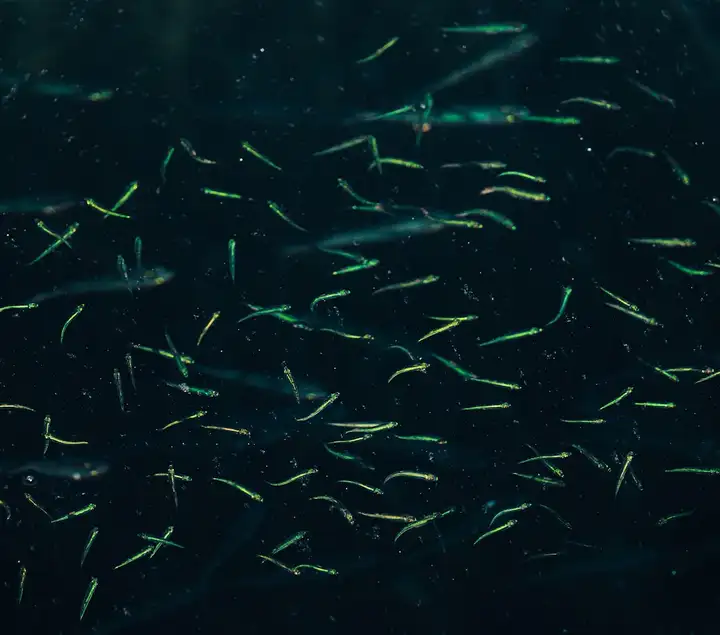
Why Vibrio Worsens in High Salinity
It is the dry season in a coastal vannamei pond near Bapatla. Salinity has risen from 22 ppt at stocking to 32 ppt by day 45 because of evaporation and limited freshwater inflow. Within a week, the first cases of luminous shrimp appear at night. Within two weeks, mass mortality starts. Salinity is not just a comfort parameter for shrimp — it directly controls how aggressive the pathogen becomes.
Why Salinity Drives Vibrio Severity
Vibrio bacteria are saltwater organisms by nature. Vibriosis is a bacterial disease caused by Vibrio bacteria, and acute infection usually appears around one month of culture. In higher salinity the severity is usually greater and is caused by luminous species, particularly Vibrio harveyi which produces visible blue-green light at night. Chronic vibrio infections at later stages, beyond day 60, link to loose shell syndrome, where shrimp grow larger but develop a paper-thin carapace with a gap between the muscle and the shell. The primary cause of chronic loose shell is a toxic pond bottom combined with high bacterial load.
The condition that triggers severe vibriosis on most coastal farms is salinity rising above 25 ppt during dry weather combined with a poor pond bottom and uneaten feed buildup.
Steps to Manage Vibrio in High Salinity
- Test salinity twice weekly — once at sunrise and once in late afternoon — and record the trend through the crop.
- If salinity rises above 28 ppt, exchange 10 to 15 percent water from a screened reservoir, prioritising lower-salinity source water if available.
- Apply BKC (Benzal Konium Chloride) at the manufacturer-recommended dose at the first sign of luminous shrimp or bacterial fouling.
- Reduce stocking density on coastal farms expecting high dry-season salinity — 30 to 40 PL per square metre is safer than 60 plus.
- Check the pond bottom every week — if a black smelly layer is forming, agitate it gently during partial water exchange to dislodge organic matter and reduce vibrio growth.
Field Observation
In our monitoring across Bapatla and Nellore coastal farms, ponds maintaining salinity between 15 and 22 ppt with regular partial water exchange faced milder vibrio episodes that responded to BKC. Ponds with salinity above 28 ppt and poor bottom condition repeatedly lost 50 to 80 percent of stock to luminous vibriosis.