 Marine Mitra
Why do my shrimp glow blue-green in the dark at night?
త్వరిత సమాధానం · Quick answer
Shrimp glow because of Vibrio harveyi, a luminescent bacterium that infects them in salinity above 25 ppt. The condition often kills 50 to 80 percent of post-larvae and juveniles within days. You will also see lethargy, reduced feeding, and shrimp gathering at pond edges before mortality starts.
మీ చెరువు పుస్తకం ఫోన్లో · Keep your pond's book on your phone Pond Book · Google Play
Why Your Shrimp Are Glowing at Night
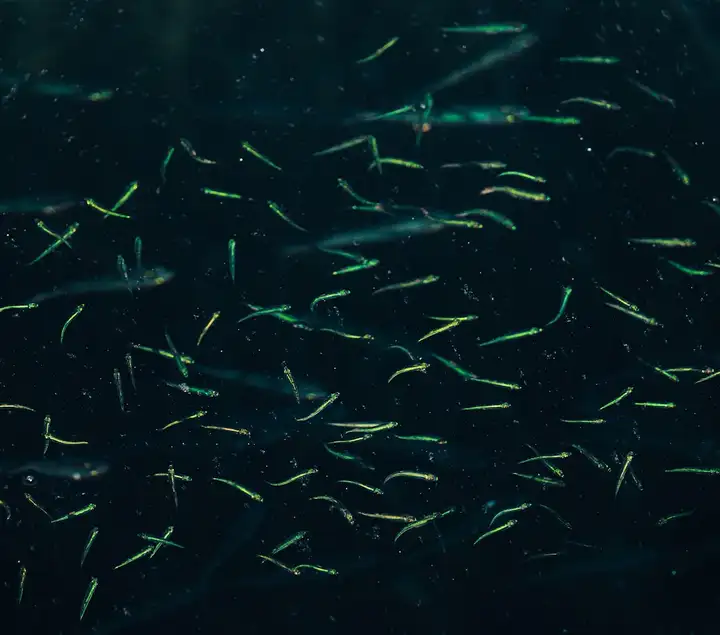
It is past 9 pm. You walk to the pond bund in Nellore for the last check of the day, and as your torch sweeps the water, you notice a faint blue-green light moving below the surface. Some farmers think it is reflection — it is not. Live shrimp infected with Vibrio harveyi actually emit light, and that light tells you the outbreak has already entered an advanced stage.
Why Vibriosis Becomes Luminescent
Vibrio harveyi is a saltwater bacterium that produces light through an enzyme called luciferase, the same biological mechanism used by deep-sea fish. Vibrio infection in shrimp usually appears around one month of culture and is therefore called one month mortality syndrome by farmers. In higher salinity above 25 ppt, the severity increases sharply, and luminescent vibriosis takes over. Chronic vibrio infection at later culture stages, beyond day 60, is usually linked to loose shell syndrome and a toxic pond bottom.
The condition that triggers luminous vibriosis on most coastal farms is salinity above 25 ppt combined with a heavy organic load on the pond floor.
Steps to Take Immediately
- Reduce feed by 30 percent at the next meal — Vibrio thrives on uneaten feed and faeces.
- Exchange 20 to 30 percent of the water from a screened reservoir to dilute the bacterial load.
- Apply Benzal Konium Chloride (BKC) at the manufacturer's shrimp-pond dose. BKC is a strong disinfectant and kills bacteria including external fouling pathogens.
- Apply Zeolite at 200 kg/ha to absorb ammonia stress, since stressed shrimp are far more vulnerable.
- Run aerators continuously for 48 hours — low oxygen is the second blow that turns vibriosis into a mass-mortality event.
Field Observation
In our monitoring across Bapatla and Nellore coastal farms, ponds with salinity below 20 ppt and clean bottoms rarely showed luminous shrimp, while ponds at 28 to 32 ppt with poor bottom condition lost 60 to 80 percent of stocked post-larvae inside one week.
 Why does vibrio infection get worse in higher salinity water?