 Marine Mitra
What is the pearlspot (Etroplus suratensis) pond farming protocol?
త్వరిత సమాధానం · Quick answer
CIBA Package 2021 verified pearlspot (Etroplus suratensis) pond protocol: pond filled with 25-30 cm water, fertilised with poultry dropping 500 kg/ha or cow dung 2,000 kg/ha. Plankton in 7 days, water raised to 100 cm. Bamboo poles + coconut leaves placed at 2m intervals for periphyton growth and egg attachment. Stocking: 4-5 cm seeds at 30,000/ha monoculture, 15,000/ha + milkfish/mullet 5,000/ha polyculture. Water: temp 25-32°C, salinity 0-30 ppt, pH 7.0-8.5, alkalinity 200-300 ppm. Marketable 250g in 10-12 months, 80% survival, 6 t/ha production.
మీ చెరువు పుస్తకం ఫోన్లో · Keep your pond's book on your phone Pond Book · Google Play
Source — CIBA Package of Aquaculture Practices 2021 verified
This pearlspot (Etroplus suratensis) pond farming protocol is from the ICAR-CIBA Package of Aquaculture Practices 2021.
Why pearlspot matters
Pearlspot, known locally as "karimeen" in Malayalam, is the official state fish of Kerala. It is a cultural and culinary icon — the dish "Karimeen Pollichathu" (wrapped in banana leaf and grilled) is a Kerala signature.
The species is endemic to Indian backwaters, primarily Vembanad Lake, Ashtamudi Lake, and Pulicat Lake. Premium market price: ₹300-600/kg farmgate.
Pond preparation (verified)
Directly from CIBA:
"After filling 25-30 cm water column in the pond, poultry dropping at 500 kg/ha or cow dung at 2000 kg/ha is applied to boost natural feed production in the culture pond."
Step-by-step:
- Fill pond with 25-30 cm water column initially
- Apply organic manure:
- Poultry dropping: 500 kg/ha, OR
- Cow dung: 2,000 kg/ha
- Wait 7 days for plankton bloom development
- Slowly raise water level to 100 cm
Periphyton substrate installation
Directly verified from CIBA:
"Bamboo poles and coconut leaves are placed along the sides of the pond with 2 m interval for facilitating the growth of periphyton. It will also act as egg attaching substrates during breeding."
Specifications:
- Substrate: Bamboo poles + coconut leaves
- Placement: Along pond sides
- Spacing: 2 m interval
- Dual purpose:
- Periphyton growth (natural food)
- Egg attachment surface during breeding
Water quality requirements
Directly from CIBA Package 2021:
| Parameter | Optimum Range |
|---|---|
| Temperature | 25-32°C |
| Salinity | 0-30 ppt (very euryhaline) |
| pH | 7.0-8.5 |
| Transparency | 25-40 cm |
| Dissolved oxygen | Above 4.5 ppm |
| Alkalinity | 200-300 ppm |
Stocking — monoculture vs polyculture
From CIBA:
"Seeds having a size of 4-5 cm are stocked in cage, happa or pen installed in the same pond to ensure maximum survival. As the growth rate is relatively poor in pond, seeds are stocked @ 30,000/ha for monoculture. If it is polyculture, stocking density is reduced @ 15,000/ha along with milkfish or mullet at 5000/ha."
Stocking specifications:
- Seed size: 4-5 cm
- Initial holding: cage, happa, or pen inside the pond (improves survival)
- Monoculture: 30,000 fingerlings per hectare
- Polyculture: 15,000 pearlspot + 5,000 milkfish/mullet per hectare
Feeding
From verified CIBA source:
Feed in morning and evening with floating pelletted feed or conventional feed (groundnut oil cake + rice bran + fish meal + vitamin-mineral mix). Feed contains 24-34% protein and 5% fat.
CIBA-verified feed table:
| ABW (g) | Protein content (%) | Feed size (mm) | Daily feeding rate (% of ABW) |
|---|---|---|---|
| 3-5 | 34 | 0.8 | 6 |
| 5-25 | 32 | 1.2 | 4 |
| 25-50 | 28 | 1.8 | 3 |
| 50-100 | 28 | 2.5 | 3 |
| 100-200 | 24 | 2.5 | 2 |
| 200-400 | 24 | 4.0 | 2 |
Pond maintenance
- Water depth: 1-2 m maintained
- 20-30% water replaced fortnightly
- Agricultural lime at 250 kg/ha on inner bund (prevents pH drop)
- Cow dung 250-500 kg/ha every 7 days based on plankton availability
- Paddle wheel aerators at 2 hp/ha for production above 6 t/ha
- Growth monitored by periodic cast net sampling
Harvest
From CIBA:
"The fish attains marketable size of 250 g over a period of 10-12 months with a survival rate of 80%. A production of 6 t/ha can be expected."
Production summary:
- Marketable size: 250 g
- Culture period: 10-12 months
- Survival rate: 80%
- Production: 6 tonnes per hectare
Polyculture economics
The 15,000 pearlspot + 5,000 milkfish/mullet polyculture utilises pond niches more efficiently than monoculture — pearlspot grows slowly so total pond productivity is enhanced by adding faster-growing species like milkfish or mullet.
With pearlspot at ₹300-600/kg and milkfish at ₹150-250/kg, polyculture can substantially exceed monoculture revenue per hectare while reducing single-species disease risk.
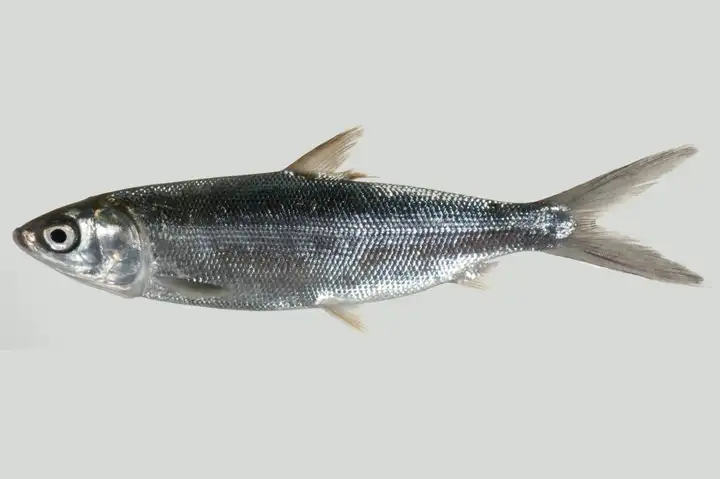 What is milkfish (Chanos chanos) and why is it ideal for coastal aquaculture?