 Marine Mitra
What is milkfish (Chanos chanos) and why is it ideal for coastal aquaculture?
త్వరిత సమాధానం · Quick answer
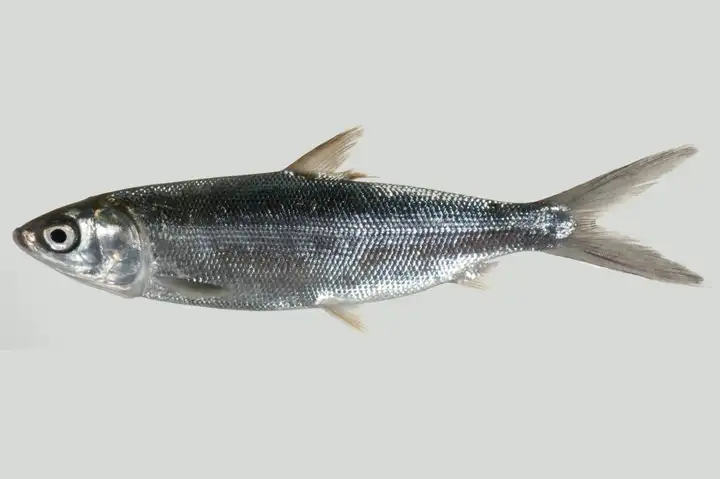
Milkfish (Chanos chanos) is a marine finfish with symmetrical streamlined body, large forked caudal fin, no teeth. Feeds predominantly on algae and invertebrates. Tolerates 15-40°C temperature and 0-145 ppt salinity — extreme euryhaline range. Spawns in open sea (50m depth). Female 6-7 years old releases 3-7 lakh eggs per kg body weight. Eggs 1.10-1.25 mm, hatch in 24 hours. Adults feed on detritus mats. CIBA has developed commercial seed production technology — previously farming relied on wild-collected seed.
మీ చెరువు పుస్తకం ఫోన్లో · Keep your pond's book on your phone Pond Book · Google Play
Source — CIBA Package of Aquaculture Practices 2021 verified
Milkfish (Chanos chanos) biology and farming data is from the ICAR-CIBA Package of Aquaculture Practices 2021, chapter 16.
Why milkfish is ideal for coastal aquaculture
Directly from CIBA:
"The milkfish, Chanos chanos is one of the ideal candidate species for farming in coastal areas. It has a symmetrical and streamlined body with large forked caudal fin. It has no teeth and predominantly feeds on algae and invertebrates."
Key advantages:
- Extreme salinity tolerance: 0-145 ppt range. This means milkfish survives:
- Pure freshwater (0 ppt)
- Brackishwater (5-25 ppt)
- Normal seawater (35 ppt)
- Hypersaline coastal lagoons (>50 ppt)
- Even extreme hypersaline conditions (up to 145 ppt has been documented)
- Wide temperature tolerance: 15-40°C — suitable for tropical, subtropical, and temperate coastal conditions
- Plant-based diet: No teeth, feeds on algae, microalgae, detritus, mangrove organic matter. Low-input feeding possible.
- No predator behaviour: Compatible with other fish in polyculture (verified in CIBA mud crab + milkfish polyculture)
Reproduction
From CIBA:
"Adult fish spawn in the open sea with a water depth of about 50 m. The female fish (6-7 years old) spawns annually or biannually, releasing about 3-7 lakh eggs/kg body weight at a time. The planktonic eggs are 1.10-1.25 mm in diameter and hatch-out within 24 hours."
Reproductive specifics:
- Spawning depth: 50 m in open sea
- Sexual maturity: 6-7 years old
- Egg output: 300,000-700,000 eggs per kg body weight
- Egg size: 1.10-1.25 mm diameter
- Hatching time: 24 hours
- Eggs are pelagic (drift with currents)
Life cycle in nature
From CIBA:
"The young-ones get into coastal waters along with the tidal inflow. Mangrove ecosystem with plenty of micro and macro live feed organisms and high organic matter, provides an excellent feeding ground to them till the sub-adult stage. On attaining a size of 200-300 g, the fish migrate back to the sea."
Milkfish life stages utilise multiple habitats — oceanic spawning, coastal nursery, mangrove juvenile, oceanic adult.
Indian milkfish aquaculture status
From CIBA:
"Aquaculture of the species depends on wild-collected seeds in India, however, ICAR-CIBA has developed commercial seed production technology in the recent years."
Until recently, milkfish farming relied on wild fry collection (March-June main season, October-December secondary). CIBA has now developed commercial hatchery technology — significantly de-risking the industry.
Adult feeding
From CIBA:
"The adult fish feed mainly on the mats of detritus consisting of plankton, microalgae and associated organisms."
In pond culture, milkfish is fed natural plankton blooms supplemented with formulated feed (36% protein, 6% lipid).
Production economics
From CIBA-verified pond culture data:
- Marketable size: 250 g in 10-12 months
- Survival rate: 80%
- Production: 6 tonnes per hectare
In polyculture with mud crab — total production 2,440 kg/ha/crop (crab 1,000 kg + milkfish 1,440 kg) in 138 days.