 Marine Mitra
How is hilsa fish cultured in brackishwater ponds in India?
త్వరిత సమాధానం · Quick answer
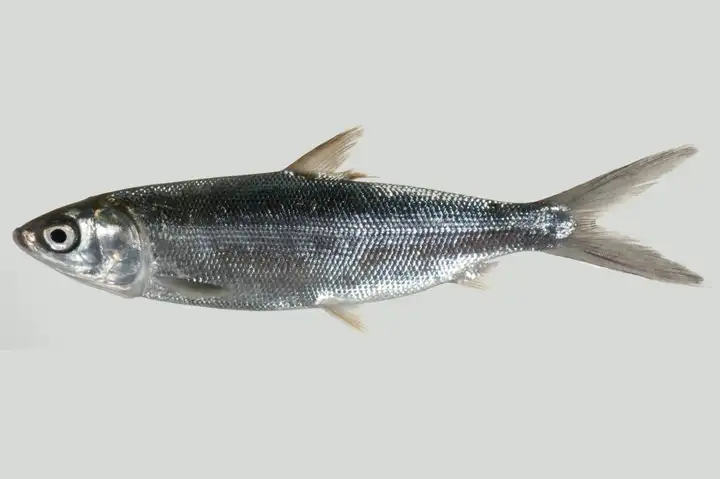
CIBA 2021 documented hilsa (Tenualosa ilisha) brackishwater pond culture protocol. Pond chlorinated with 500 kg/ha bleaching powder before stocking, then Plankton Plus at 160 kg/ha. Nursery hilsa fry (1.84 g, 5.58 cm) stocked at 14,000/ha after dechlorination. Fertilised with Plankton Plus 30 kg/ha + mustard oil cake 60 kg/ha in alternate weeks. Slow-sinking grow-out feed (HilsaPlus) fed at 5-10% body weight. After 250 days, fish reached 36.28 g and 17.34 cm.
మీ చెరువు పుస్తకం ఫోన్లో · Keep your pond's book on your phone Pond Book · Google Play
Source — CIBA Annual Report 2021 verified
The hilsa (Tenualosa ilisha) brackishwater pond culture protocol below is from the ICAR-CIBA Annual Report 2021.
Hilsa farming background
Hilsa is the state fish of West Bengal and a culturally significant fish across India and Bangladesh. Historically caught only from wild rivers and estuaries, captive farming of hilsa has been a CIBA research priority for years.
CIBA-verified pond culture protocol
Pond preparation:
- Pond chlorinated using 500 kg/ha bleaching powder to remove unwanted and predatory fish
- After dechlorination, Plankton Plus applied at 160 kg/ha
- 5 days waiting period after Plankton Plus application before stocking
Stocking:
- Nursery-reared hilsa fry stocked at average body weight 1.84 ± 0.30 g / body length 5.58 ± 0.40 cm
- Pond: 0.15 ha brackishwater pond
- Stocking density: 14,000 per hectare
Pond fertilisation during culture:
- Plankton Plus at 30 kg/ha
- Mustard oil cake at 60 kg/ha
- Applied in alternate weeks to maintain plankton population
Feeding regime:
- Formulated slow-sinking grow-out feed: HilsaPlus
- Feeding rate: 5-10% body weight
Verified growth results
After 250 days of culture:
- Average body weight: 36.28 ± 2.98 g
- Average body length: 17.34 ± 0.29 cm
Plankton community observed
During brackishwater grow-out culture, the dominant plankton:
Zooplankton: Copepod, daphnia, rotifers
Phytoplankton: Chlorella sp., filamentous algae, Gyrosigma sp., Nitzschia sp., Nannochloropsis sp.
CIBA-developed hilsa feed specifications
From the same CIBA 2021 report, formulated hilsa feeds shared with partner institute ICAR-CIFRI:
- Grow-out feed: CP 35%, EE 12%
- Broodstock feed: CP 39.5%, EE 15%
Both showed promising results in pond culture.
Sensory evaluation — wild vs captive hilsa
CIBA tested whether captive-pond-reared hilsa tasted the same as wild river hilsa. Using a 9-point hedonic scale with 50 evaluators tasting steamed hilsa and hilsa curry:
"It was observed that there was no significant difference in smell, taste and texture of muscle between captive and wild stock of hilsa."
This is a major finding — captive-cultured hilsa is sensorially equivalent to wild hilsa.
 What is milkfish (Chanos chanos) and why is it ideal for coastal aquaculture?