 Marine Mitra
What is the shrimp farming meaning and market chain from farmer to international buyer?
త్వరిత సమాధానం · Quick answer
The Indian shrimp market chain: hatchery sells PL to farmer → farmer grows shrimp → harvested shrimp sold to local collection center or processing facility directly → processor grades, freezes, and packages → MPEDA-registered exporter ships to international importer → international importer sells to retailer or food service. Farmer typically receives 40% to 60% of the final retail price. Understanding each step helps farmers identify where margin is lost.
మీ చెరువు పుస్తకం ఫోన్లో · Keep your pond's book on your phone Pond Book · Google Play
What Is Shrimp Farming
Shrimp farming — formally known as shrimp aquaculture or penaeid shrimp culture — is the controlled cultivation of shrimp species (primarily Litopenaeus vannamei and Penaeus monodon in India) in managed pond systems from post-larvae stocking to harvest weight, using artificial feed, water quality management, and biosecurity practices to optimize production.
In India, commercial shrimp farming is concentrated in coastal brackishwater areas of Andhra Pradesh, Odisha, West Bengal, Tamil Nadu, and Kerala. From less than 1 lakh metric tonnes in 1995-96, India's farmed shrimp production has grown to over 3.80 lakh tonnes by 2014-15, making India one of the world's largest shrimp producers and exporters.
The Complete Shrimp Market Chain
Step 1 — Broodstock suppliers and hatcheries: SPF broodstock is imported or sourced from certified facilities. Hatcheries use broodstock to produce post-larvae (PL) through nauplius, zoea, and mysis stages. PL are sold to grow-out farmers at ₹40 to ₹100+ per 1,000 PL depending on quality and certification.
Step 2 — Input suppliers: Feed manufacturers (Avanti, CP, Godrej, Waterbase, Skretting), probiotic suppliers, lime suppliers, aeration equipment dealers, and chemical suppliers serve the farmer between stocking and harvest. Feed alone represents 50% to 60% of total production cost.
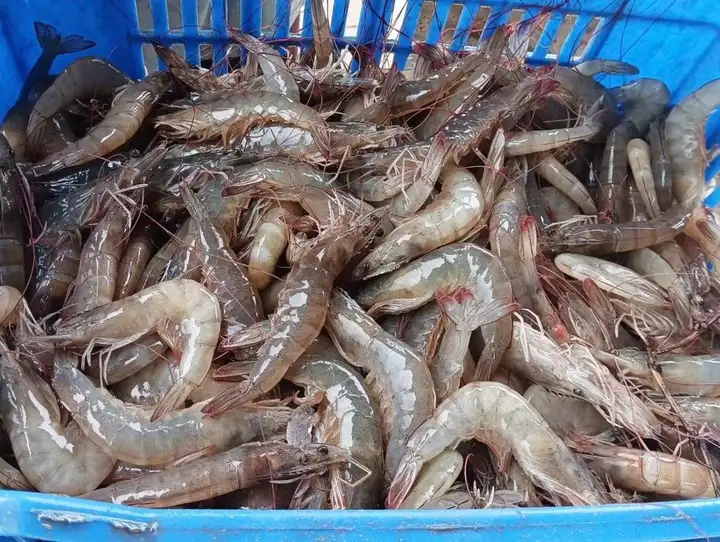
Step 3 — Grow-out farmer: The farmer manages the pond for 90 to 120 days, investing in feed, electricity for aeration, labor, water management chemicals, and farm maintenance. At harvest, shrimp are sold through one of two channels:
- Directly to a processing facility (best price, requires established relationship)
- Through a local collection agent or trader (more accessible, slightly lower price)
Step 4 — Collection agents and local traders: Agents visit farms at harvest, purchase shrimp, provide ice and transport, and aggregate product from multiple farms before selling to processing facilities. They earn a margin of ₹5 to ₹20 per kilogram for this aggregation and logistics service.
Step 5 — Processing facilities: MPEDA-registered processing facilities wash, grade, dehead, peel, devein, blast freeze, and pack shrimp to export specification. They add significant value — a ₹350/kg farm-gate price becomes ₹500+/kg as processed frozen HLSO product FOB Nhava Sheva or Krishnapatnam port.
Step 6 — Exporters: Export-registered companies handle international sales, shipping documentation, letter of credit negotiation, and regulatory compliance. Major exporters include Devi Fisheries, Apex Frozen Foods, and Nekkanti Sea Foods.
Step 7 — International importers and distributors: Import companies in USA, EU, and Japan receive the frozen shrimp, clear customs, and distribute to retail chains, food service operators, and restaurant distributors.
Step 8 — Retail and food service: Consumers purchase Indian shrimp in supermarkets (Walmart, Costco, Tesco) or eat it in restaurants. Retail prices are typically 3 to 5 times the Indian farm-gate price.
What Farmers Capture in the Value Chain
Farmers typically receive 40% to 60% of the FOB export price and 15% to 25% of the final retail price in destination markets. Understanding this margin distribution motivates two farm-level strategies:
- Produce larger, premium-count shrimp to capture higher farm-gate price
- Build direct relationships with processing facilities rather than selling through agents — removing one margin layer
Field Observation
Field observation: In our monitoring work across Andhra Pradesh farming communities, the farmers achieving the best margins are those who have built direct relationships with MPEDA-registered processors and can deliver consistent quality across multiple harvests on a predictable schedule. Processors value reliability — a farmer who consistently delivers 21-25 count antibiotic-free shrimp on the agreed schedule commands ₹20 to ₹40 per kilogram premium over the spot market price.
 What is the shrimp count-to-size conversion — how many shrimp per kilogram at harvest?