 Marine Mitra
How does a paddle wheel aerator work in a fish pond?
త్వరిత సమాధానం · Quick answer
A paddle wheel aerator works by rotating paddles on a horizontal shaft that break the water surface, splashing water into the air and creating turbulence that transfers atmospheric oxygen into the water. Each rotation pulls oxygen from air into water droplets and introduces oxygenated water back into the pond. Standard 2 hp paddle wheel aerators in India achieve 1.5-2.5 kg of oxygen transfer per hour (OTR) in standard conditions.
Work it out: Aerator HP per pond · ఏరేటర్ HP లెక్క
మీ చెరువు పుస్తకం ఫోన్లో · Keep your pond's book on your phone Pond Book · Google Play
The mechanical principle
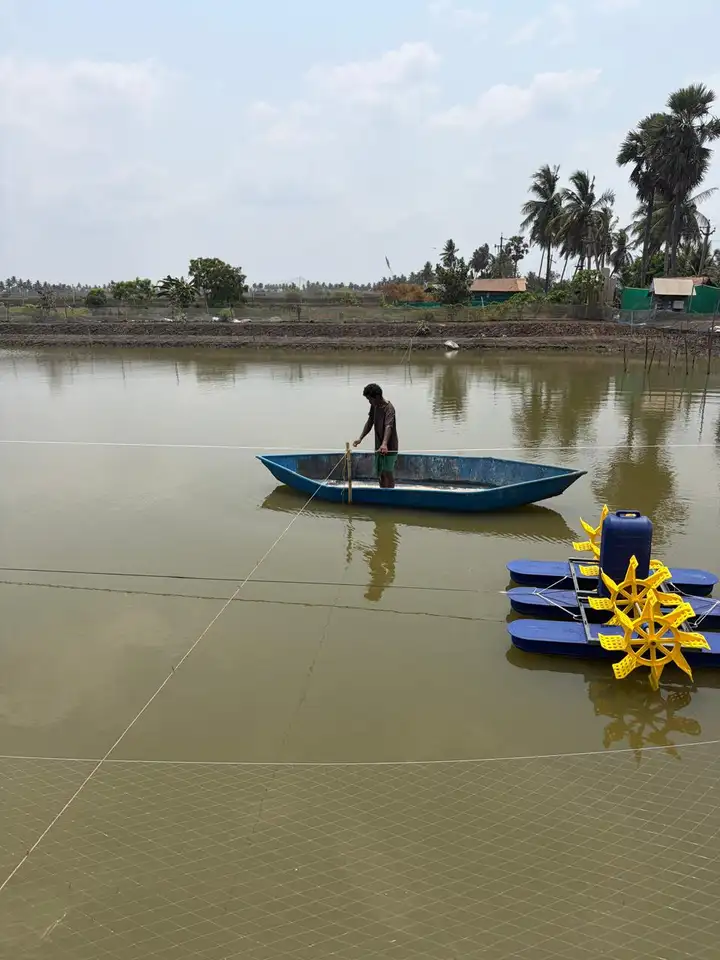
A paddle wheel aerator consists of a horizontal shaft with multiple paddles (flat or scooped blades) attached radially, powered by an electric motor through a gearbox. The shaft rotates at 60-120 RPM, and the paddles:
- Break the water surface — disrupting the surface film that limits oxygen transfer
- Splash water into air — water droplets exposed to air absorb oxygen across their surface area
- Create circulation currents — water movement mixes oxygenated surface water into the deeper water column
- Re-introduce oxygenated water — the splash falls back into the pond carrying dissolved oxygen
This combination of surface disruption, droplet formation, and water circulation is why paddle wheels are more effective than simple propeller-type agitators.
Oxygen transfer rate (OTR)
Standard 2 hp paddle wheel aerators operating in standard conditions (clean water, 20°C, zero DO) transfer approximately 1.5-2.5 kg of oxygen per hour. In actual pond conditions (warm water at 30°C, already partially oxygenated), effective transfer is 60-70% of the standard rating.
This is why aeration requirements are calculated in hp per hectare rather than assuming one aerator handles everything.
Placement for maximum effect
Paddle wheels placed parallel to the long axis of a rectangular pond create a circular current — water flows along one wall, across the end, back along the other wall. This circular flow:
- Keeps the entire water column mixed and oxygenated
- Concentrates sludge in the centre of the pond (which is why central drain systems are effective)
- Prevents stratification (warm, oxygen-depleted bottom layer)
For a 1-hectare rectangular pond: place 4 aerators of 2 hp each on alternating sides, not all on the same side. Stagger placement by 30-40 metres.
When to run aerators
Semi-intensive ponds (15-25 PL/m²): Night-only from weeks 1-5, 8 pm to 7 am. Continuous from week 6 onwards as biomass increases. Intensive ponds: continuous from stocking.