 Marine Mitra
What are paddle wheel aerators and how many do I need per hectare?
త్వరిత సమాధానం · Quick answer
Paddle wheel aerators (PWAs) supply oxygen and water circulation in shrimp ponds. CIBA research recommends 2 hp/hectare if production above 5-6 tonnes/ha is planned, scaling up with stocking density. Intensive vannamei culture typically uses 4 to 8 PWAs per hectare (16-32 hp/ha). Place along the long sides of the pond for circulation.
Work it out: Aerator HP per pond · ఏరేటర్ HP లెక్క
మీ చెరువు పుస్తకం ఫోన్లో · Keep your pond's book on your phone Pond Book · Google Play
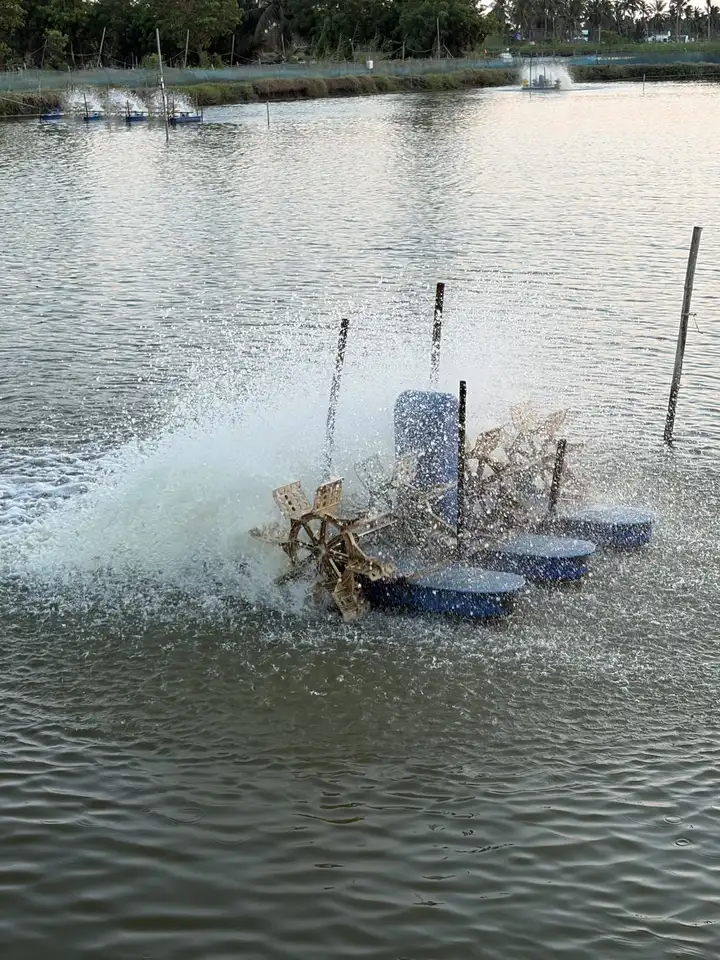
Why Paddle Wheel Aeration Matters
It is infrastructure planning week for your new vannamei pond in coastal Andhra Pradesh. The contractor proposes 2 paddle wheel aerators per hectare. The neighbour with intensive culture uses 8 per hectare. The honest field truth: aeration capacity is one of the strongest predictors of crop survival and production, and matching aerator capacity to stocking density and target production is critical infrastructure planning.
Why Aerator Capacity Is Critical
Paddle wheel aerators (PWAs) are surface aerators with rotating paddles that splash water into the air, transferring oxygen from atmosphere to water and creating circulation that mixes the entire water column. Documented guidance on aerator capacity for fish ponds recommends paddle-wheel-aerator at 2 horsepower per hectare if production of more than 5 to 6 tonnes per hectare is anticipated. For semi-intensive vannamei culture targeting 3 to 6 tonnes per hectare, 4 to 8 hp per hectare (1 to 2 PWAs of 2 hp each) is typical. For intensive culture targeting 8 to 15 tonnes per hectare, 16 to 32 hp per hectare (4 to 8 PWAs) is needed. Biofloc systems require even higher capacity at 30+ hp per hectare due to high microbial respiration. CIBA research on aeration efficiency of different aerators showed that aerator type, placement, and operating hours all affect oxygen transfer efficiency and operating cost. Critical DO threshold for shrimp is 3.7 ppm in culture ponds — below this is dangerous. Aerators should maintain DO above 4 ppm at all times during the second half of the crop. Place PWAs along the long sides of the pond to create circular water flow, not in corners where they create dead zones. Position outflow paths so they push water across the pond surface rather than into the bunds.
The condition that triggers under-aeration on most farms is matching aerator count to pond size without considering stocking density or target production.
Steps to Plan Aeration Capacity
- Calculate target production. For 3 to 6 tonnes/ha (semi-intensive), use 4 to 8 hp/ha. For 8 to 15 tonnes/ha (intensive), use 16 to 32 hp/ha.
- For a typical 1-hectare semi-intensive vannamei pond, install 4 PWAs of 2 hp each (8 hp total). Adjust upward for higher density.
- Place PWAs along the long sides of the pond at 30 to 50 metre intervals. The orientation should create circular water flow.
- Plan power backup. Generator or solar capacity must support 100 percent of aerator load during outages — even a 6-hour outage during summer can crash DO and kill stock.
- Operate aerators based on DO monitoring. During the first month, run during night and early morning when DO is lowest. From day 30 onward, run continuously through the second half of the crop.
Field Observation
In our work across Indian shrimp farms, ponds with appropriately sized and placed paddle wheel aerators consistently maintained DO above 4 ppm and supported planned production targets. Farms with under-aeration faced repeated DO crashes, vibrio outbreaks, and survival drops below 60 percent despite other good management.
 What body parts should I examine in cast netted shrimp every week?