 Marine Mitra
What is seaweed farming in Andhra Pradesh — a complete overview for beginners?
త్వరిత సమాధానం · Quick answer
Seaweed farming in AP is the cultivation of marine algae — mainly Kappaphycus alvarezii and Gracilaria — in coastal sea water or brackishwater ponds along AP's 974 km coastline. It requires no land ownership, no chemical inputs, and minimal investment (₹75,000–₹1 lakh per acre). The government pays 40–60% of setup cost through PMMSY. First harvest in 45 days. Income: ₹40,000–₹2 lakh per year per acre depending on scale and buyers.
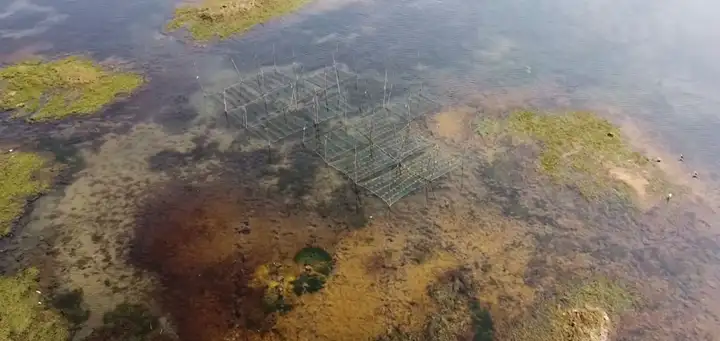
Welcome to Seaweed Farming
Seaweed farming is the cultivation of seaweed — marine plants that grow in the sea — for commercial purposes. It is one of the simplest, lowest-cost, and most environmentally friendly farming activities available to coastal communities in India.
In Andhra Pradesh, seaweed farming is still in an early growth phase — which is both a challenge and a major opportunity. Farmers who start now get the best government support, the first access to buyers, and the advantage of experience over those who start later.
What You Grow
Two main species are grown commercially in AP:
Kappaphycus alvarezii — A fast-growing red seaweed used to produce carrageenan. It grows 5 times its planted weight in 45 days. Grows in open sea water with salinity above 25 ppt. Harvest every 45 days. Price: ₹20–₹45/kg dry.
Gracilaria — A red seaweed used to produce agar. Grows well in coastal brackishwater ponds at lower salinity (15–30 ppt). Ideal for integration with shrimp ponds. Harvest every 30–45 days. Price: ₹20–₹40/kg dry.
What You Need to Start
| Item | Needed? |
|---|---|
| Land ownership | No — sea water is public, ponds can be leased |
| Large capital | No — ₹75,000–₹1 lakh for 1 acre, partially covered by PMMSY subsidy |
| Boat | Yes — small canoe or fishing boat |
| Special skills | No — 2-day training covers everything |
| Feed or chemicals | No — seaweed needs only sunlight and seawater |
| Full-time commitment | No — 2–3 visits per week, manageable alongside fishing |
What the Government Gives You
Under the PMMSY (Pradhan Mantri Matsya Sampada Yojana) scheme:
- General category farmers: 40% of setup cost paid by government
- SC/ST and women farmers: 60% of setup cost paid by government
- Kisan Credit Card (KCC) loan for the remaining amount at 4% interest
- Crop insurance with premium subsidy
- Free training through AP Fisheries Department, CMFRI Visakhapatnam, and KVKs
The Timeline From Start to First Income
| Week | Activity |
|---|---|
| Week 1–4 | DFO registration, PMMSY application, training |
| Week 5–6 | Equipment purchase (after work order), farm setup |
| Week 7 | Seed planting |
| Week 7–13 | Growing period — visits twice a week |
| Week 13 | Harvest — 300–400 kg wet from 1 acre |
| Week 13–15 | Drying — 60–80 kg dry seaweed |
| Week 15 | First payment from buyer |
First income arrives approximately 15 weeks (4 months) after you begin the application process. No other coastal farming delivers income this quickly.
What You Earn
| Farm size | Annual income (net after costs) |
|---|---|
| 1 acre (solo) | ₹15,000–₹40,000 |
| 3 acres (SHG group) | ₹45,000–₹1.2 lakh |
| 5 acres (established farmer) | ₹80,000–₹2 lakh |
| 10 acres (cooperative) | ₹1.5–₹4 lakh |
The Most Important First Step
Every AP coastal fisher interested in seaweed farming should start with one action:
Visit your District Fisheries Office this week.
Tell them you want to start seaweed farming. Ask for:
- Fisher Identity Card (if you do not have one)
- PMMSY seaweed farmer registration form
- Date of next seaweed farming training
- Buyer contacts in your district
Everything else follows from that one visit. The government schemes exist. The buyers exist. The training is free. The sea is right there. The only remaining ingredient is your decision to start.
The Bottom Line
Seaweed farming in AP is a proven opportunity — not a theory or a promise. It is happening right now in Tamil Nadu, Kerala, and parts of coastal India, with real income for real fishing families. Andhra Pradesh has better coastline, better government support, and stronger market access than many of those early-adopting states. What it needs is more farmers willing to be among the first. Be one of them.
 What happens if seaweed prices fall — how do you protect yourself?
 Why does water current matter so much for seaweed farming and how do you check it?