 Marine Mitra
Why does water current matter so much for seaweed farming and how do you check it?
త్వరిత సమాధానం · Quick answer
Water current of 30–60 cm per second is the ideal range for Kappaphycus farming. Current brings nutrients, removes waste, prevents epiphyte buildup, and maintains oxygen around the plant. Too slow (below 20 cm/s): disease risk rises sharply. Too fast (above 80 cm/s): ropes break and plants tear. Test current by timing a floating object travelling 1 metre.
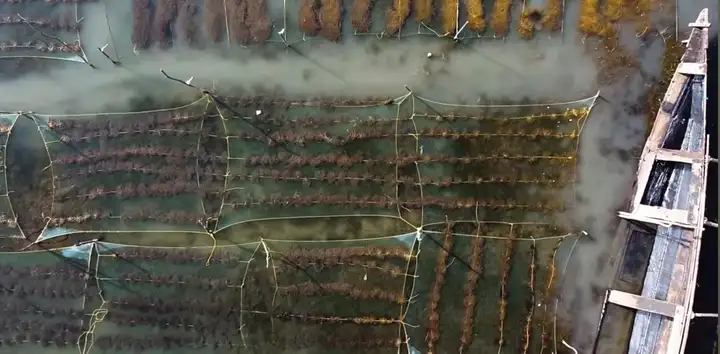
Seaweed Cannot Drink — It Relies on Water Movement
Unlike land plants, seaweed has no roots. It cannot actively absorb water or nutrients from the ground. Everything it needs — nitrogen, phosphorus, trace minerals, dissolved CO₂, and carbon — must come to it through the water flowing around it.
This is why water current is not optional. It is the delivery mechanism for everything the plant needs to grow.
What Current Does for Your Seaweed
Delivers nutrients continuously Seawater contains dissolved nutrients that seaweed absorbs through its entire surface. Moving water brings fresh nutrient-rich water to the plant every second. Still water depletes nutrients rapidly around the plant — and growth stalls.
Removes metabolic waste Seaweed produces waste compounds during photosynthesis and respiration. These accumulate in still water and build up around the plant, slowing growth and weakening it. Current continuously flushes this away.
Prevents epiphyte settlement Epiphyte spores floating in the water need to land on a surface and stay long enough to attach. Moving water prevents spores from settling. Farms in good current zones have far fewer epiphyte problems than farms in slow water.
Maintains oxygen levels Seaweed photosynthesises during the day but respires 24 hours a day. At night, seaweed consumes oxygen. In still water, oxygen can be depleted around the plant overnight. Current refreshes oxygen constantly.
Maintains ideal temperature Current mixes surface and deeper water — preventing the surface water from overheating in summer beyond the 30°C limit that stresses Kappaphycus.
The Ideal Current Speed — 30 to 60 cm Per Second
This is the established range for Kappaphycus farming from research and farming experience across India and Southeast Asia.
- Below 20 cm/s: The water is too slow. Nutrients deplete rapidly around the plant, epiphytes accumulate, oxygen drops overnight. Ice-ice disease risk is high. Do not farm here.
- 20–30 cm/s: Marginal. Farming is possible but yields will be below optimal. Monitor carefully and move plants if ice-ice appears.
- 30–60 cm/s: Ideal. Maximum growth rate, minimum epiphyte problems, lowest disease risk.
- 60–80 cm/s: Fast but manageable with strong rope and anchoring systems.
- Above 80 cm/s: Too fast. Ropes snap, plants tear from ropes, structures collapse. Untenable for monoline or SRFR systems.
How to Test Current Speed at Your Site
You do not need any equipment. Use this simple method:
The float test:
- Take a small piece of floating material — a small plastic bottle cap, a piece of foam, or a leaf
- Drop it on the water surface at your site
- Start timing on your phone
- Measure how long it takes to travel exactly 1 metre
- Calculate: speed (cm/s) = 100 ÷ time in seconds
Reading the result:
| Time to travel 1 metre | Current speed | Assessment |
|---|---|---|
| Less than 1.5 seconds | Above 67 cm/s | Too fast for standard structures |
| 1.5–3 seconds | 33–67 cm/s | Ideal range |
| 3–5 seconds | 20–33 cm/s | Marginal |
| More than 5 seconds | Below 20 cm/s | Too slow — find a better site |
Test at different times: Current speed changes with tides. Test at three different times — incoming tide, peak tide, and outgoing tide — to understand the full range at your site.
Test in different seasons: Ask local fishers how current changes in summer, monsoon, and post-monsoon. Some sites have good current in one season and almost nothing in another.
What to Do if Your Site Has Insufficient Current
If your preferred site has current below 30 cm/s, you have three options:
- Find a different site — this is the most practical solution
- Try pond farming with Gracilaria — Gracilaria tolerates lower current than Kappaphycus
- Create artificial current — in enclosed ponds, a small pump can be used to circulate water. Not practical for open sea sites.
The Bottom Line
Check water current before you buy a single rope. It is a 5-minute test with no equipment needed. A good current site will produce good crops consistently. A poor current site will produce frustration, disease, and poor yields regardless of everything else you do right.
Related Guides
- What are the Andhra Pradesh government's plans for growing seaweed farming?
- Which coastal districts in Andhra Pradesh are best for seaweed farming?
- What are the most common mistakes new seaweed farmers make and how to avoid them?
- How do you choose the right location for seaweed farming in Andhra Pradesh?
 Can seaweed farming create jobs and income for young people on the AP coast?
 What happens if seaweed prices fall — how do you protect yourself?
 What is seaweed farming in Andhra Pradesh — a complete overview for beginners?