 Marine Mitra
What is murrel fish farming and how is it done in India?
త్వరిత సమాధానం · Quick answer
Murrel (Channa striata, snakehead fish) farming in India (CIBA Package 2021 verified): earthen pond 0.1 ha, 1 m depth, fenced 90 cm height (murrel escapes by jumping and crawling). Water quality: salinity 0-5 ppt, pH 7.5-8.2, temp 28-31°C. Stocking: uniform-sized fingerlings 8 cm at 2/m². Feeding: 2-10% of body weight twice daily, formulated feed 36-45% CP (less than 5g = 45% CP, 5-20g = 40% CP, 20-100g = 40% CP, 100-500g = 36% CP). Harvest: 1-1.5 kg in 8-10 months. Marketed live — fetches high price. Partial harvest by seining, final harvest after complete dewatering.
What murrel is
Murrel (snakehead fish) refers primarily to Channa striata (spotted snakehead) and related Channa species farmed in India. Known in Tamil as Viral meen, in Telugu as Korameenu, in Hindi as Sawal meen.
Why murrel commands premium prices:
- Live fish market: murrel can survive out of water for hours due to a modified labyrinth organ that allows air breathing
- Transported and sold alive — highest price in live fish markets
- Medicinal reputation in traditional medicine (wound healing, post-surgery recovery)
- Lean, firm flesh with minimal bones
CIBA-verified pond farming specifications
From ICAR-CIBA Package of Aquaculture Practices 2021, Chapter on Murrel farming:
Pond type:
- Rectangular earthen pond
- Area: 0.1 ha (ideal)
- Depth: 1 m
- Fencing: poles and net 90 cm height around entire pond perimeter
Why fencing is mandatory: Murrel escapes by both jumping (over low bunds) and crawling on moist land. The 90 cm net fence prevents both escape routes.
Bund lining from CIBA Package 2021:
"If the side bund of the earthen pond is weak, it should be lined with materials like polythene sheet."
Verified water quality requirements
From CIBA Package 2021:
| Parameter | Range |
|---|---|
| Salinity | 0-5 ppt (freshwater to slightly brackish) |
| pH | 7.5-8.2 |
| Temperature | 28-31°C |
Murrel are hardy and tolerate some organic pollution — but optimal production requires clean freshwater with adequate DO.
Stocking specifications
From CIBA Package 2021:
"As cannibalism is high in the earlier stages, uniform-sized fingerlings having the size of 8 cm are stocked into the pond after acclimatisation at a density of 2 no./m²."
Critical requirement — uniform size: Murrel are highly cannibalistic. If different-sized fingerlings are stocked together, larger fish eat smaller fish. Strictly use uniform-sized (8 cm) fingerlings — size difference of 1-2 cm can result in cannibalism.
CIBA-verified feeding guide
From CIBA Package 2021, Table 3.1 — Feed requirement:
| ABW (g) | Protein content (%) | Feed size (mm) | Daily feeding rate (% ABW) |
|---|---|---|---|
| Less than 5 | 45% | 0.8 mm | 10% |
| 5-20 | 40% | 1.2 mm | 8% |
| 20-100 | 40% | 1.8 mm | 5% |
| 100-500 | 36% | 2.5 mm | 4% |
| 500-1,000 | 36% | 4.0 mm | 3% |
| Above 1,000 | 32% | 6.0 mm | 2% |
Feeding frequency: Twice daily
Feed types (from CIBA Package 2021):
- Formulated pelleted feed (36-45% protein)
- Trash fish
- Prawn waste
- Boiled slaughterhouse waste
- Silkworm pupae
Care and maintenance
From CIBA Package 2021:
"Murrels are generally hardy and tolerate organic pollution in derelict waters to some extent. However, the replacement of 10% of water fortnightly is ideal. Growth assessment is carried out monthly by cast netting. Intermittent application of agricultural lime, manure and other monitoring procedures are similar to that of the major carps. Incidence of the disease is not common, but there is a possibility of infestation by ectoparasites like Lernea and Argulus."
Parasite management: Lernea (anchor worm) and Argulus (fish louse) can be controlled with periodic freshwater dip or approved treatments.
Harvest and marketing
From CIBA Package 2021:
"If the management practices are proper, murrels attain a growth of 1-1.5 kg within a culture period of 8-10 months. Partial harvesting is done by seining after lowering the water to 60 cm. Final harvesting is done during summer season after complete dewatering of the pond and picking them manually as the fish shows burrowing habit in the bottom mud. The fish can be kept in live condition out of water for a long time. Hence, it is transported and marketed in live state to distant markets and fetches high demand and decent price."
Harvest summary:
- Target: 1-1.5 kg in 8-10 months
- Partial harvest: seining at 60 cm water depth
- Final harvest: complete dewatering + manual picking (murrel burrows into mud)
- Transport: live — high value
Species note: This blog covers freshwater murrel (Channa striata) only. NOT applicable to shrimp.
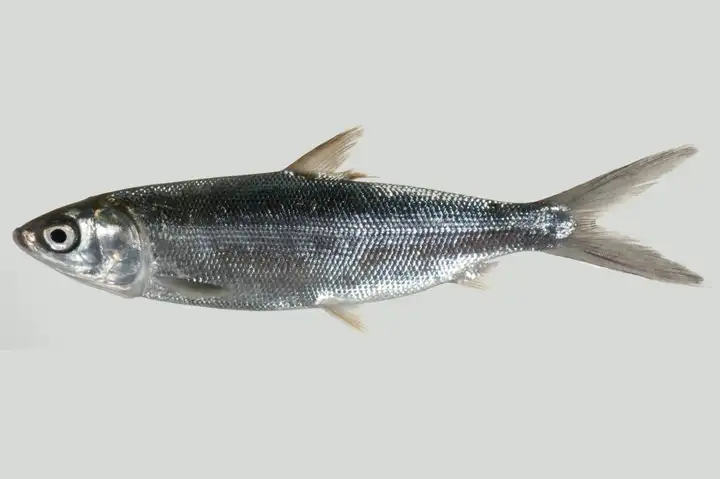 What is milkfish (Chanos chanos) and why is it ideal for coastal aquaculture?