 Marine Mitra
Nighttime feeding in shrimp ponds — is it necessary?
త్వరిత సమాధానం · Quick answer
Nighttime feeding in shrimp ponds is necessary during the first 30-45 days when PL and juvenile shrimp are more active at night and need frequent feeding. After day 45, a late-evening meal (7-8 pm) replaces dedicated nighttime feeding for most semi-intensive farms. Continuous nighttime feeding in mid-to-late crop adds feed cost without proportional benefit unless high-density intensive systems with 40+ PL/m².
మీ చెరువు పుస్తకం ఫోన్లో · Keep your pond's book on your phone Pond Book · Google Play
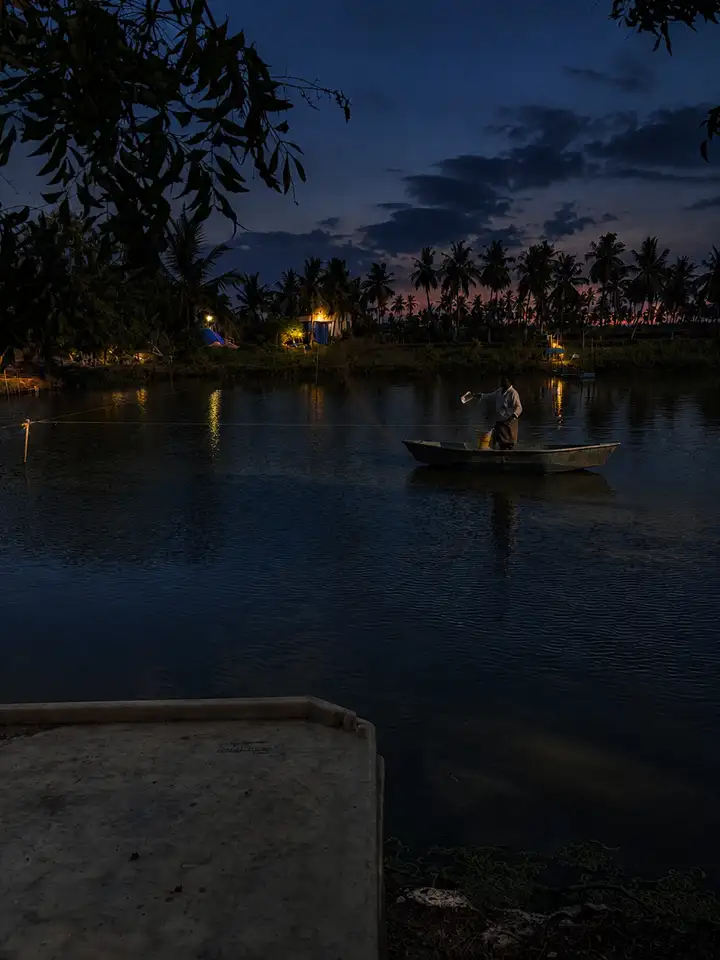
What shrimp do at night
Shrimp are nocturnally active. They move more, feed more actively, and compete less with each other at night than during the day. In natural environments, shrimp are most active during the hours after sunset. In pond culture, this nocturnal behaviour means the evening and night feeding window is actually the highest-efficiency feeding period of the day.
The question isn't whether to feed at night — it's how many meals and at what times across the 24-hour cycle.
First 30-45 days: nighttime feeding matters
In the first 30-45 days, PL shrimp have such a short gut transit time (60-90 minutes) that skipping the nighttime period means 6-8 hours of empty gut. For this reason, maintaining a feeding interval of roughly every 4 hours — including one or two meals between 8 pm and 4 am — improves early-stage growth significantly.
Practically: a meal at 8 pm, one at midnight, and one at 4 am gives 6 feedings across 24 hours without requiring someone to be at the farm every 4 hours. Two farmers sharing 12-hour shifts can manage this during the critical first month.
After day 45: late-evening is enough for most farms
From day 45-50 onwards, shrimp body weight has crossed 2-3 grams. The gut transit time has extended. A four-meal schedule (6 am, 11 am, 4 pm, 8 pm) covers the key daytime and peak-evening feeding windows for semi-intensive operations (stocking density 15-25 PL/m²).
A dedicated midnight feed is rarely cost-justified for semi-intensive ponds after day 45. The marginal weight gain from the extra meal doesn't cover the labour cost in most operations.
Exception: high-density intensive systems
Intensive ponds stocked at 40-60 PL/m² have much higher biomass by day 60-70. Feed conversion at this density benefits from more frequent delivery to avoid localised overfeeding in some areas and underfeeding in others. These operations often maintain 5 feedings per day including a late-night meal through the full crop.
Practical rule
For semi-intensive AP vannamei farms: 5-6 feedings per day including night meals for the first 45 days. 4 feedings per day with latest meal at 8 pm from day 45 onwards. Adjust based on tray consumption — trays emptying too fast mean more frequency; trays with residue mean reduce.
Related Guides
- What is the FCR target in shrimp aquaculture and how to improve it?
- How to Use Feeding Trays (Anco Trays) in Shrimp Ponds?
- How algae in ponds contribute to shrimp nutrition
- What is a biofloc system and how does it work in shrimp farming?