 Marine Mitra
How do paddle wheel aerators affect feed distribution in a shrimp pond?
త్వరిత సమాధానం · Quick answer
Aerator currents move sinking feed pellets away from the 2-meter feeding zone near the pond bund where shrimp concentrate during meals. Stop all paddle wheel aerators before each feeding and restart 1 hour later — this single practice improves FCR by 0.2 to 0.3 in intensive ponds. Position aerators to concentrate sludge in the center, keeping the perimeter feeding zone clean.
Work it out: Aerator HP per pond · ఏరేటర్ HP లెక్క
మీ చెరువు పుస్తకం ఫోన్లో · Keep your pond's book on your phone Pond Book · Google Play
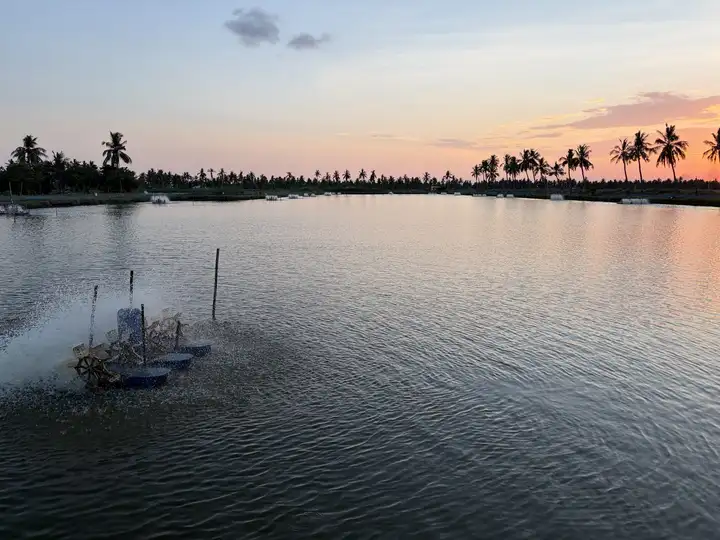
You broadcast 6 kg of feed around the pond perimeter at 7 AM while your three paddle wheel aerators run at full speed. The feed hits the water and within 30 seconds, the aerator current sweeps the sinking pellets toward the pond center — away from the 2-meter feeding zone at the edges where your shrimp are concentrated. By the time your shrimp detect the feed chemically and move toward the scent, the pellets are in the center current. Only 30% of the meal is consumed. The rest sinks to the center sludge zone and rots.
How Aerators Interfere with Shrimp Feeding
Paddle wheel aerators create a strong circular water current that moves water from the aerator blade across the pond surface and returns along the bottom. This current is strong enough to move sinking pellets — which have a slow settling rate of 2 to 5 cm per second — horizontally across the pond before they reach the bottom feeding zone.
Shrimp use chemosensory detection through antennae to locate feed. They need the feed to be stationary or slow-moving in the water column to accurately locate and move to it. Moving feed dispersed through the water column by aerator currents is significantly harder for shrimp to locate and consume efficiently.
BMP guidelines from the MPEDA/NACA Technical Assistance study confirm that stopping aerators before feeding is a recommended practice for intensive shrimp grow-out ponds.
The Correct Aerator Management Protocol During Feeding
- 30 minutes before each meal: Switch off all paddle wheel aerators
- Broadcast feed: Distribute evenly within a 2-meter zone from the pond bund on all sides — this is where shrimp concentrate during feeding
- 1 hour after broadcasting: Restart all aerators at full capacity
- Never extend the aerator-off period beyond 1 hour: DO can drop dangerously in high-density ponds if aerators are off longer than 1 hour, especially at night
During night feeding (which should account for more than 60% of daily ration for Vannamei): The aerator-off protocol is even more important at night because natural DO production from algae photosynthesis is zero. Monitor DO continuously during night feeding aerator-off periods — if DO drops below 4 ppm before 1 hour is up, restart aerators immediately regardless of feeding completion.
Aerator Positioning for Clean Feeding Zones
Position paddle wheel aerators to create a circular current that concentrates sludge in the center of the pond — away from the perimeter feeding zone. This positioning serves two purposes:
- Keeps the 2-meter perimeter feeding zone clean and free from sludge accumulation
- Allows shrimp to feed on a clean bottom surface rather than in organic-rich sludge that harbors Vibrio
Change feeding area position at least once every 10 days depending on bottom condition — BMP guidelines confirm this prevents localized sludge buildup at fixed feeding areas.
Field Observation
Field observation: In our monitoring work across Nellore district farms, switching from continuous aeration during feeding to the 1-hour aerator-off protocol consistently produces FCR improvements of 0.2 to 0.3 in intensive ponds — without any change in feed brand, stocking density, or any other management practice. This is the single highest-return low-cost management change available to most Andhra Pradesh shrimp farmers.
Related Guides
- How do I manage pH fluctuations in a shrimp pond during the monsoon season?
- What causes black sludge to build up on the pond bottom and how do I remove it?
- What is the difference between burnt lime and agricultural limestone for pond preparation?
- How do I calculate the survival rate of my shrimp pond using the tray formula?